How Much Does It Cost to Charge an Electric Car at Home?
Most U.S. drivers pay roughly $0.03 to $0.15 per mile charging at home, or about $30 to $120 per month for average commuting. Your actual number depends on your utility rate, the kWh you add, charging losses, and your EV’s mi/kWh.
For most U.S. homeowners, how much does it cost to charge an electric car at home works out to roughly $0.03 to $0.15 per mile driven, or about $30 to $120 per month for average commuting. The exact figure depends on four things: your electricity rate, the kWh you actually add, charging losses, and how many miles your EV extracts from each kWh.
- Cost: Home charging typically runs $0.03–$0.15 per mile, far below gasoline for most drivers.
- Formula: Cost = (kWh added ÷ charging efficiency) × your all-in rate per kWh.
- Losses: Level 2 losses are commonly estimated at 5–12%; Level 1 losses tend to run.
- Rate plan: Shifting charging to off-peak hours on a TOU plan can cut your per-kWh cost.
- Safety: Circuit, breaker, and wiring must follow equipment instructions and local code — use a.
The Short Answer: How Much Does It Cost to Charge an Electric Car at Home in 2026?
Home charging is almost always the cheapest way to fuel an EV. The U.S. Energy Information Administration has reported average residential electricity prices in the mid-to-high teens of cents per kWh in recent years, and most drivers land well below the per-mile cost of gasoline. But “average” is doing a lot of work in that sentence — your bill is personal.
Quick Cost Formula and a Typical U.S. Example
The formula is simple: Cost = (kWh added ÷ charging efficiency) × your rate per kWh. Charging efficiency accounts for energy lost as heat in the onboard charger, the EVSE, and the battery itself.
Here is a typical example. A driver covering 12,000 miles a year in an EV averaging 3.2 mi/kWh needs about 3,750 kWh at the wheels. At roughly 90% charging efficiency, that becomes about 4,167 kWh drawn from the grid. At $0.17/kWh, the annual cost is about $708, or roughly $59 per month.
Illustrative only. Rates, taxes, fixed fees, time-of-use pricing, and real-world losses vary by utility, vehicle, and climate.
Why Your Number Will Differ from Your Neighbor’s
Two households on the same street can pay very different amounts. Utility territory, rate plan, seasonal pricing, and whether you charge at 7 p.m. or 2 a.m. all move the number. So does the vehicle itself: a heavy truck-shaped EV at 2.0 mi/kWh costs far more per mile than a compact sedan at 4.0 mi/kWh, even on identical electricity.
The Home Charging Cost Formula: Electricity Rate, kWh Delivered, and Charging Losses
Step 1: Find Your Electricity Rate ($/kWh)
Your rate is not just the headline number on your bill. Look for the energy supply charge, the delivery charge, applicable taxes, and any fixed monthly customer charge. If you are on a time-of-use plan, you have several rates rather than one. Current rates require verification against your utility’s published tariff — they change, sometimes seasonally.
Step 2: Determine the kWh You Need to Add (Battery Size × State of Charge)
If your EV has a 75 kWh usable battery and you arrive home at 20% state of charge, refilling to 80% means adding roughly 45 kWh. Note the word usable — manufacturers often quote total pack capacity, and the gap between total and usable varies by model. Your vehicle’s app or dashboard typically shows the energy added after a session, which is the most reliable figure to work from.
Step 3: Adjust for Charging Losses (Level 1 vs. Level 2 Efficiency)
Not every kWh you pay for reaches the battery. Some is lost as heat in the vehicle’s onboard AC charger, in the EVSE, and in the pack itself. Commonly cited estimates put Level 2 losses in the range of roughly 5–12%, with Level 1 losses somewhat higher, often 10–15% or more, especially in cold weather or during long sessions. Treat these as estimates, not guarantees — losses vary by vehicle, ambient temperature, and charge rate.
Level 1 vs. Level 2 Home Charging: Equipment, Speed, and Cost Comparison
Both options use the same electricity; they differ in speed, convenience, and installation cost. The kWh price is identical. What changes is how quickly you replace range and how much you spend on hardware and wiring.
| Item | Level 1 (120V) | Level 2 (240V) |
|---|---|---|
| Typical power | ~1.2–1.8 kW | ~7.2–11.5 kW |
| Range added per hour | Roughly 3–6 miles | Roughly 20–40 miles |
| Equipment cost | Usually included with the car | Varies widely by model |
| Installation | Standard household outlet | Dedicated 240V circuit, often hardwired |
| Best fit | Low-mileage drivers, plug-in hybrids | Most daily commuters and long-range EVs |
Level 1 (120V) Charging: Cost, Connector, and Vehicle Onboard-Charger Limits
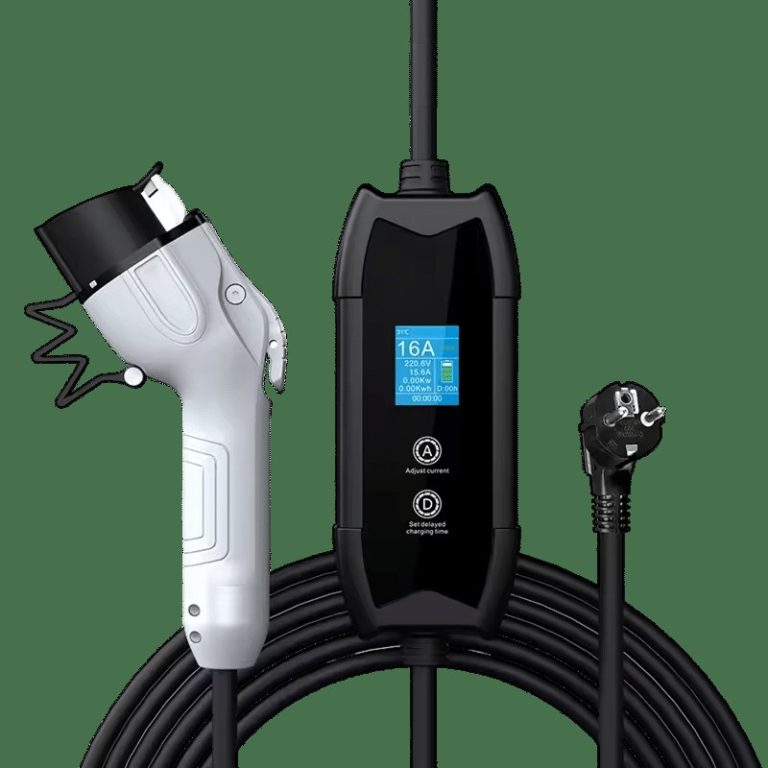
Level 1 uses the portable cord set that ships with many EVs, plugged into a standard grounded household outlet. It is slow, but for a driver covering 30 miles a day it can be enough overnight. The vehicle’s onboard AC charger still governs the maximum rate, though at 120V that ceiling is rarely the limiting factor.
Level 2 (240V) Charging: EVSE Amperage, kW, and Plug-in vs. Hardwired Options
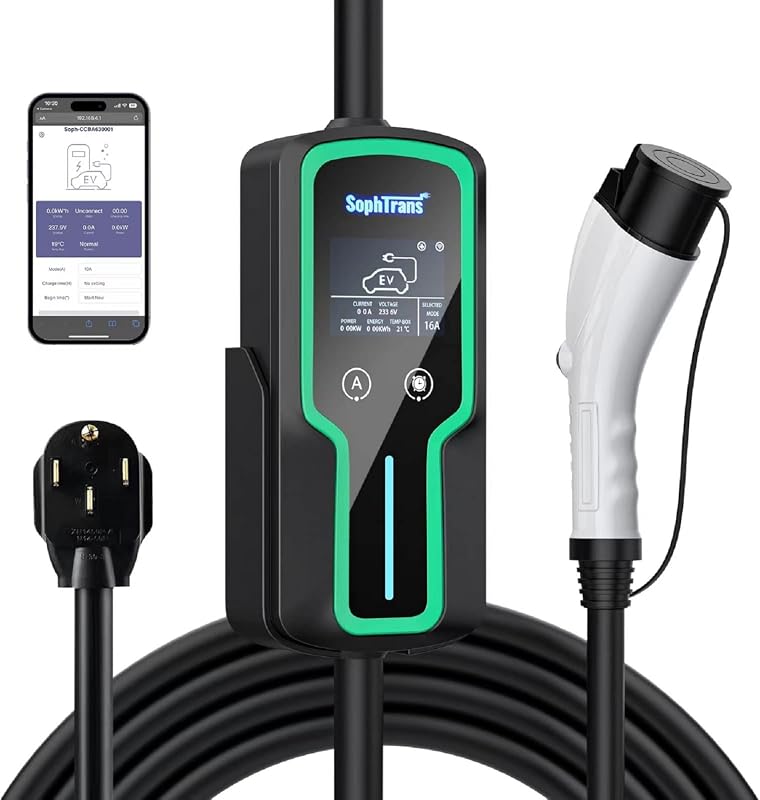
Level 2 is the practical default for most EV owners. Popular configurations include 32A, 40A, and 48A units, but the kW you actually get depends on the EVSE setting, the circuit, and the vehicle’s onboard charger limit. If you want to understand how many kW a 48-amp Level 2 charger actually delivers — and where the onboard charger caps it — that breakdown matters before you buy. Tesla owners have a related question worth checking: whether a Tesla can charge at 48 amps depends on the specific model and its onboard charger.
Uses a compatible 240V receptacle and plug. Portable and easier to swap, but the receptacle, breaker, and wiring must match the EVSE’s requirements.
Wired directly to the circuit. Often used for higher-amperage units and outdoor installations where a receptacle adds a failure point.
Circuit, Panel, and Cable Length Implications for Installation Cost
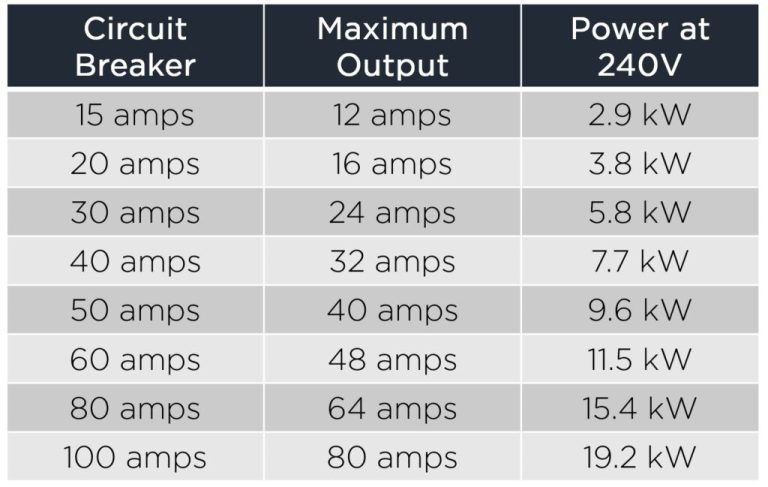
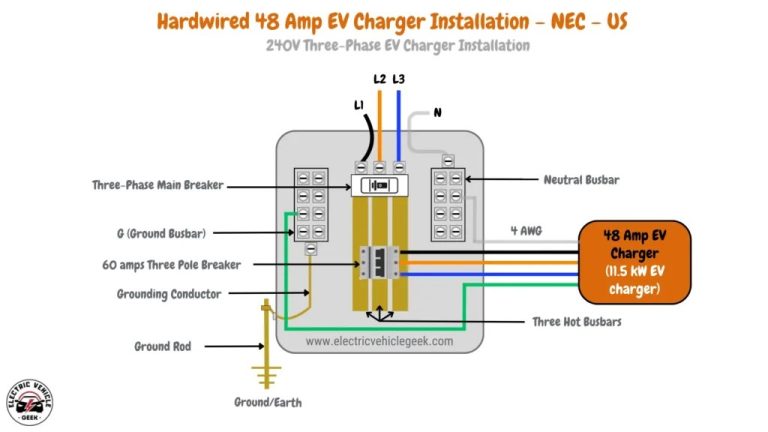
Higher amperage means larger conductors, a larger breaker, and more panel headroom. A 48-amp EVSE generally requires a 60-amp circuit under the 80% continuous-load rule, but confirm against the equipment instructions and your local authority. If your panel is full or your service is undersized, a panel upgrade or service change can add substantially to the project. Long cable runs from the panel to the parking spot also increase material and labor.
Time-of-Use Rates and Smart Charging: How to Lower Your Cost per kWh
Understanding Off-Peak, Mid-Peak, and On-Peak Pricing
Many U.S. utilities offer time-of-use plans where the price per kWh changes by hour. Off-peak windows — often overnight — can be dramatically cheaper than on-peak afternoon or evening rates. The trade-off is that on-peak rates are usually higher than a flat rate would be, so a TOU plan only saves money if you can shift most charging to cheap hours.
Using Smart EVSE Features and Vehicle Scheduling to Save
Most modern EVs let you schedule charging start and stop times, and many networked EVSEs offer the same plus utility demand-response programs. Before relying on either, check what happens if the app, cloud service, or Wi-Fi connection is unavailable — a schedule that lives only in the cloud can be a problem. Some utilities also offer separate EV submetering or managed-charging credits; verify current program terms directly with your utility.
Equipment and Installation Costs: What to Budget Beyond Electricity
Level 2 Charger Price Ranges, Warranty, and Support
Hardware prices vary widely by amperage, cable length, enclosure rating, and smart features, so check current listings rather than relying on older figures. When comparing models, weigh the safety listing, warranty term, US-based support, app requirements, and whether the unit is designed for indoor or outdoor use. If you are shopping specifically for higher-output hardware, this roundup of the best 48-amp Level 2 EV chargers for home charging covers the criteria that actually affect ownership.
Installation Cost Factors: Permits, Electrician Labor, and Panel Upgrades
The installation quote usually dominates the project budget. Factors include the distance from the panel, whether the run is indoors or outdoors, whether conduit is required, whether a receptacle or hardwire is used, permit and inspection fees, and whether the panel needs work. Get at least two quotes and ask specifically what the electrician will pull for permits.
Weather Suitability and Cable Length Considerations for Outdoor Installations
For driveway or carport installations, verify the EVSE’s enclosure rating and operating-temperature range from the manufacturer’s documentation — not from marketing photos. Also check the manufacturer’s guidance on connector storage when the unit is not in use, and confirm the cable length reaches your parking position without strain.
How Battery Size, Driving Efficiency, and Climate Affect Your Monthly Charging Bill
Battery Capacity and State of Charge: Manufacturer Guidance vs. General Patterns
Battery size affects how much energy a full session costs, but not necessarily your monthly bill — you pay for the miles you drive, not the size of the pack. Daily charging targets should follow your vehicle manufacturer’s guidance, which varies by chemistry and thermal-management design. There is no universal 80% rule.
Temperature, HVAC, Speed, Elevation, Payload, and Tires: Impact on mi/kWh
Cold weather is the biggest single swing factor for many owners. Cabin heating, battery warming, and reduced regenerative braking can cut efficiency by 20–35% in winter for some vehicles. Highway speeds above 70 mph, roof racks, underinflated tires, and heavy payloads all push the number the wrong way.
DC Fast Charging vs. Home Charging: Cost and Battery Health Trade-offs
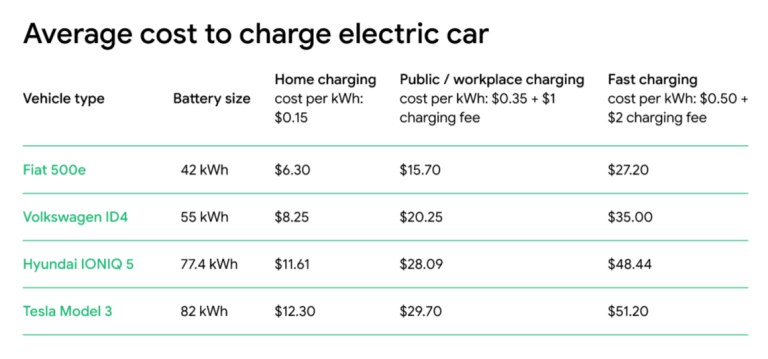
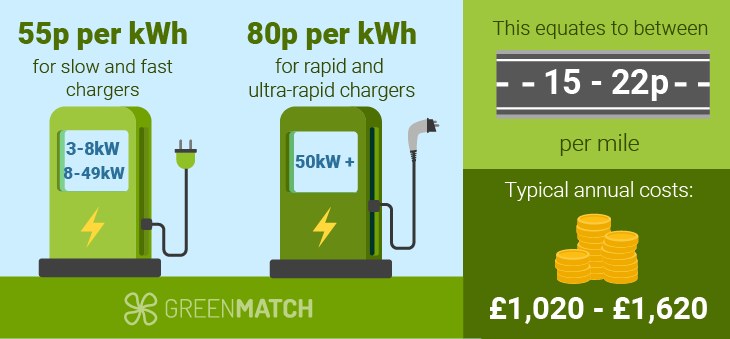
DC fast charging is a different mode entirely, not just a faster version of home charging. Public DC rates are frequently several times higher per kWh than residential rates, and some networks bill by the minute or add session fees. Home AC charging is generally cheaper and gentler, which is why most owners treat DC fast charging as a road-trip tool rather than a daily habit.
Real-World Examples: Cost to Charge Popular EVs at Home in the U.S.
Example 1: Compact EV (60 kWh Battery, 3.5 mi/kWh) in a Low-Rate State
Add 45 kWh at 90% efficiency, so 50 kWh from the wall. At $0.11/kWh, that session costs about $5.50 and adds roughly 158 miles. That is about $0.035 per mile.
Example 2: Long-Range EV (100 kWh Battery, 2.8 mi/kWh) in a High-Rate State
Add 70 kWh at 90% efficiency, so about 78 kWh from the wall. At $0.32/kWh, that session costs about $24.89 and adds roughly 196 miles — about $0.127 per mile. Same energy, very different bill.
Example 3: Comparing Winter vs. Summer Efficiency and Cost
Using Example 1’s 50 kWh wall draw: in summer at 3.5 mi/kWh you get about 158 miles for $5.50. In winter at 2.4 mi/kWh you get about 108 miles for the same $5.50. The electricity cost per session is unchanged; the cost per mile rises from roughly $0.035 to $0.051.
Adapters and Compatibility: When You Might Need One for Home Charging
AC vs. DC Adapters: What Works with Home EVSE
Home EVSE delivers AC power. DC fast charging uses a completely different protocol and connector path. An adapter that physically connects a DC charger to an AC-only inlet — or the reverse — is not a valid solution, regardless of how it fits.
Connector Types (J1772, NACS, CCS1) and Adapter Direction
Important: Physical fit alone does not prove every AC or DC charging mode is supported.
Power Limits, Thermal Safety, and Firmware/Vendor Requirements
Adapters carry amperage and thermal ratings. Using one beyond its rating is a fire risk. Some adapters also require specific vehicle software versions or are restricted by the charging network. Verify the adapter’s rating, the vehicle-side requirement, and the charger-side requirement separately before use.
Key Takeaways: Estimating Your Own Home EV Charging Cost in 2026
Assumptions, Formulas, and Where to Verify Local Rates
Build your estimate from three verified numbers: your all-in rate per kWh, the kWh your vehicle reports adding, and a realistic charging-loss assumption. Then verify your rate against your utility’s current published tariff, since rates, riders, and TOU windows change.
Balancing Convenience, Battery Health, and Installation Costs
A Level 1 cord may be free and sufficient. A Level 2 install may cost more upfront but transform daily ownership. Neither choice changes your cost per kWh — only how fast you refill and how much you spend on hardware and wiring. Start with your daily mileage, then decide.
Frequently Asked Questions
It depends on battery size and your rate. A 60 kWh pack charged from near-empty to full might draw around 65–70 kWh from the wall after losses. At $0.15/kWh that is roughly $10–$11; at $0.35/kWh it is closer to $23–$25.
Home charging is almost always cheaper per kWh. Public DC fast charging often costs several times the residential rate and may add session or idle fees, so most owners reserve it for road trips.
The price per kWh is the same, but Level 1 typically has higher charging losses, so you may pay for slightly more grid energy to add the same kWh to the battery. Level 2 is generally more efficient.
Installation varies widely based on cable run length, indoor versus outdoor routing, permit fees, and whether your panel needs an upgrade. Panel or service upgrades are usually the largest cost driver. Get multiple quotes from licensed electricians.
Often yes, if you can shift most charging into off-peak hours. Compare the full TOU rate schedule against your current flat rate, since on-peak TOU prices are typically higher and can offset savings if you charge at the wrong time.
Only if your vehicle inlet and your EVSE connector do not match. Adapters must be rated for the correct amperage and charging mode — an AC adapter cannot make a home EVSE deliver DC fast charging, and physical fit alone does not confirm compatibility.