Can Non-Tesla Cars Use Tesla Chargers? NACS Access Explained
Yes — non-Tesla EVs can use many Tesla chargers, but only when the connector, adapter direction, and Tesla network access all line up for your specific vehicle. The main limitation is that not every Supercharger site is open to other brands, and DC adapters must be manufacturer-approved.
Can non Tesla cars use Tesla chargers? In most cases, yes — provided three things line up: the physical connector, the correct adapter for the charging mode, and Tesla’s network access rules for your specific vehicle. The catch is that “Tesla charger” covers three very different pieces of hardware with three different sets of rules, and mixing them up is the most common reason a driver shows up and cannot charge.
- Compatibility: NACS inlets plug in directly; CCS1 and J1772 vehicles need the correct adapter for.
- Performance: Station output is a ceiling — your vehicle’s onboard charger, pack temperature, and state.
- Safety: AC and DC adapters are not interchangeable, and unapproved third-party DC adapters can affect.
- Cost: Supercharger rates vary by site and time, a monthly membership can lower per-kWh pricing.
The Short Answer: Can Non-Tesla Cars Use Tesla Chargers in the U.S. in 2026?
Yes—If Connector, Adapter, and Tesla Network Access Align
Tesla has progressively opened a large portion of its U.S. Supercharger network to other brands, and most major automakers have either shipped or announced NACS (SAE J3400) inlets on new models. That means a non-Tesla driver today may charge at a Tesla station in one of three ways: natively with an NACS inlet, through a manufacturer-supplied NACS-to-CCS1 DC adapter, or through a NACS-to-J1772 adapter at an AC Destination Charger.
Each path has its own limits. Adapter direction, AC versus DC mode, vehicle firmware, and site eligibility all have to be correct before the session will start.
Tesla Superchargers vs. Destination Chargers: Different Rules for Non-Tesla Drivers
A Tesla Supercharger is DC fast charging on Tesla’s own network. Access is controlled through the Tesla app, and only certain hardware generations and locations are open to non-Tesla vehicles — Tesla publishes a live map showing which sites accept other EVs.
A Tesla Destination Charger is AC Level 2 equipment, usually mounted at hotels, restaurants, and parking garages. Many use a J1772 handle, some use NACS, and pricing is set by the property owner, not Tesla. A Tesla Wall Connector is the same class of AC hardware for homes and businesses.
NACS, CCS, and J1772: Connector and Adapter Compatibility Explained
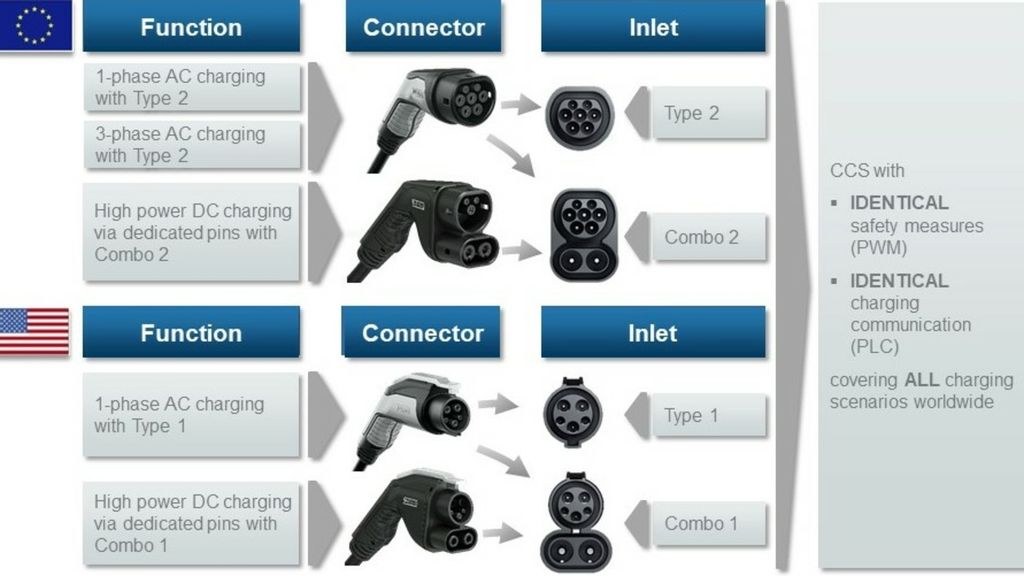
Source Connector vs. Destination Connector: Which Adapter Direction You Need
Adapters are described by two ends: the vehicle side and the charger side. A NACS-to-CCS1 adapter has a NACS plug that goes into the Tesla handle and a CCS1 inlet that goes into your car — that is the DC fast-charging adapter for a CCS1 vehicle.
A NACS-to-J1772 adapter works the other way around for AC: a NACS plug into the Tesla AC handle, and a J1772 connector into your car. These two adapters are not interchangeable, and using one in the wrong mode is a genuine safety problem.
Important: Physical fit alone does not prove every AC or DC charging mode is supported.
AC Level 2 Adapters for Destination Chargers and Wall Connectors
AC adapters are largely passive — they carry the pilot signal and power but do not perform DC negotiation. What matters is the current rating. If your vehicle can accept 48 A and the adapter is only rated for 40 A, the adapter becomes the bottleneck and may run hot.
Tesla Wall Connectors can be configured with access control settings so they will charge non-Tesla vehicles. Owners report that a unit left in a restricted mode may refuse a session even when the adapter fits, so check the configuration in the Tesla One or Tesla app setup before assuming a hardware fault.
DC Fast Charging Adapters: Power Limits, Thermal Safety, and Firmware Requirements
DC adapters carry high voltage and high current and are the part of this ecosystem where cutting corners is most costly. Manufacturer-supplied adapters — the ones Ford, Rivian, GM, and others have distributed to owners — are built and validated for their specific vehicles and are the safest default.
Third-party DC adapters exist. Before buying one, verify the safety listing, the current and voltage rating, the manufacturer’s stated vehicle compatibility, and whether your automaker has approved it. An unapproved adapter can affect warranty coverage on charging-related failures.
Vehicle-side firmware also matters. Automakers have pushed over-the-air updates to enable Supercharger handshakes, so a car that could not charge last year may be able to now — and vice versa if an update is pending.
Which Non-Tesla EVs Can Use Tesla Chargers? Vehicle and Network Restrictions
Native NACS Vehicles vs. Adapter-Equipped CCS Vehicles
Newer models with a factory NACS inlet plug directly into a Supercharger or NACS Wall Connector with no adapter. Vehicles with a CCS1 inlet need a DC adapter for Superchargers and a separate J1772 setup for AC.
Older EVs are the weakest case. Some lack the software to complete Tesla’s charging handshake, some have low onboard charger limits that make AC charging slow, and some automakers have not issued an approved adapter at all.
Tesla App, Account, and Supercharger Site Eligibility
Non-Tesla drivers generally start sessions through the Tesla app rather than Plug & Charge. That means creating an account, adding a payment method, and selecting the correct stall number. Not every Supercharger is open to other EVs, and Tesla has historically excluded older V2 hardware from non-Tesla access.
Site-level restrictions can also include parking layout, cable reach, and local rules. Verify the specific site in the app before routing a trip around it.
Manufacturer Approval, Warranty, and Software Updates
Your automaker’s position matters more than forum consensus. Some brands have published adapter programs with specific approved hardware and firmware minimums. Others have stated that damage caused by unapproved adapters may not be covered.
Keep the vehicle software current, use approved hardware, and check whether your brand requires a dealer visit to enable Supercharger access on older models.
Tesla Charger Hardware: Wall Connectors, Destination Chargers, and Superchargers
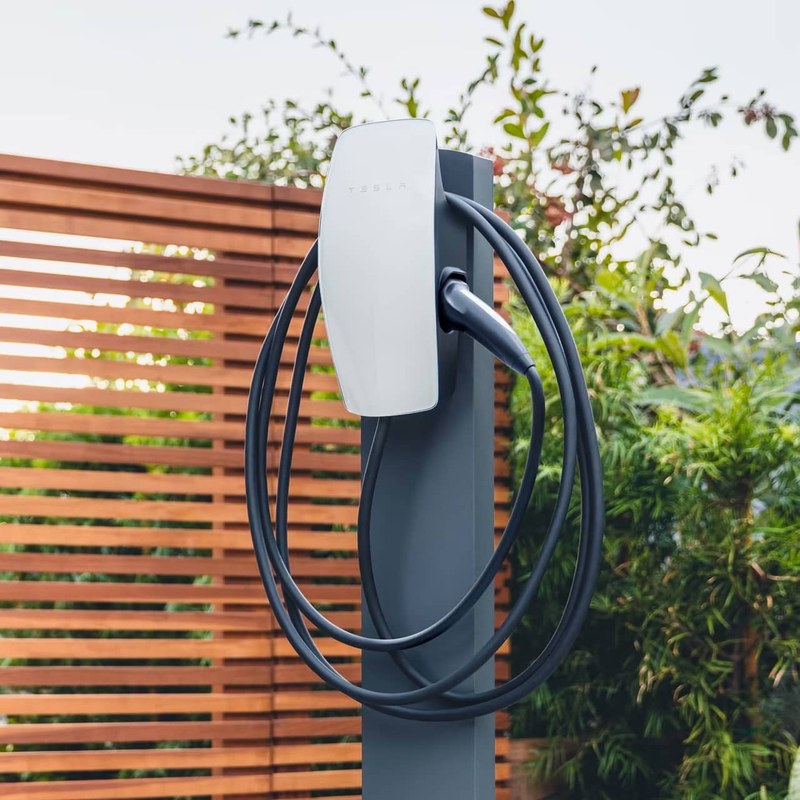
Connector, EVSE Amperage, kW, and Vehicle Onboard-Charger Limits
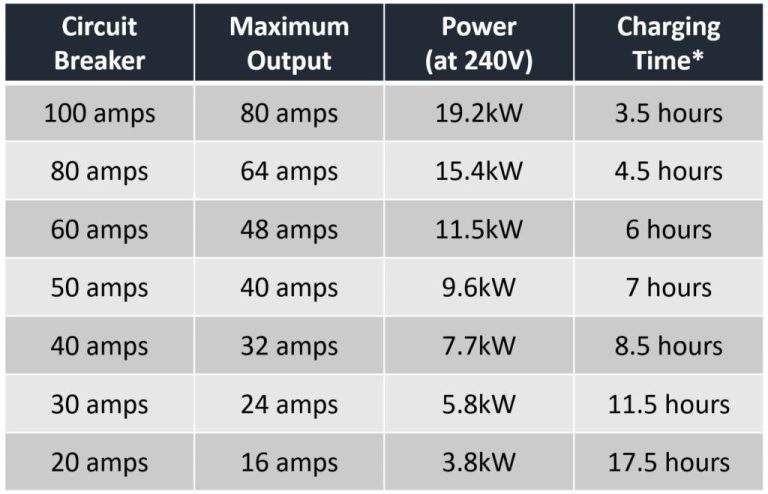
The Wall Connector is the AC unit most homeowners consider. It is available in multiple output configurations, and the actual delivered power is the lower of the EVSE setting and the vehicle’s onboard charger limit. A 48 A-capable wall unit does nothing extra for a car with a 32 A onboard charger.
If you are comparing home units, our breakdown of 48 amp hardwired EV chargers covers how output ratings translate into real charging speed.
Plug-In vs. Hardwired, Circuit/Panel Implications, and Cable Length
Hardwired installation typically allows a higher continuous current setting than a plug-in configuration on a standard receptacle, because the circuit and overcurrent protection are dedicated and sized to the equipment. Cable length matters too: a 24-foot cable reaches most driveway parking positions, but a detached garage or a long driveway may need a different mounting plan.
For renters and travelers, a portable EV charger paired with the right adapter is often more practical than permanent installation.
Weather Suitability, Smart Features, Warranty/Support, and Installation Code/Permits
Outdoor installation requires verifying the enclosure rating and the manufacturer’s operating temperature range, plus connector storage guidance for winter. Smart features — scheduling, load sharing, app control, and utility integration — depend on connectivity, so confirm what happens if the cloud service is unavailable.
Charging Speeds and Power Limits: What Non-Tesla Cars Actually Get
AC Charging: Onboard Charger Limits and Shared Circuit Reality
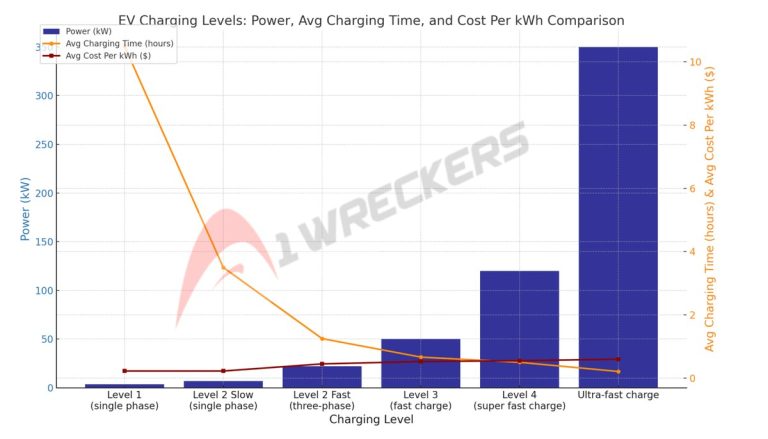
At an AC Destination Charger, your speed is set by your vehicle’s onboard charger and the circuit feeding the unit — not by the Tesla branding. A car with a 7.2 kW onboard charger will not exceed roughly 7.2 kW regardless of what the wall unit can supply. Shared circuits at commercial properties can reduce that further.
DC Fast Charging: Vehicle Limits, Tesla Cabinet Output, and Temperature
At a Supercharger, the cabinet may be capable of far more than your car will accept. Peak DC rate depends on pack voltage, state of charge, battery temperature, and the vehicle’s own charging curve. A cold pack or a pack above roughly 80% state of charge will taper sharply.
Why a 250 kW Supercharger May Not Mean 250 kW for Your EV
The 250 kW figure describes the stall’s capability, not a promise to your vehicle. A 400 V architecture car on a 250 kW post, a car with a conservative thermal strategy, or a car arriving at 60% state of charge will all see lower numbers. Treat published station output as a ceiling.
Tesla Charging Costs for Non-Tesla Cars: Rates, Fees, and Formulas
Electricity Rate, kWh Delivered, Charging Losses, and Time-of-Use Pricing
The basic formula is simple: energy added (kWh) × price per kWh = energy cost. The complications are real. Supercharger pricing varies by site, by state, and by time of day, and it includes taxes and fees. Charging losses mean the kWh billed may exceed the kWh stored in the battery.
Supercharger Membership vs. Non-Tesla Pricing and Idle Fees
Tesla has published a monthly Supercharger membership that lowers the per-kWh rate for non-Tesla drivers. Whether it pays off depends on how much DC fast charging you do per month. Idle fees apply when a session finishes and the vehicle remains plugged in while the site is busy — rates and thresholds are published by Tesla and can change.
Equipment, Adapter, and Installation Cost Assumptions
Budget for the adapter if your automaker does not supply one, plus any home AC adapter, plus installation if you add a wall unit. Home electricity is usually far cheaper per kWh than DC fast charging, which is why most owners reserve Superchargers for road trips.
Illustrative only. Verify current site pricing, taxes, time-of-use rates, membership discounts, and idle fees in the Tesla app before budgeting.
Battery Health and Charging Behavior: What Non-Tesla Owners Should Know
Manufacturer Guidance vs. General Patterns for Daily and DC Fast Charging
Follow your own automaker’s guidance first. There is no universal state-of-charge rule that applies across chemistries. Some manufacturers recommend a daily charge target; others publish different guidance for LFP versus nickel-based packs.
Temperature, State of Charge, Charging Power, and Chemistry/Thermal Management
DC fast charging stresses a pack more when it is very cold, very hot, or at a high state of charge. Vehicles with active liquid thermal management handle repeated fast charging differently than those with simpler cooling. Preconditioning before a Supercharger stop — where your car supports it — helps both speed and pack behavior.
Convenience Trade-Offs: Adapter Handling, Cable Reach, and Station Layout
Non-Tesla drivers often park at an angle to reach a Supercharger cable that was designed for a Tesla charge port location. Adapters add bulk and need a place to go when wet or dirty. V4 posts with longer cables reduce this friction; older V3 posts can require creative parking.
Range, Efficiency, and Real-World Charging Losses at Tesla Chargers
mi/kWh and Wh/mi Context for Comparing Tesla Charger Stops
Efficiency is usually expressed as mi/kWh (higher is better) or Wh/mi (lower is better). Knowing your car’s real-world number lets you estimate how much range a 60 kWh session actually delivers.
Speed, Weather, HVAC, Elevation, Payload, Tires, and Battery Temperature
Highway speed, cold or hot weather, cabin HVAC, elevation change, passengers and cargo, tire type and pressure, and battery temperature all move the number. A winter highway run can consume meaningfully more energy per mile than a mild-weather commute.
Accounting for Charging Losses in Trip Planning
Plan for losses between the meter and the battery, particularly in cold weather when the pack must be warmed. A practical rule is to add a buffer to your arrival state of charge rather than assuming the billed kWh equals usable range.
Mark Reynolds’ Verdict: Who Should Use Tesla Chargers—and Who Should Wait?
Best Fit: Adapter-Ready CCS EVs and Native NACS EVs
Drivers with a factory NACS inlet, or with a manufacturer-approved DC adapter and current firmware, get the most value. The Supercharger network adds genuine route options on corridors where CCS1 coverage is thinner.
Less Ideal: Older EVs, Low Onboard Charger Limits, or Restricted Networks
Older EVs without approved adapters, cars with low onboard charger limits, and drivers whose automaker has not enabled access should not plan trips around Tesla stations yet. Check eligibility before relying on it.
- Newer EVs with NACS inlets or approved DC adapters
- Road-trippers on corridors with limited CCS1 coverage
- Older EVs without approved adapters or updated firmware
- Drivers who mainly need cheap home AC charging
Final Compatibility Checklist and Evidence Limits
Before you rely on a Tesla charger, confirm your vehicle inlet, the correct adapter for the charging mode, your automaker’s approval status, current firmware, and the specific site’s eligibility in the Tesla app. Specifications, pricing, and site access change frequently, so verify against Tesla’s and your automaker’s current published documentation rather than a forum post or an older article.
- Best for: Native NACS EVs and CCS1 EVs with a manufacturer-approved DC adapter and current firmware.
- Think twice if: Your automaker has not approved an adapter, your car lacks the enabling software update, or you are counting on an unverified site.
- Next step: Check the Tesla app map for open sites and confirm your brand’s adapter guidance before your next road trip.
Frequently Asked Questions
Many can. Tesla has opened a large portion of its U.S. Supercharger network to other brands through the Tesla app, but access depends on the site’s hardware generation and whether your vehicle has a native NACS inlet or an approved DC adapter plus current firmware.
If your car has a CCS1 inlet, yes — you need a NACS-to-CCS1 DC adapter. Manufacturer-supplied adapters are the safest default. Vehicles with a factory NACS/SAE J3400 inlet plug in without an adapter.
Yes, in most cases, using a NACS-to-J1772 AC adapter if your car has a J1772 inlet. The Wall Connector must be configured to allow non-Tesla vehicles, and the adapter must be rated for the current your vehicle draws.
No. Tesla publishes a live map showing which sites are open to other EVs, and older hardware generations have generally been excluded. Always check the specific site in the Tesla app before routing a trip around it.
Pricing varies by site, state, and time of day, and includes taxes and fees. Tesla has published a monthly membership that lowers the per-kWh rate for non-Tesla drivers. Verify current rates in the Tesla app before budgeting.
Usually yes. Many Destination Chargers use a J1772 handle that fits most non-Tesla EVs directly, while NACS-equipped units require an AC adapter. Pricing and access are set by the property owner, not Tesla.