Does a Hardwired EV Charger Need a GFCI Breaker?
In most US jurisdictions, a hardwired EV charger does not require a GFCI breaker, because the NEC ground-fault rule targets receptacles and a hardwired unit has none. The exceptions are local amendments and manufacturer instructions, so confirm both before installation.
If you are planning a home installation, one of the first code questions is simple: does a hardwired EV charger need a GFCI breaker? For most hardwired Level 2 EVSE in the United States, the answer is no — the NEC ground-fault requirement that applies to EV charging receptacles generally does not apply to a hardwired connection. But there are real exceptions, local amendments, and manufacturer instructions that can change the answer for your specific home.
- Code basis: The NEC ground-fault requirement for EV charging is written around receptacles, which is why.
- Built-in protection: Hardwired EVSE provides integral ground-fault protection through its CCID circuit, typically at a higher.
- Nuisance trips: Stacking a GFCI breaker with an EVSE’s internal protection is a common cause of.
- Local control: Your AHJ and the product manual override general guidance — verify both before buying.
The Short Answer: Does a Hardwired EV Charger Need a GFCI Breaker?
In most US jurisdictions, a hardwired Level 2 EVSE does not require a GFCI circuit breaker on the branch circuit. The reason is structural rather than technical: the NEC ground-fault requirement for EV charging is written around receptacles, and a hardwired charger has no receptacle. The EVSE itself supplies ground-fault protection through its internal CCID circuit.
That said, “most” is doing real work in that sentence. Code adoption, local amendments, and the charger manufacturer’s installation instructions all have a say. A hardwired install can still end up on a GFCI breaker — sometimes because the local authority requires it, sometimes because the equipment instructions do.
What the National Electrical Code (NEC) Says in 2026
The relevant NEC provision for EV charging ground-fault protection has historically been framed around receptacles rated 50 amperes or less that supply electric vehicle charging. That framing matters: it targets the outlet, not the appliance.
NEC editions are adopted state by state and sometimes city by city, and adoption lags publication by years in some places. A home in one state may be inspected under a different edition than a home two hours away. That is why no article — including this one — can give you a single nationwide answer. The applicable edition in your jurisdiction is the one your inspector will use.
When a Hardwired EV Charger Does Not Require a GFCI Breaker
A hardwired EVSE typically falls outside the receptacle-based GFCI requirement when all of the following are true:
- The unit is permanently wired to a dedicated branch circuit with no receptacle or plug.
- The manufacturer’s installation instructions do not call for a GFCI breaker.
- Your local code and permitting authority have not amended the requirement to cover hardwired EVSE.
- The unit carries a recognized safety listing that includes the required integral ground-fault protection.
When those conditions line up, a standard circuit breaker sized to the circuit is the normal configuration.
When a GFCI Breaker May Be Required or Recommended for Hardwired EVSE
There are several situations where a GFCI breaker is required or at least sensible for a hardwired charger:
- Local amendment: Some jurisdictions extend GFCI protection to all EV supply equipment circuits, hardwired or not.
- Manufacturer instruction: A few EVSE manuals specify GFCI protection on the supply circuit. Follow the manual — it governs the warranty and the listing.
- Wet or damp locations: Garages, carports, and outdoor pedestals may trigger broader GFCI rules in your adopted code edition.
- Shared or unusual wiring: Circuits with long runs, shared conduit, or atypical grounding paths can benefit from added protection.
If any of these apply, treat the GFCI breaker as required until your AHJ or a licensed electrician tells you otherwise.
Hardwired vs. Plug-In EV Chargers: GFCI and Circuit Differences
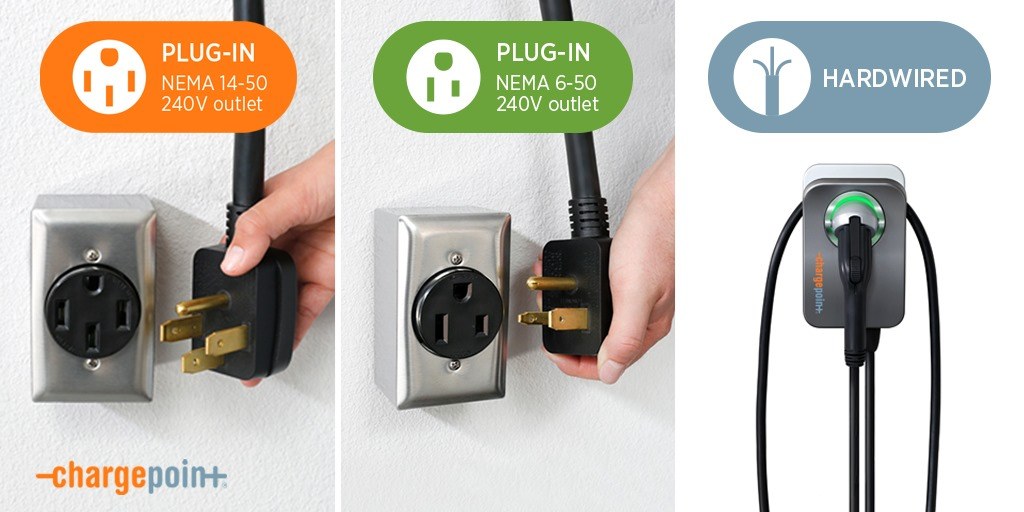
The GFCI question is really a question about how the charger connects to the house. Change the connection method and the code treatment changes with it.
GFCI Requirements for Receptacle-Based (Plug-In) EV Charging
Plug-in Level 2 chargers use a receptacle — commonly a NEMA 14-50 or 6-50 — and that receptacle is exactly what the NEC ground-fault provision targets. In the code editions most widely adopted today, a receptacle supplying EV charging at 50 A or less generally requires GFCI protection for personnel.
That is a meaningful cost and complexity difference. A GFCI breaker for a 40 A or 50 A circuit is a specialized, more expensive device than a standard breaker, and it is a component that can nuisance-trip.
Hardwired EVSE and Integral Ground-Fault Protection (CCID)
Hardwired EVSE is not unprotected. SAE J1772 and the UL 2231 family of standards expect the charging equipment to include a charge circuit interrupting device — usually written as CCID — that detects ground faults and interrupts the charging session.
The important nuance is sensitivity. A GFCI breaker and a receptacle GFCI trip in the roughly 4–6 mA range. EVSE personnel-protection CCID circuits are generally set higher, around the 20 mA range, with a separate equipment-protection threshold. They are not interchangeable devices, and they are not designed to be stacked.
Amperage, Voltage, and Circuit Sizing: A Side-by-Side Comparison
| Item | Plug-in EVSE | Hardwired EVSE |
|---|---|---|
| Connection | Receptacle and plug | Permanent wiring |
| Typical GFCI treatment | Receptacle GFCI generally required | Often not required on the branch circuit |
| Typical circuit | 40 A or 50 A, 240 V | Commonly 40 A to 60 A, 240 V |
| Maximum charge current | Usually capped by plug and circuit | Can reach higher settings, e.g. 48 A |
| Portability | Can be unplugged and moved | Fixed installation |
| Typical install complexity | Lower | Higher |
If you are sizing a specific setup, the breaker and conductor math is covered in more depth in our guides to 48 amp EV charger breaker size and 48 amp EV charger wire size.
Who Each Option Fits: Hardwired vs. Plug-In
Fits renters, households that may move the unit, and owners who want a simpler install and are comfortable with a receptacle GFCI on the circuit.
Fits owners who want maximum current, a cleaner permanent install, and a configuration that usually avoids stacked ground-fault devices.
Understanding GFCI Breakers and EVSE Ground-Fault Protection
These two protection layers are often confused because both are described as “ground fault protection.” They differ in what they watch, how sensitive they are, and what they do when they detect a problem.
How GFCI Breakers Work vs. EVSE Internal GFCI (CCID)
A GFCI breaker continuously compares current on the hot conductor with current returning on the neutral. Any imbalance above its threshold — typically a few milliamps — indicates current leaking somewhere it should not, and the breaker opens the circuit. It protects people from shock and can also catch certain wiring faults.
An EVSE’s internal CCID does something similar but within the charging equipment, and it acts on the charging session rather than on the branch circuit. It is part of the product’s safety architecture and is required for the unit to hold its listing.
Why Double GFCI Protection Can Cause Nuisance Tripping
When two ground-fault sensing devices are in series, the more sensitive one wins the race — and it may win for reasons that have nothing to do with a real fault. Small cumulative leakage from long conductor runs, moisture in a connector, an aging heating element in a different appliance on a shared neutral, or normal capacitive leakage can push a 4–6 mA GFCI over its threshold while the 20 mA CCID sees nothing wrong.
The result is a charger that trips the breaker mid-session, resets fine, then trips again days later. Owners often blame the car or the charger when the interaction between two protection devices is the actual cause.
When a GFCI Breaker Is the Right Choice for a Hardwired Charger
A GFCI breaker is the right choice when your local code requires it, when the EVSE manufacturer specifies it, or when the installation is in a location where the adopted code edition extends GFCI protection more broadly. In those cases, the correct move is not to argue with the requirement — it is to install equipment that tolerates it well, which usually means a hardwired unit whose internal protection is compatible with upstream GFCI.
Local Codes, Permits, and Installation for Hardwired EV Chargers

The national code is a floor, not a ceiling. Your city or county can be stricter, and many are.
Always Check Your Product Manual and Local Amendments
Start with the manual that came with the EVSE. It will state the required circuit rating, conductor sizing, breaker type if specified, mounting requirements, and any restrictions on location. Then check your local amendments. If the two disagree, the stricter requirement generally governs, and your inspector will have the final word.
Panel Capacity, Load Calculations, and Circuit Breaker Sizing
An EV charger is a large continuous load, and that changes the math. A load calculation determines whether your service and panel can support the new circuit alongside existing appliances. If capacity is tight, options include a lower charge current setting, a load-management device, or a service upgrade.
Breaker sizing follows the manufacturer’s specified circuit rating and the applicable code rules — not guesswork. For a common 48 A hardwired setup, the circuit requirement is frequently discussed in our article on whether a 48 amp EV charger needs a 60 amp circuit.
When to Hire a Licensed Electrician for EVSE Installation
Mains-voltage work is safety-sensitive. A qualified electrician handles the load calculation, permit, conductor sizing, torque specifications, grounding and bonding, and inspection. If you are unsure about GFCI requirements in your jurisdiction, that is exactly the kind of question to ask before the work begins rather than after a failed inspection.
Troubleshooting GFCI Trips with Hardwired EV Chargers
Tripping is information, not just an inconvenience. The pattern of trips usually points to the cause.
Common Causes of Nuisance Tripping
- Stacked protection: A GFCI breaker feeding an EVSE with its own ground-fault sensing.
- Moisture: Water in the connector, handle, or conduit, especially after rain or snowmelt.
- Long circuit runs: Cumulative leakage current rises with conductor length.
- Shared neutrals or other loads: A separate appliance on the same neutral can create imbalance.
- Aging or damaged equipment: A failing EVSE, cable, or connector can leak current legitimately.
Diagnostic Steps Before Calling an Electrician
- Note exactly when it trips: at plug-in, mid-session, after rain, or only at high current.
- Try a lower charge current setting in the vehicle or the app to see whether the trip is load-dependent.
- Inspect the connector and cable for moisture, damage, or debris, and dry the connector if wet.
- Check whether other equipment on the panel trips at similar times.
- Record the pattern so an electrician has something concrete to work with.
Do not open the panel or the EVSE enclosure to investigate. That work belongs to a qualified professional.
When to Replace or Upgrade Your Breaker
Replacement is worth considering when the breaker is old, has tripped many times, or is a model known to be sensitive. Upgrading to a different breaker type — or removing a GFCI where code and the manual do not require it — is a decision for your electrician and your AHJ, not a do-it-yourself fix. Repeated tripping caused by a genuine ground fault will not be solved by swapping hardware.
Cost Considerations: GFCI Breaker vs. Standard Breaker for EV Charging
Cost is a secondary factor here, but it is real, and it cuts in two directions.
Equipment and Labor Cost Differences
A GFCI breaker carries a higher equipment cost than a comparable standard breaker, and the gap varies by brand, amperage, panel type, and availability. Because these are specialty devices, they can also be harder to source quickly, which can affect scheduling. Labor is broadly similar for either type since the wiring work is the same — the difference is mostly in the part.
Verify current pricing with your electrician or supplier. Breaker prices and availability change, and they vary significantly by panel manufacturer.
Potential Savings from Avoiding Nuisance Trips
The hidden cost of a mismatched GFCI setup is not the part — it is the repeat service calls, the interrupted charging, and the time spent diagnosing a problem that is really a compatibility issue. Where code and the manual allow a standard breaker on a hardwired circuit, that configuration often avoids the whole category of problem.
Warranty and Support Implications
Installing an EVSE outside the manufacturer’s specified circuit requirements can affect warranty coverage. If the manual specifies a particular breaker type or circuit rating and the installation differs, a future warranty claim may be more complicated. Keep the installation documentation and the permit record.
Choosing the Right Hardwired EV Charger for Your Home in 2026
Once the circuit question is settled, the equipment choice comes down to connector, current, and environment.
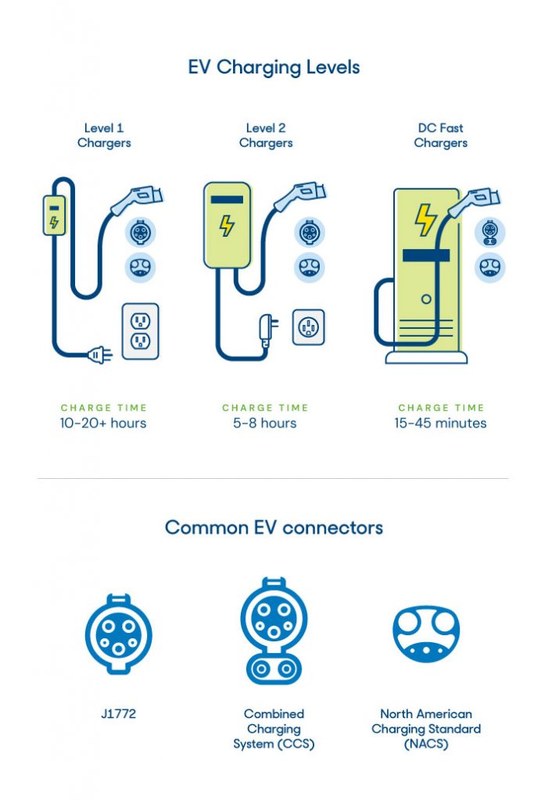
Connector Types: J1772, NACS, and Vehicle Compatibility
J1772 remains the standard AC connector on most older and many current EVs. NACS, standardized as SAE J3400, is now used on a growing share of new vehicles. For home AC charging, the practical question is which connector your vehicle’s inlet accepts, and whether an adapter is needed and permitted. Physical fit alone does not prove a charging mode is supported, so verify the vehicle side and the charger side separately.
EVSE Amperage, Onboard Charger Limits, and Charging Speed
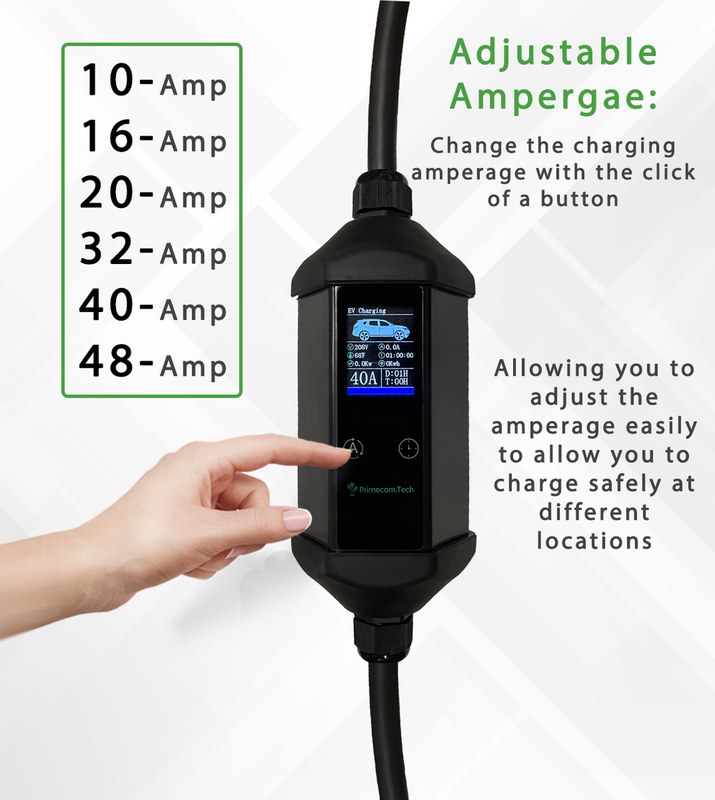
Buying a 48 A charger does not guarantee 48 A of charging. The vehicle’s onboard AC charger sets the ceiling, and the EVSE setting and circuit capacity set the floor. A car with a 32 A onboard charger will not charge faster on a 48 A unit. Match the EVSE to the vehicle’s actual capability and to your panel’s capacity.
If you are comparing 48 A options specifically, our roundup of 48 amp hardwired EV chargers covers the category and what to check before buying.
Weather Suitability, Cable Length, and Smart Features
For garage and outdoor installations, verify the enclosure rating, operating-temperature range, and connector storage guidance from the manufacturer rather than assuming weather resistance. Cable length matters more than it seems — a few extra feet often determines whether you can charge without repositioning the car. Smart features such as scheduling, load management, and utility integration can add value, but confirm what happens if the app or cloud service is unavailable.
- Confirm your vehicle’s AC inlet and maximum onboard charger current
- Verify the EVSE amperage and its specified circuit rating
- Ask your electrician whether your jurisdiction requires GFCI for hardwired EVSE
- Check the manufacturer manual for any GFCI or breaker-type instruction
- Confirm enclosure rating and operating temperature for your location
- Verify the safety listing, warranty terms, and support channels
Final Thoughts: What EmissionsFreeCars Recommends
The short answer holds for most US homes: a hardwired EV charger generally does not need a GFCI breaker, because the NEC ground-fault requirement for EV charging is written around receptacles and a hardwired unit has none. The EVSE’s internal CCID provides the ground-fault protection the equipment is listed to provide.
But the honest version of that answer includes the caveats. Local amendments exist. Manufacturer instructions sometimes specify GFCI. And a jurisdiction can be stricter than the model code.
Follow the Manual and Local Code Every Time
The manual and your AHJ outrank any general guidance, including this article. If the manual says GFCI, install GFCI. If your inspector says GFCI, install GFCI. Where both are silent, a standard breaker on a properly sized dedicated circuit is the conventional hardwired configuration.
When in Doubt, Consult a Qualified Electrician
GFCI requirements, load calculations, and breaker selection are exactly the areas where a local professional adds the most value. A short conversation before you buy equipment is cheaper than redoing an installation after a failed inspection — or chasing nuisance trips for months.
- Best for: Hardwired EVSE on a dedicated circuit where local code and the manual do not require GFCI.
- Think twice if: Your jurisdiction amends the requirement, your manual specifies GFCI, or the location triggers broader ground-fault rules.
- Next step: Confirm the requirement with your AHJ and electrician, then verify the EVSE’s specified circuit rating before purchase.
Frequently Asked Questions
Generally no. The NEC ground-fault requirement for EV charging is written around receptacles rated 50 amperes or less, and a hardwired EVSE has no receptacle. The unit’s internal CCID provides ground-fault protection instead. However, code adoption varies by state and city, so confirm the edition and any amendments with your local authority having jurisdiction.
The most common cause is stacked protection: a GFCI breaker trips at roughly 4–6 mA while the EVSE’s internal CCID is set higher, so the breaker reacts to small cumulative leakage the charger considers normal. Moisture in the connector, long conductor runs, and shared neutrals can also contribute. Repeated tripping should be evaluated by a licensed electrician rather than worked around.
In many jurisdictions yes, provided the manufacturer’s instructions do not specify GFCI and local code does not require it. The circuit still needs correct overcurrent protection, proper conductor sizing, grounding, and a permit where required. Confirm the requirement with your AHJ and electrician before the work begins.
Plug-in Level 2 chargers use a receptacle, and that receptacle is what the NEC ground-fault provision targets. In the code editions most widely adopted today, a receptacle supplying EV charging at 50 A or less generally requires GFCI protection for personnel. This is one of the main practical differences between plug-in and hardwired installations.
No. Both detect ground faults and interrupt current, but they operate at different sensitivities and act on different parts of the system. A GFCI breaker protects the branch circuit and trips in the roughly 4–6 mA range. An EVSE’s CCID protects within the charging equipment, typically with a higher personnel-protection threshold. They are complementary, not interchangeable.
Your local authority having jurisdiction and your licensed electrician, using the adopted code edition plus the EVSE manufacturer’s installation instructions. If the manual and local code disagree, the stricter requirement typically governs. Get the answer before you purchase equipment so you are not redoing an installation after a failed inspection.