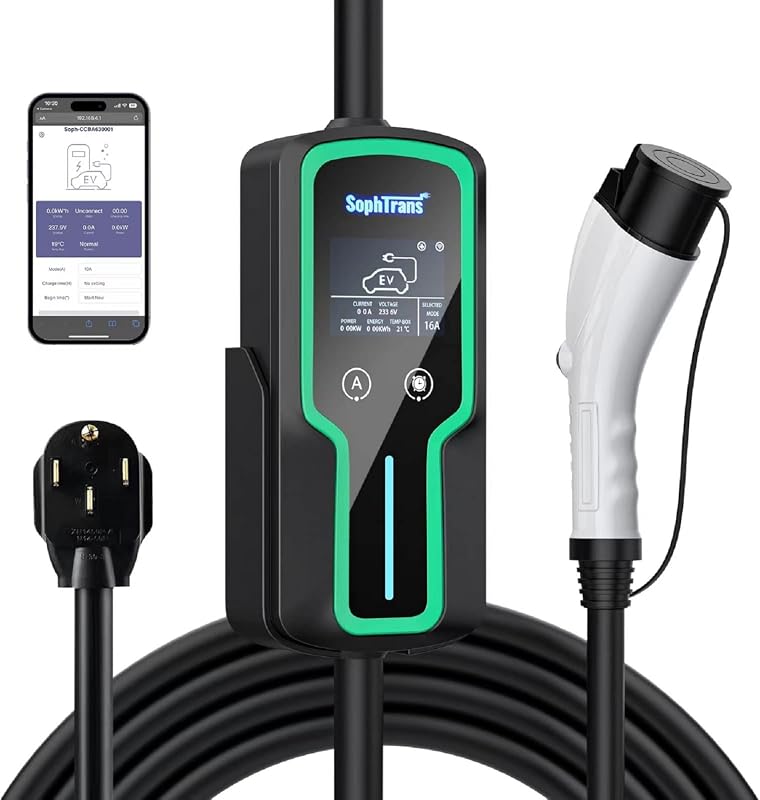
8 Best Budget Portable EV Chargers for U.S. EV Owners
Finding the best budget portable EV charger in the U.S. usually comes down to two questions: which connector your EV uses, and how much current your garage outlet or travel receptacle can actually supply. Both answers decide whether a plug-in unit is a smart buy or an expensive paperweight. This roundup compares eight affordable portable EVSE options that cover NACS and J1772 vehicles, Level 1 and Level 2 charging, and cable lengths from 16 to 25 feet.
The Lectron NACS Level 1/2 Portable EV Charger is the strongest overall pick for Tesla and NACS owners because it is the only model here that ships with both a NEMA 5-15 and a NEMA 14-50 plug, so it covers 8A trickle charging and higher-amperage Level 2 charging in one bag. Its main limitation is obvious: NACS only, so J1772 drivers should look at the AIMILER Jet or the Lectron J1772 instead.
None of these units are hardwired, so none of them require a permanent installation — but every one of them still depends on a properly wired receptacle and a vehicle whose onboard AC charger can accept the current being offered. A 40A portable charger does not make a 32A vehicle charge at 40A, and an 8A household outlet will not deliver Level 2 speed no matter what the box says. Use the comparison below to match connector, amperage, and cable reach to your actual car and parking setup.
Quick Product Comparison
| Product | Image | Type / Connector | Best For | Current Price |
|---|---|---|---|---|
| Lectron NACS Level 1/2 Portable EV Charger |  |
Level 1 & 2 / NACS | Tesla and NACS owners who want one charger for home and travel | See Price → |
| NexCyber 32A Level 2 EV Charger | 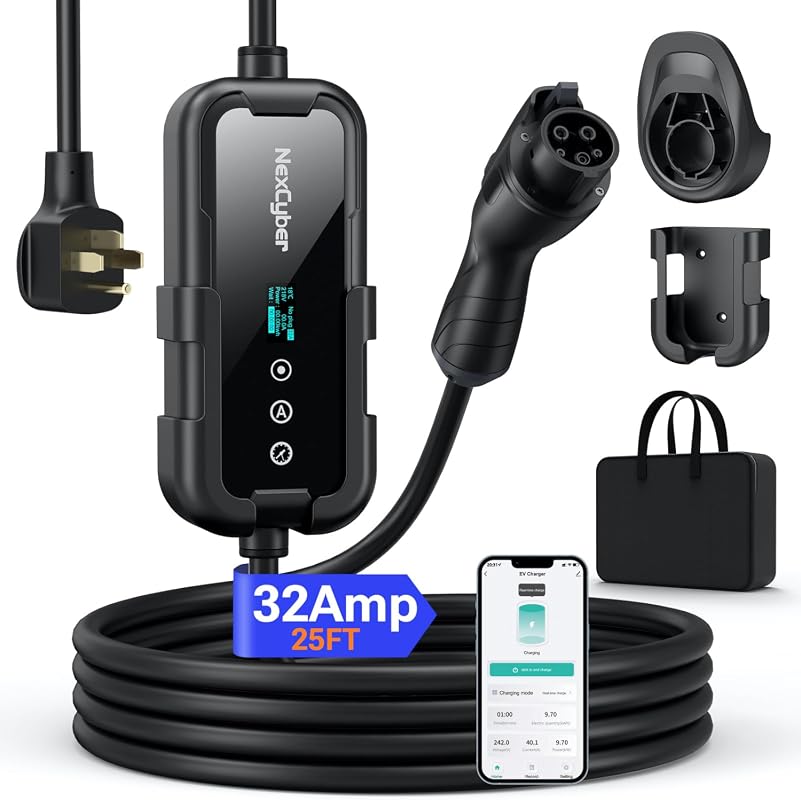 |
Level 2 / J1772 | J1772 drivers who want a certified 32A plug-in unit with app control | See Price → |
| WOLFBOX PE40 Portable Level 1 & 2 EV Charger | 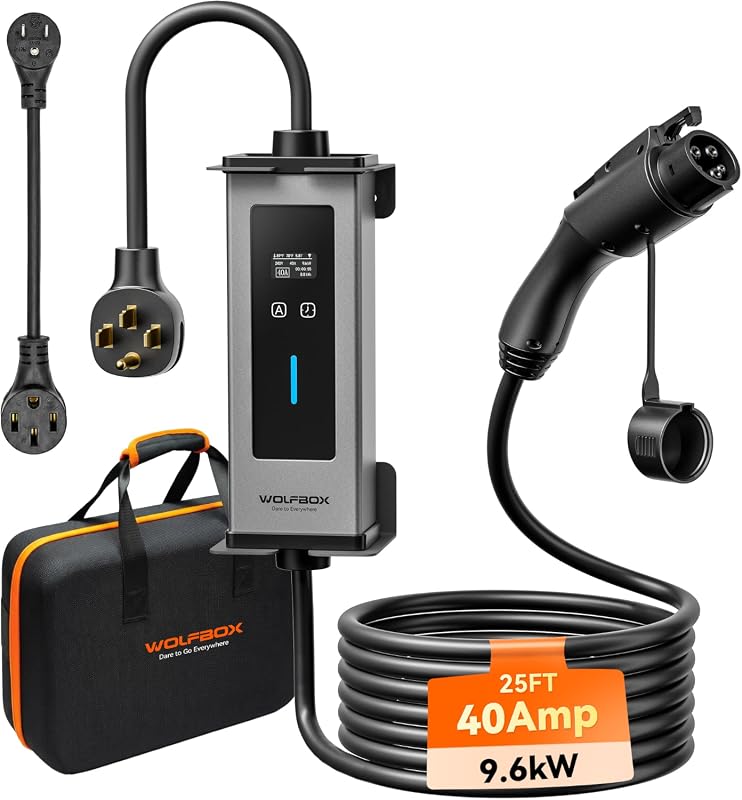 |
Level 1 & 2 / J1772 | J1772 owners who want a 40A-capable dual-level travel charger | See Price → |
| Energbison 40A Level 2 EV Charger | 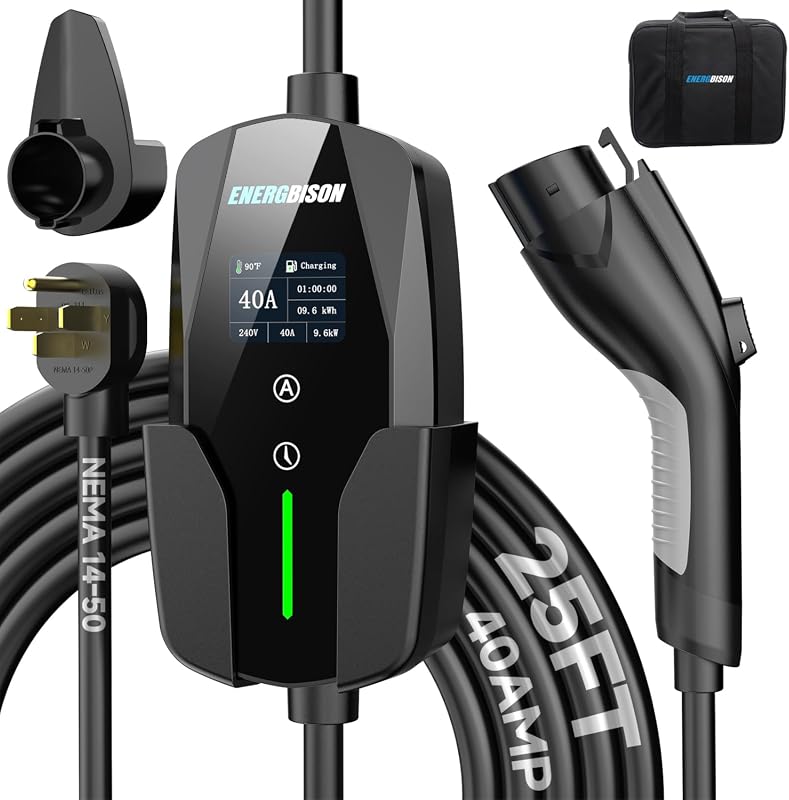 |
Level 2 / J1772 | Drivers who want a scheduled off-peak charge window without an app | See Price → |
| AIMILER Jet 40A Level 2 EV Charger | 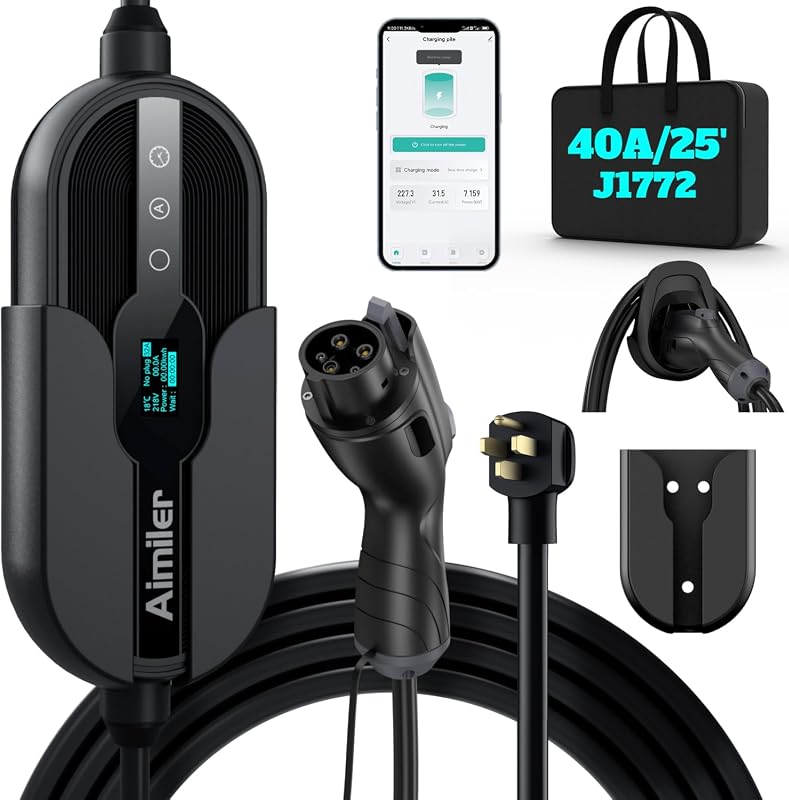 |
Level 2 / J1772 | Buyers who want a heavily reviewed 40A plug-in charger with app control | See Price → |
| AIMILER 32A Level 2 EV Charger | 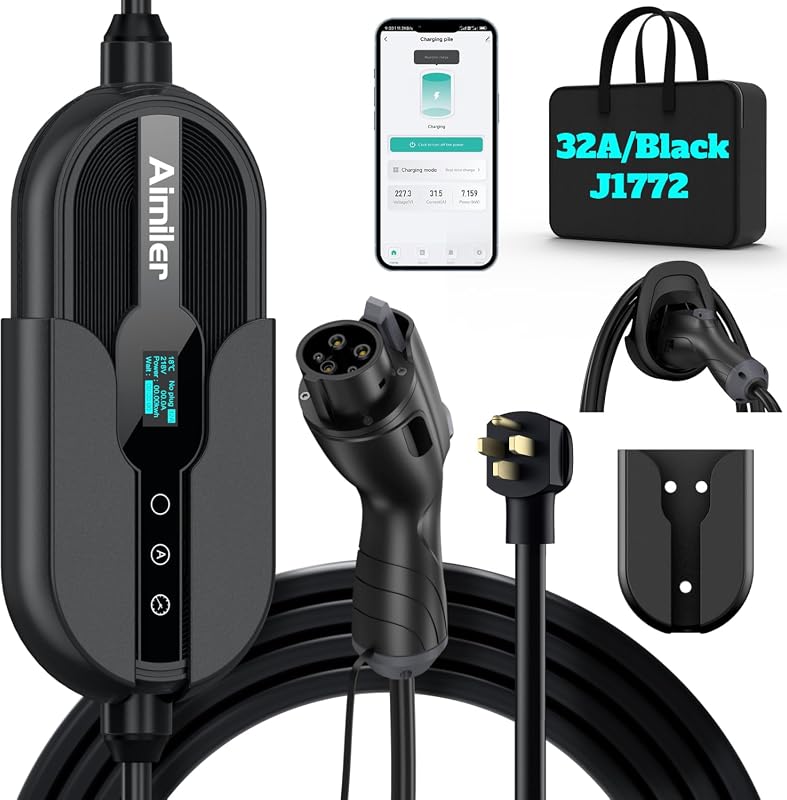 |
Level 2 / J1772 | EVs whose onboard charger tops out near 32A | See Price → |
| Lectron WiFi Level 2 J1772 Charger | 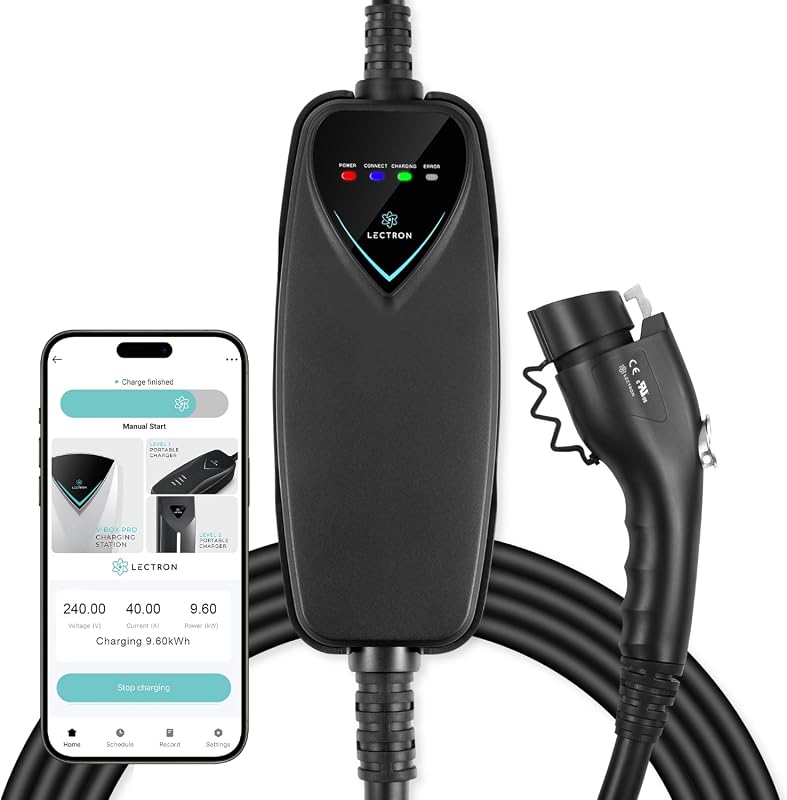 |
Level 2 / J1772 | J1772 drivers who want in-app energy limits and scheduling | See Price → |
| Disaenco 32A Portable Level 2 EV Charger | 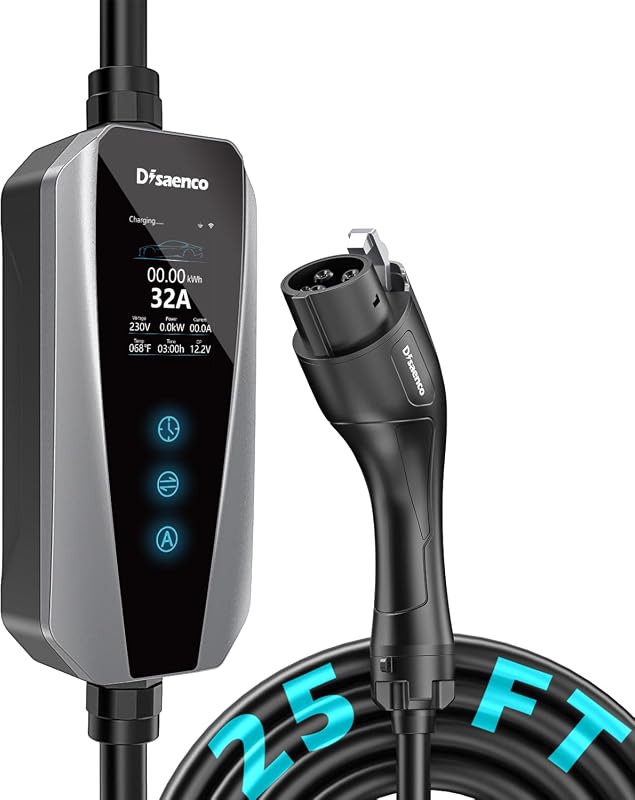 |
Level 2 / J1772 | Budget-minded J1772 drivers charging on a modest 240V outlet | See Price → |
What Matters for the Best Budget Portable EV Charger
1. Connector match: NACS vs. J1772
This is the single fastest way to narrow the field. Most non-Tesla EVs in the U.S. still use the J1772 AC connector, while Tesla vehicles and a growing number of newer models use NACS (SAE J3400). Only one product in this roundup uses NACS, so the connector decision usually eliminates half the list immediately. Physical fit alone does not prove every charging mode works, so confirm the listing before you buy.
2. Advertised amperage vs. your vehicle’s onboard limit
A 40A charger is not automatically faster than a 32A charger in your garage. The vehicle’s onboard AC charger sets the ceiling, and the EVSE negotiates down to whatever the car requests. If your EV tops out at 32A, paying more for 40A capability buys you nothing at home — though it may still help on a future vehicle. If you are unsure where your car lands, this breakdown of whether 40 amps is enough for a Level 2 EV charger is a good starting point.
3. Plug type and receptacle reality
Most Level 2 picks here use a NEMA 14-50 plug, the common 240V garage and RV receptacle. One model adds a NEMA 5-15 plug for standard household outlets at 8A. Never assume an outlet is wired for the load just because the plug fits — an existing 240V receptacle may have been installed for a different purpose. Check the circuit before you plug anything in.
4. Cable reach and portability
Cable length ranges from 16 to 25 feet across these picks. If your parking spot is tight or you back in, the extra nine feet matters. Longer cables add bulk and weight, so a 25-foot unit is less fun to toss in the trunk than a 16-foot one. For background on how dual-level portables handle this trade-off, see this guide to the 40-amp Level 1 and 2 portable EV charger category.
5. Smart features: app control vs. onboard timers
Some units here offer Wi-Fi app control for scheduling and energy limits, while at least one uses a simple 1-to-12-hour delayed-start timer built into the unit. Both approaches let you shift charging to off-peak hours, but app-based control usually adds setup steps and depends on a stable Wi-Fi signal at the parking spot.
6. Safety listings and what to verify
Certification language varies a lot in this price range. Some listings cite ETL, FCC, or Energy Star marks; one cites CE only. Because listings and certifications can change, verify the current safety documentation on the product page before buying, and confirm outdoor suitability rather than assuming it from the housing.
Our Top 8 Picks
1. Lectron Level 1/2 Tesla NACS Portable EV Charger with Dual-Level 8A-40A Charging and NEMA 14-50/5-15 Plug
This is the most flexible charger in the roundup on paper. It ships with both a NEMA 5-15 plug for standard household outlets and a NEMA 14-50 plug for 240V charging, and it moves between an 8A Level 1 mode and a 40A Level 2 mode. The 20-foot cable and included wall mount mean you can run it as a semi-permanent garage setup or pull it off the bracket for road trips. It is ETL-certified per the listing and carries overvoltage, overcurrent, and over-temperature protections. Real-time status comes from LED indicators rather than an app. The limitation is structural: NACS only, and the 40A figure is the charger’s advertised ceiling, not a promise about your vehicle.
- Only pick here with both NEMA 5-15 and NEMA 14-50 plugs supplied
- Adjustable 8A–40A range covers trickle charging and faster home charging
- 20 ft cable plus a wall mount for semi-permanent use
- ETL-certified with overvoltage, overcurrent, and over-temperature protection listed
- NACS connector only — check your vehicle before ordering
- No Wi-Fi app control; status is LED-only
- Actual charge rate still depends on your vehicle and circuit
2. Level 2 EV Charger 32A WiFi APP Plug-Play, 240V NEMA 14-50P, 25FT Cable, ETL Certified J1772
This NexCyber unit pairs a 32A Level 2 output with a 25-foot cable and Wi-Fi app control, which is a sensible combination for a plug-in charger you may move between a garage and a relative’s house. The listing cites compliance with SAE J1772 along with a long list of UL standards and states ETL and FCC certification plus a 3-year warranty. Where it stands out against the 40A options below is the amperage: if your vehicle’s onboard charger sits near 32A, this delivers the same real-world result with less headroom you would never use. The trade-off is that the supplied feature data is thin beyond certification and warranty, so verify cable management hardware and app details on the listing.
- 32A, 240V Level 2 output with a 25 ft cable
- Listing states ETL and FCC certification and a 3-year warranty
- Wi-Fi app control for scheduling and monitoring
- No NACS option — J1772 vehicles only
- Fewer supplied details on connector holder and included accessories
- 32A may be below the ceiling of some newer EVs
3. WOLFBOX PE40 Portable Level 1&2 EV Charger 40A for J1772 EVSE Home and Travel
The PE40 is the J1772 counterpart to the Lectron NACS pick: a dual-level portable with a 40A advertised ceiling that the manufacturer positions for both home and travel. That dual-level capability is the reason it earns a spot here — carrying one charger that can work on a household outlet and on a 240V receptacle is the whole point of a portable EVSE. The catch is disclosure. This listing provides no feature bullets in the supplied data, so there is very little to verify about cable length, plug types, certification marks, app support, or weather handling. That does not make it a bad charger, but it does mean you should read the full product page carefully before committing.
- Advertised 40A output with both Level 1 and Level 2 capability
- J1772 connector suits most non-Tesla EVs and plug-in hybrids
- Positioned as a home-and-travel unit rather than a fixed station
- No feature bullets supplied — verify cable length, plugs, and certification on the listing
- Lower review volume than the AIMILER picks
- Confirm which plug types are actually included in the box
4. Level 2 EV Charger 40A 9.6KW 240V SAE J1772 Portable Electric Vehicle Charging Station
This Energbison unit is the simplest 40A option on the list. It uses a NEMA 14-50 plug, so it drops into an existing 240V receptacle without hardwiring, and it includes a 1-to-12-hour delayed-start timer for pushing charging into off-peak hours. No app, no Wi-Fi, no account — just set the delay and walk away. For a lot of buyers that is a feature, not a shortcoming. The listing also notes compatibility with all SAE J1772 EVs and plug-in hybrids. What it does not provide is a cable length, so verify that detail before buying if reach matters in your parking setup.
- 40A / 9.6 kW / 240V output with NEMA 14-50 plug-in setup
- Built-in 1–12 hour delayed start for off-peak charging
- No app or Wi-Fi dependency
- No smart app features or remote monitoring
- Cable length not stated in the supplied data — verify on the listing
- Lower review volume than the AIMILER models
5. AIMILER Jet Level 2 EV Charger 40A WiFi APP Plug-Play with 25ft Cable, NEMA 14-50P, J1772
The AIMILER Jet is the highest-visibility product here by a wide margin, and the supplied package contents are unusually complete: the charger, a 25-foot cable, a portable handbag, a gun and cable holder, and a fixing cover. That bundle makes it genuinely practical as a travel unit rather than a charger you leave permanently on a hook. It runs 40A at 240V with Wi-Fi app control, and the listing lists short circuit protection, water resistance, and automatic off among its special features. As with every 40A unit in this roundup, treat the rating as the charger’s capability rather than a guaranteed charge speed for your car.
- 40A / 240V Level 2 output with a 25 ft cable
- Wi-Fi app control for monitoring and scheduling
- Includes a carrying bag, cable holder, and fixing cover
- Very high review volume compared with other picks
- J1772 only — no NACS version
- Water resistance is listed as a feature, not a stated numeric weather rating
- 40A capability is wasted on vehicles limited to 32A
6. AIMILER Level 2 EV Charger 32A WiFi APP Plug-Play with 25ft Cable, NEMA 14-50P, J1772 for Home
This is the same AIMILER formula as the Jet, dialed back to 32A. If your EV cannot accept more than roughly 32A of AC charging, this is the rational pick: the 25-foot cable, Wi-Fi app control, and NEMA 14-50 plug are all still there, and the listing cites ETL and FCC certification. You give up nothing in the real world and potentially spend less. The supplied feature data for this variant is thinner than the Jet’s, so check the listing for the full accessory list and warranty terms before ordering. Note the odd “item weight” field on the listing — treat weight figures there with suspicion and confirm shipping weight instead.
- 32A / 240V output matched to common onboard charger limits
- 25 ft cable and Wi-Fi app control
- Listing cites ETL and FCC certification
- No NACS option
- Supplied accessory details are sparse compared with the 40A AIMILER
- Not the right pick if your EV can accept 40A or more
7. Lectron Level 2 J1772 WiFi EV Charger 40A 240V with NEMA 14-50 Plug and 16ft Cord
The standout feature here is the Lectron App, which the listing says lets you monitor charging status, schedule sessions, and set exactly how many kWh you want to add. That last capability is genuinely useful if you charge on a rate plan where the marginal cost changes, or if you want to top up a fixed amount before a trip. The safety paperwork is also comparatively detailed: the handle is listed as UL 2251 certified and the charger as Energy Star, ETL, and FCC certified. The obvious compromise is the 16-foot cord — the shortest in this roundup — so measure your parking setup before assuming it will reach.
- 40A / up to 9.6 kW / 240V Level 2 output
- App-based scheduling and kWh-limited charging sessions
- Listing cites UL 2251 on the handle plus Energy Star, ETL, and FCC certification
- Carrying case included for storage and travel
- 16 ft cord is the shortest here — check reach first
- Requires a compatible NEMA 14-50 outlet
- J1772 only, no NACS option
8. Portable Level 2 EV Charger 32A with NEMA 14-50 Plug, 25ft Cable, J1772 Connector for Home
This Disaenco unit is the most straightforward entry in the roundup: 32A at 240V for up to 7.7 kW, a NEMA 14-50 plug, and a 25-foot cable. The listing is honest that actual speed depends on the vehicle, the circuit, and available power — which is the correct framing and worth remembering across every charger on this page. It weighs 9.9 pounds, making it a reasonable travel companion. The one thing to scrutinize is the safety mark: the listing cites CE, which is not the same as a North American listing such as ETL or UL. If that distinction matters for your insurance or your comfort level, verify the current documentation before buying. Review volume is also very low so far.
- 32A / 7.7 kW / 240V output with a 25 ft cable
- Simple plug-in NEMA 14-50 setup, no hardwiring
- Listing states actual speed depends on vehicle and circuit
- Only CE is cited — confirm whether a North American safety listing applies
- Very low review count so far
- No app control or smart scheduling mentioned
Buying Guide: How to Choose a Budget Portable EV Charger
Start with the connector, not the price
NACS and J1772 are physically different connectors. Buying the wrong one means an adapter or a return. Tesla models and NACS-equipped vehicles take the Lectron NACS unit; everything with a J1772 port takes one of the other seven. For a wider look at what 40A plug-in hardware can do in this category, see our roundup of the best 40 amp Level 2 EV chargers.
Match amperage to your vehicle, not to the spec sheet
Your car’s onboard charger is the real bottleneck. A 40A EVSE on a vehicle that accepts 32A charges at 32A. Buying more amperage than your car can use is only worth it if you plan to replace the vehicle or want a future-proof unit.
Confirm the plug and the circuit behind it
NEMA 14-50 is the dominant Level 2 plug here. Before plugging in, confirm the receptacle was installed for EV charging and that the circuit can support continuous duty. NEMA 5-15 household outlets, as used by the Lectron unit’s Level 1 mode, are a different animal entirely and will only give you a slow trickle.
Decide how portable you actually need it to be
A 25-foot cable with a carrying case is a travel charger. A 16-foot cord on a wall bracket is a garage charger. Both are valid — just be honest about which one you are buying, because hauling a heavy 25-foot unit in and out of a trunk every week gets old.
Weigh smart features against simplicity
App control adds scheduling, monitoring, and energy limits. A built-in delay timer does the single most valuable thing — shifting charging to cheaper hours — without Wi-Fi, an account, or a firmware update. If your rate plan is simple, the timer may be all you need.
- Confirm connector and vehicle-side charging compatibility
- Verify charger/output and installation requirements
- Confirm cable reach or adapter direction as relevant
- Verify safety listing, warranty, app, and outdoor details when important
- Include installation and accessory costs
Verify connector, charging mode/output, and manufacturer instructions.
Check the relevant electrical, mounting, cable, or adapter requirements.
Follow the product instructions and use a qualified professional where required.
Final Verdict
- Best for: NACS and Tesla owners who want true dual-level flexibility — the Lectron NACS Level 1/2 Portable EV Charger, thanks to its included NEMA 5-15 and NEMA 14-50 plugs and 8A–40A range.
- Think twice if: your EV uses J1772, or if your vehicle’s onboard charger caps out near 32A and a 40A unit would be wasted money.
- Next step: confirm your connector type and receptacle wiring before ordering anything — those two facts decide most of this list.
Frequently Asked Questions About Best Budget Portable Ev Charger
The Lectron NACS Level 1/2 Portable EV Charger is the only NACS model in this roundup, and it is also the only one that includes both a NEMA 5-15 and a NEMA 14-50 plug. That combination lets you trickle charge from a household outlet or use a 240V receptacle with the same unit.
Not necessarily. Dual-level units like the Lectron NACS charger and the WOLFBOX PE40 can run on standard household outlets at lower amperage, which is slow but useful in a pinch. For meaningful Level 2 speed, you need a 240V receptacle such as a NEMA 14-50 that has been properly wired for the load.
The charger can offer up to 40A, but your vehicle’s onboard AC charger decides how much it accepts. Many EVs cap out below 40A, and the EVSE negotiates down to the lower of the two. Check your vehicle’s onboard charger rating before paying extra for 40A capability.
Look at the charge port. Tesla vehicles and newer NACS-equipped models take the NACS connector, while most other EVs and plug-in hybrids currently use J1772. Physical fit alone does not guarantee every charging mode works, so confirm compatibility in the product listing for your specific vehicle.
Only if the product listing confirms outdoor suitability for your conditions. One pick here lists water resistance as a feature, which is not the same as a stated weather rating. Verify the manufacturer’s guidance before leaving any portable EVSE exposed to rain, snow, or extreme temperatures.
Cables in this roundup run from 16 to 25 feet. Longer cables are more forgiving if you park nose-in or your outlet is across the garage, while shorter cables are lighter and easier to stow. Measure the distance from your outlet to your charge port before choosing.
Price is the least interesting variable in this category. The eight chargers here all sit in a similar budget range, and the differences that actually matter — connector type, amperage ceiling, cable length, plug style, and safety documentation — are the things that will either make the charger useful or leave it sitting in a box.
Pick your connector first, confirm what your vehicle will accept second, and verify the receptacle behind your outlet third. Do those three things and any of these units will do the job. Skip them and even the best-reviewed charger on the list will disappoint.