Hat Size Breaker for a 40 Amp EV Charger: Choosing the Right Electrical Protection
A 40-amp EV charger draws a continuous load, so we must size its circuit accordingly. A 40-amp EV charger typically requires a dedicated 50-amp double-pole breaker.
We also need to match the wire size, charger installation method, panel capacity, and local electrical requirements. The details can change for hardwired equipment, receptacle installations, long cable runs, or panels with limited available capacity.
Key Takeaways
- A 40-amp charger typically uses a 50-amp breaker.
- EV charging circuits require continuous-load sizing.
- Wire, panel capacity, and installation requirements must match.
Electrical Requirements And Continuous Load Rules
A 40-amp EV charger typically requires a 50-amp, 240-volt dedicated circuit because EV charging counts as a continuous load. We must also verify conductor ampacity, breaker compatibility, panel capacity, installation method, and the charger’s configured output.
Understanding 80% Circuit Loading
Under the continuous-load rule, we size the circuit at 125% of the charger’s maximum current. This creates the commonly used 80% limit:
40 amps × 125% = 50 amps
Therefore, a charger that draws 40 amps continuously generally needs a 50-amp two-pole breaker. The circuit must use conductors with ampacity suitable for that installation, considering the wiring method, terminal temperature ratings, ambient conditions, conductor bundling, and local code requirements.
The 80% limit applies to the actual continuous charging current, not necessarily the breaker label. If we configure the EVSE to deliver 32 amps, the calculation becomes 32 × 125% = 40 amps, so a 40-amp circuit may be appropriate when the equipment and installation support it.
Matching Charger Output To Circuit Capacity
We must match the charger’s configured output to the circuit’s permitted continuous capacity. A 50-amp circuit generally supports up to 40 amps of continuous EV charging, while a 40-amp circuit generally supports up to 32 amps.
| Charger output | Minimum circuit rating |
|---|---|
| 32 amps | 40 amps |
| 40 amps | 50 amps |
| 48 amps | 60 amps |
A plug-in EVSE may also be limited by the receptacle, plug, and manufacturer instructions. For hardwired equipment, we must follow the listed installation requirements and set the maximum output accordingly. We should also complete a dwelling load calculation before installation, because the service panel must support the EV charger alongside existing loads such as heating, cooking, and water heating equipment.
Circuit Breaker Selection
We size the branch circuit for the charger’s maximum continuous output, then verify the panel, wiring, and breaker ratings. A 40-amp EV charger typically needs a 50-amp, two-pole breaker, while panel compatibility determines whether that installation is acceptable.
Why A 50-Amp Breaker Is Typically Required
We treat EV charging as a continuous load because the charger can operate for several hours without interruption. Under the common NEC sizing method, we multiply the charger’s 40-amp maximum output by 125%:
40 amps × 1.25 = 50 amps
That calculation supports a 50-amp branch-circuit rating. The circuit must also use conductors with an ampacity suitable for the installation, wiring method, temperature ratings, and local code requirements. We should follow the charger manufacturer’s instructions if they require a different circuit size or conductor specification.
A 50-amp breaker does not make the charger deliver more than 40 amps. The charger’s internal settings and the vehicle’s charging system control the actual current. If the charger allows adjustable output, we must configure it so its maximum continuous current does not exceed the circuit’s rating.
Breaker Type And Panel Compatibility
We use a two-pole breaker that matches the electrical panel’s brand, series, and listing. The breaker must connect to the correct bus positions and provide the voltage specified by the charger, typically 240 volts for a Level 2 installation. We should not substitute a breaker solely because it fits physically.
The panel also needs enough capacity for the added continuous load. We evaluate the service and feeder load, available spaces, bus rating, and any manufacturer requirements before installation. A 100-amp or 200-amp service does not automatically confirm that the panel can support a 40-amp charger.
We should use a qualified electrician to perform the load calculation and installation. Local authorities may require a permit, inspection, GFCI protection, or other requirements under the current adopted electrical code.
Wire Size And Conductor Considerations
A 40-amp EV charger typically operates continuously, so we size its circuit for 125% of the charging current. We also account for conductor material, installation conditions, circuit length, and local electrical-code requirements before selecting the final wire size.
Copper Versus Aluminum Conductors
For a charger that draws 40 amps continuously, the circuit must generally provide at least 50 amps of ampacity. For typical residential installations, we commonly use 6 AWG copper on a 50-amp, two-pole breaker, although the exact size depends on the cable type, terminal ratings, ambient temperature, and number of current-carrying conductors.
Some installations use 4 AWG aluminum instead. Aluminum costs less and weighs less for long runs, but it requires terminals listed for aluminum conductors and careful preparation. We must torque every connection to the manufacturer’s specification because loose or improperly prepared terminations can overheat.
| Conductor | Common starting point for a 40A continuous charger |
|---|---|
| Copper | 6 AWG on a 50A circuit |
| Aluminum | 4 AWG on a 50A circuit |
We should verify the EVSE’s maximum input current and installation instructions. A charger configured for less than 40 amps may require a smaller circuit, while local code may require conduit, a particular insulation rating, or larger conductors.
Accounting For Distance And Voltage Drop
Long conductor runs create voltage drop, which can reduce charging efficiency and cause equipment problems. Electrical design commonly targets no more than 3% voltage drop on the branch circuit, although the enforceable requirement depends on the adopted code and local authority.
We should calculate voltage drop using the conductor material, wire length, circuit voltage, and charging current. Measure the full circuit path, including both ungrounded conductors, rather than measuring only the one-way distance.
For longer runs, we may increase the conductor size even when the standard ampacity calculation allows 6 AWG copper. For example, a detached-garage installation with a substantial run might use 4 AWG copper or a larger aluminum conductor to limit voltage loss. We must also confirm that the EVSE terminals accept the selected wire size and that the conduit can accommodate it.
Charging Equipment And Installation Requirements
We size the circuit for the charger’s maximum continuous output, then verify the installation method, panel capacity, grounding, and local requirements. A 40-amp EV charger generally needs a 50-amp circuit because EV charging operates as a continuous load.
Hardwired Versus Plug-In Chargers
With a hardwired charger, we connect the equipment directly to the branch-circuit wiring through an approved disconnecting means when required by local code. This approach avoids a receptacle connection, often provides a cleaner installation, and can suit chargers installed outdoors or in locations subject to moisture.
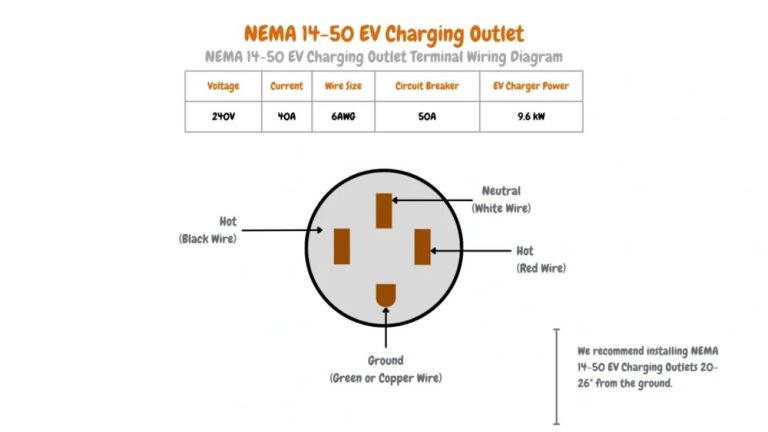
A plug-in charger typically uses a NEMA 14-50 receptacle or another configuration specified by the manufacturer. We must match the receptacle, plug, conductors, and breaker to the charger’s requirements. For a 40-amp charging load, the branch circuit commonly uses a 50-amp breaker, but the receptacle must also carry the intended continuous load and receive proper torque during installation.
We also check the charger’s installation manual before selecting either method. Some equipment supports both options, while other units require hardwiring or specify a particular receptacle and overcurrent protection.
GFCI And Local Code Considerations
Under current NEC rules, many EV charging outlets require GFCI protection, especially installations using a receptacle. A 50-amp GFCI breaker may protect a plug-in charger, but we confirm compatibility because some chargers include internal ground-fault monitoring that can interact with upstream protection.
Local amendments can impose requirements beyond the NEC, including an outdoor disconnect, weather-resistant equipment, bollard protection, conduit specifications, or permits and inspections. We verify these conditions with the authority having jurisdiction before installation.
We also confirm that the panel can support the additional continuous load through a load calculation. If the existing service cannot accommodate the charger, we may need load management, a reduced charging setting, a subpanel, or a service upgrade rather than simply installing a larger breaker.
Safety Checks Before Energizing
We should confirm that the electrical service can support the added continuous load and that the installation matches local code requirements. We also need to verify the circuit, equipment, grounding, and required approvals before energizing the charger.
Panel Load Calculation
A 40-amp EV charger typically operates as a continuous load, so we size the branch circuit for 125% of 40 amps, or 50 amps. This commonly means a dedicated 50-amp, 240-volt circuit, but the charger’s installation instructions and local code requirements control the final selection.
We should calculate the home’s existing demand rather than judge capacity only by the main breaker rating. Include electric heating, air conditioning, water heating, ranges, dryers, pumps, and other substantial loads. A qualified electrician can determine whether the service and panel have adequate capacity or whether load management, a service upgrade, or a lower charging setting is necessary.
Before energizing, we should verify that the breaker, conductors, terminals, disconnects, and receptacle or hardwired connection match the equipment rating. We should also confirm correct polarity, secure terminations, equipment grounding, and any required GFCI protection.
Professional Inspection And Permitting
We should obtain any required electrical permit before installation and arrange the inspection required by the local authority. Requirements vary by jurisdiction, especially for hardwired equipment, receptacles, exterior installations, and work in garages or other damp locations.
A licensed electrician should inspect the completed circuit and test the charger under load. We should confirm that the breaker is firmly seated, connections meet manufacturer torque specifications, cable protection is adequate, and the enclosure or receptacle is suitable for its location.
We should not energize the circuit if we find damaged insulation, loose conductors, overheating, missing covers, improper grounding, or a breaker that does not match the panel. After approval, we can monitor the first charging session for nuisance tripping, unusual heat, burning odors, or fault messages and disconnect power if any unsafe condition appears.
Frequently asked questions
What breaker size does a 40-amp EV charger need?
We typically use a 50-amp, double-pole breaker for a charger rated to deliver 40 amps. EV charging counts as a continuous load, so we size the circuit at 125%: 40 × 1.25 = 50 amps.
Does the charger need a dedicated circuit?
Yes. We install Level 2 EV chargers on a dedicated 240-volt circuit so other loads do not share the charger’s capacity.
What wire size should we use?
The correct conductor size depends on the installation method, conductor type, ambient conditions, terminal ratings, voltage drop, and local code. We should not select wire size from amperage alone; a licensed electrician should verify it.
Can we connect the charger to a 40-amp breaker?
Only if we configure the charger to draw no more than 32 amps continuously. A charger operating at its full 40-amp rating generally requires the 50-amp circuit described above.
Can we use a 50-amp receptacle?
We can use a properly rated receptacle and plug only when the charger manufacturer permits that connection. The receptacle, wiring, breaker, enclosure, and installation must comply with local electrical requirements, including any required GFCI protection.
Will our electrical panel support the charger?
We need a load calculation to confirm sufficient capacity. An electrician should check the panel rating, available breaker spaces, service load, and any local permitting requirements before installation.
Conclusion
For a 40-amp EV charger, we typically use a 50-amp, two-pole breaker on a dedicated 240-volt circuit. This sizing reflects the NEC continuous-load requirement, which applies 125% of the charger’s rated current: 40A × 1.25 = 50A.
We also need to confirm that the panel, wiring, disconnecting means, and charger installation meet local electrical requirements. The correct wire size depends on the installation method, terminal ratings, conductor type, distance, and applicable code—not just the breaker rating.
Before installation, we should verify:
- The charger’s manual and maximum input current
- Available panel capacity through a load calculation
- Conductor size and temperature ratings
- GFCI and other protection required by local code
- Permit and inspection requirements
A licensed electrician can confirm the design and install the circuit safely. We should not increase the breaker size unless the entire circuit and connected equipment support that rating.

3 Comments