10 Best Dual EV Chargers for Home
Finding the right dual EV charger for home use is about more than picking a charger with two cables—it’s about matching the station, connector, and installation to the EVs you actually own.
The Enphase HCS-D40 is the strongest recommendation for a true dual EV charger for home because it can power two J1772 EVs on one circuit. It suits households with two EVs and limited panel capacity, but it is expensive and J1772-only.
This roundup includes one true dual-port charger, several single-port Level 2 chargers that are common in dual-EV households, a socket splitter, and a charger stand. I have not first-hand tested any of these units; the comparison below relies on supplied Amazon listing data. If you’re focused on maximum hardwired speed, our roundup of the 10 best 48 amp hardwired EV chargers is a useful companion.
Quick Product Comparison
| Product | Image | Type / Connector | Best For | Current Price |
|---|---|---|---|---|
| Enphase HCS-D40 |  |
Hardwired dual-port / J1772 | Two J1772 EVs on one circuit | See Price → |
| Lectron Portable NACS |  |
Portable Level 1/2 / NACS | NACS owners who want home + travel | See Price → |
| Lectron Nexus |  |
Hardwired Level 2 / J1772 | Fast hardwired J1772 charging | See Price → |
| Smart J1772 48A |  |
Level 2 / J1772 | Smart features and load balancing | See Price → |
| Lectron J1772 WiFi | 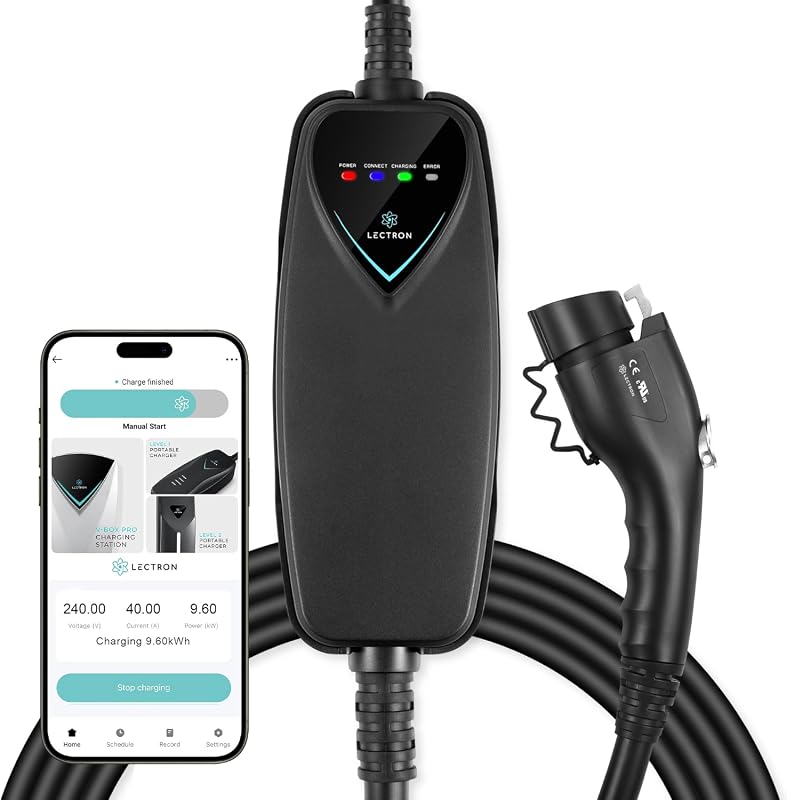 |
Portable Level 2 / J1772 | WiFi control and portability | See Price → |
| NexCyber 48A | 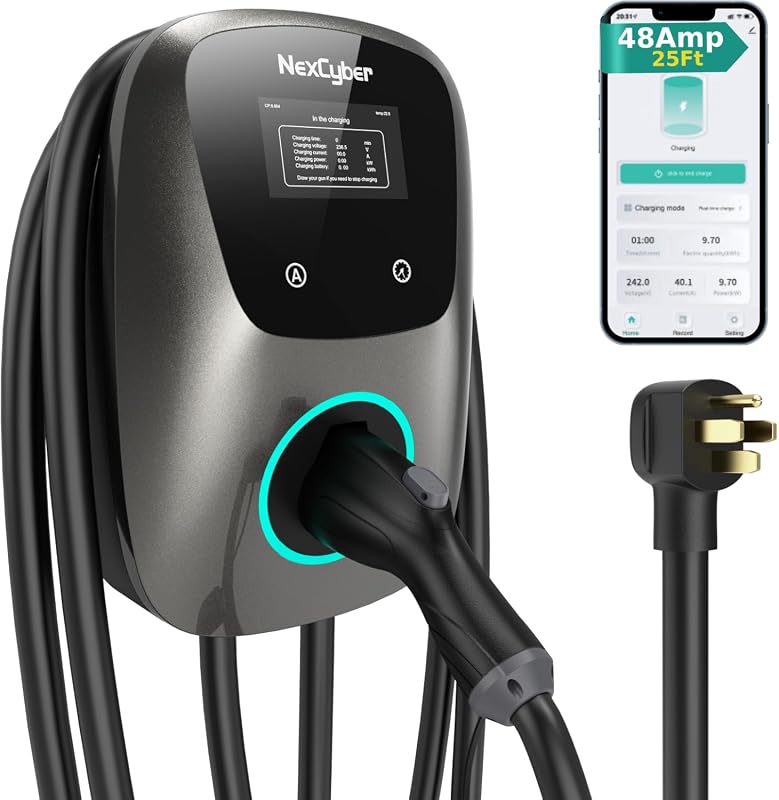 |
Plug-in Level 2 / J1772 | Budget 48A-rated plug-in charging | See Price → |
| EVDANCE Portable |  |
Portable Level 1/2 / J1772 | Budget Level 1/2 charging | See Price → |
| Compact Portable J1772 |  |
Portable Level 1/2 / J1772 | Compact home and travel charging | See Price → |
| islewire Socket Splitter |  |
Socket splitter / NEMA 14-50 | Sharing one 240V outlet between chargers | See Price → |
| Wallbox Eiffel Dual Base |  |
Charger stand / N/A | Tidy Wallbox charger placement | See Price → |
What Matters for Dual Ev Charger For Home
True dual-port vs. shared setup. A true dual-port station like the Enphase HCS-D40 splits power between two vehicles from one unit. A socket splitter, by contrast, lets two separate chargers share one outlet. Know which model matches your garage before you buy.
Connector compatibility. J1772 is the standard for most non-Tesla EVs, while NACS/J3400 is native on Teslas and newer models. Check your vehicle’s port and whether an adapter is needed.
Charging current and vehicle-side limit. A 48A charger only charges at 48A if the car’s onboard charger accepts that rate. Before assuming a 48A charger will charge your EV at 48A, check your car’s onboard charger; our explainer on whether 48 amps is enough for a Level 2 charger walks through the key numbers.
Installation type. Hardwired units generally require professional installation and a dedicated circuit. Plug-in units are easier to move but depend on outlet location and circuit capacity.
Cable reach and portability. Longer cables make it easier to reach both vehicles. Portable units add travel flexibility but may have lower amperage.
Safety documentation and smart features. Look for UL, ETL, or Energy Star marks, app controls, load management, and weather ratings when they matter for your setup.
Our Top 10 Picks
1. Enphase HCS-D40 Level 2 Dual EV Charger, 32A 240V Hardwired, 25ft Cables, J1772 Certified, formerly ClipperCreek
The Enphase HCS-D40 is the only true dual-port charger in this roundup. It is a hardwired Level 2 station that can send 32A to one J1772 vehicle or split that current to 16A per vehicle when two are charging. That makes it a strong fit for households with two EVs and limited panel capacity. The supplied data also points to commercial-grade construction, a NEMA 4-rated enclosure, 25-foot cables, UL 2594 certification, and a 5-year warranty. The main limitation is price: this is a premium station, and it uses J1772 connectors.
- True dual-port charging on one circuit
- 32A to one EV or 16A to two EVs
- NEMA 4 enclosure and UL 2594 certification
- Premium price
- J1772 only
2. Lectron Level 1/2 Portable NACS EV Charger, 8A-40A, NEMA 14-50/5-15 Plug, Compatible with All NACS Electric Vehicles
The Lectron portable NACS charger is the best alternative here if you drive a Tesla or another NACS-equipped EV. It works with NEMA 5-15 and 14-50 outlets, so you can charge at 8A on a regular household outlet or step up to 40A when a 240V outlet is available. The 20-foot cable and included wall mount give you flexibility, while ETL certification and built-in protections cover the basics. The trade-off is that this is a single-port portable charger, not a fixed dual-port station, so it won’t charge two EVs at the same time.
- Dual-level charging with 5-15 and 14-50 plugs
- ETL certified with overvoltage, overcurrent, and over-temperature protection
- NACS compatible with Tesla models
- Single-port portable unit
- Not a fixed dual-port charger
3. Lectron Nexus Level 2 EV Charger, 48A 240V Hardwired, UL2594 Certified, 23ft Cable, J1772 EVs
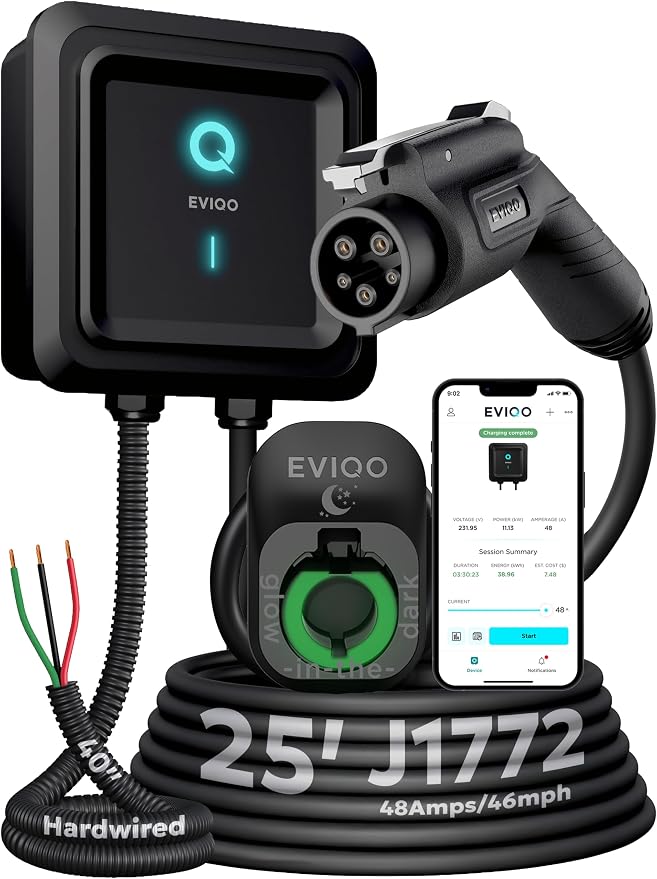
The Lectron Nexus is a hardwired Level 2 charger built for J1772 EVs that can accept higher AC charging speeds. The listing says it can deliver up to 48A at 240V (11.5kW), which works out to roughly 46 miles of range per hour, and it carries a UL2594 certification and an IP66 weatherproof rating. The 23-foot cable and included holster make mounting easier. Keep in mind that your car’s onboard charger must support 48A to get the full speed; otherwise it will charge at whatever rate the vehicle accepts. Tesla owners will need a compatible adapter to go from this J1772 charger to the vehicle’s NACS port.
- Up to 48A at 240V (11.5kW)
- UL2594 and IP66 per listing
- 23-foot cable and included holster
- Requires professional hardwired installation
- Tesla needs a compatible NACS adapter
4. J1772 Level 2 EV Charger, 48Amp/11.5kW, Energy Meter, Dual Temp Sensors, Wi-Fi, RFID, Smart App, Load Balancing
This J1772 Level 2 charger stands out for its smart-feature list: the title mentions an energy meter, dual temperature sensors, Wi-Fi, RFID, smart app control, and load balancing. That combination is useful for households that want to track usage and manage charging alongside other electrical loads. The listing supplied for this roundup did not include detailed feature bullets, so you should verify the current product page for installation type, cable length, and safety certifications before buying.
- Title lists Wi-Fi, RFID, energy meter, and load balancing
- 48A / 11.5kW output per title
- No detailed feature bullets supplied
- Verify installation and safety details
5. Lectron Level 2 J1772 WiFi EV Charger, 240V 40A, NEMA 14-50 Plug, 16ft Cord for J1772 EVs
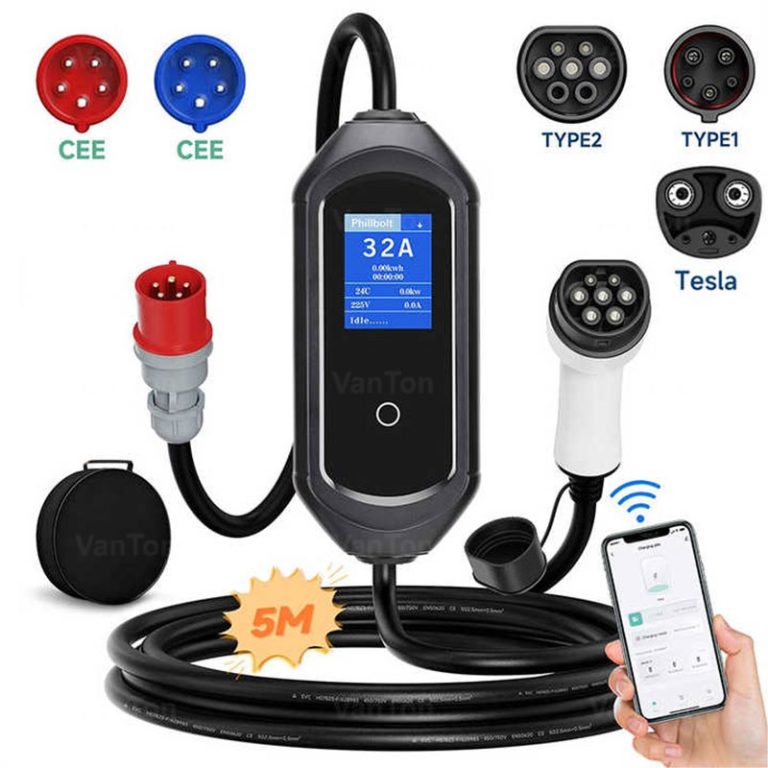
The Lectron Level 2 J1772 WiFi charger is a portable plug-in unit that combines app control with a NEMA 14-50 plug. It can deliver up to 40A at 240V (9.6kW), and the 16-foot cord keeps the charger close to the outlet. The included carrying case makes it easy to take on trips, and the supplied listing mentions Energy Star, ETL, and FCC certification, plus a UL 2251-certified handle. The main limitation is cable length: 16 feet is shorter than some fixed-wall chargers, so outlet placement matters.
- WiFi app control with real-time monitoring
- 40A / 9.6kW output for overnight charging
- Portable with carrying case
- 16-foot cable is shorter than fixed-wall options
6. Level 2 EV Charger, 48A NEMA 14-50P, WiFi App, 25ft Cable, ETL Certified J1772 Home EVSE
This NexCyber Level 2 charger is one of the more affordable 48A-rated options in this roundup. The title lists a NEMA 14-50P plug, WiFi app control, a 25-foot cable, and ETL/FCC/Energy Star certification, with a 3-year warranty. Because it is a plug-in unit, installation is simpler than a hardwired charger, but you should confirm the charger’s continuous-current rating and circuit requirements on the current listing. The 48A figure in the title does not guarantee your EV can accept 48A.
- 48A-rated plug-in with NEMA 14-50P
- 25-foot cable and WiFi app
- ETL, FCC, and Energy Star listed
- Confirm continuous-current rating and circuit requirements
7. EVDANCE Level 1&2 Portable EV Charger, 25ft Cable, ETL Listed J1772, 12A 120V/16A 240V, NEMA 5-15/6-20
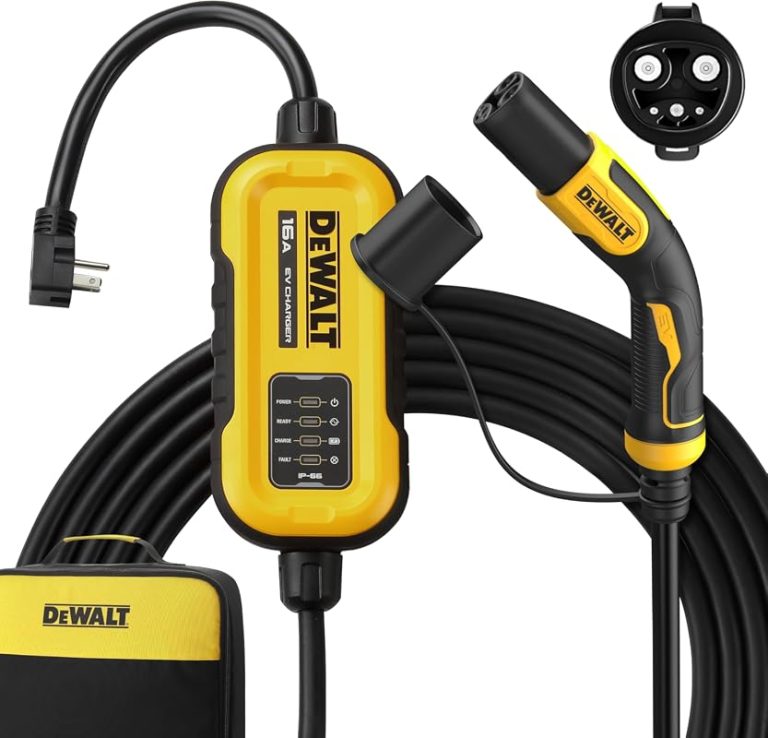
The EVDANCE portable charger is an affordable Level 1/2 option for J1772 EVs and plug-in hybrids. It draws 12A from a standard 120V outlet or 16A from a 240V outlet using the supplied NEMA 5-15 and 6-20 plugs. The 25-foot cable gives you decent reach, and the LED display shows charging status. It is ETL listed and comes with a 1-year warranty. Tesla owners will need a J1772 adapter, and the 16A Level 2 rate is much slower than a 40A or 48A station.
- Low-cost Level 1/2 portable charger
- 25-foot cable and LED display
- ETL listed
- 16A Level 2 rate is slower than 40A/48A stations
8. Portable Level 1&2 EV Charger for J1772 EVs, NEMA 5-15/6-20 Plug, Compact Home and Travel Charger
This compact portable charger is another J1772 Level 1/2 option for owners who want a simple home and travel unit. The title confirms NEMA 5-15 and 6-20 plugs and a compact design, but no detailed feature bullets were supplied for this roundup. That means you should verify amperage, cable length, safety certification, and warranty details on the current Amazon listing before buying. It is best for light-duty charging rather than maximum speed.
- Compact Level 1/2 design for home and travel
- J1772 compatible
- No detailed specs supplied
- Verify amperage, cable length, and certifications
9. Smart NEMA 14-50 Socket Splitter 240V, Auto Power Switch for Dual EV Charging, ETL Certified, LCD Display
The islewire Smart NEMA 14-50 Socket Splitter is not a charger; it is an accessory that lets two chargers share one 240V outlet. The title says it uses an auto power switch, and the listing mentions two outlets and an LCD display. This can be a practical way to add a second charging point without installing a new circuit, but it requires careful matching with your chargers and electrical setup. The rating is lower than other picks (3.8 from 30 ratings), so read recent reviews and verify compatibility before relying on it.
- Two outlets for sharing one 240V circuit
- Auto power switch and LCD display per title
- Lower rating and sparse reviews
- Verify charger compatibility
10. Wallbox Eiffel Basic Dual Base, Sturdy Stand for Wallbox EV Chargers, Space-Saving Home and Garage Design
The Wallbox Eiffel Basic Dual Base is a floor stand, not a charger. It is designed to hold Wallbox EV chargers in a space-saving home or garage layout. The supplied listing metadata includes some odd details, such as USB connector and phone compatibility, which do not match the product title, so you should verify the current listing before purchasing. It also has a very low rating with only one review, which makes it hard to evaluate.
- Sturdy floor stand for Wallbox EV chargers
- Space-saving design per title
- Listing metadata is confusing
- One review and low rating
Buying Guide: Choosing a Dual EV Charger for Home
Plug-in chargers are easier to install and move. Several picks here use NEMA 14-50 or NEMA 5-15/6-20 plugs, so your existing outlet and circuit capacity will determine whether they work for you.
Hardwired chargers usually offer a cleaner, more permanent installation and are often used for higher continuous output. They require professional installation and a dedicated circuit sized per the product manual.
- Confirm connector and vehicle-side charging compatibility
- Verify charger/output and installation requirements
- Confirm cable reach or adapter direction as relevant
- Verify safety listing, warranty, app, and outdoor details when important
- Include installation and accessory costs
Verify connector, charging mode/output, and manufacturer instructions.
Check the relevant electrical, mounting, cable, or adapter requirements.
Follow the product instructions and use a qualified professional where required.
If you’re deciding between a fixed wall unit and a travel-friendly model, our portable EV charger explainer is a useful starting point.
- Best for: households that need a true dual-port station — the Enphase HCS-D40 is the clearest fit.
- Think twice if: you need NACS-native charging or want to spend less; consider a single-port 48A charger or a portable setup.
- Next step: confirm your vehicle’s connector and onboard charging limit, then verify the installation requirements.
Frequently Asked Questions About Dual Ev Charger For Home
A dual EV charger for home is usually either a single station with two connectors that shares one circuit between two EVs, or a setup with two separate chargers and a way to share power. The Enphase HCS-D40 in this roundup is the clearest true dual-port example.
Yes, if the charger is designed for it. The Enphase HCS-D40 can send 16A to each of two J1772 vehicles at the same time, or 32A to one vehicle. Your vehicles’ charging speeds and the circuit capacity still matter.
A dual-port charger has two connectors built into one unit and manages power internally. A socket splitter like the islewire gives two separate chargers a way to share one NEMA 14-50 outlet, but it does not control charging speed by itself.
Only if your EV’s onboard charger accepts 48A AC. If the car’s limit is lower, the car will draw less. The charger’s maximum rating is not a guarantee of your vehicle’s charging speed.
The Lectron portable NACS charger in this roundup is designed for NACS-port vehicles such as Tesla models. A J1772 EV would need a separate J1772 charger; do not assume a NACS charger can simply be reversed.
Hardwired chargers like the Enphase HCS-D40 and Lectron Nexus require connection to a dedicated circuit, so a qualified electrician is the safe choice. Follow the product manual and local electrical code for breaker sizing, wire sizing, and permits.
Bottom line: a dual EV charger for home can mean different things depending on your garage. If you need one station that can handle two J1772 EVs on a single circuit, the Enphase HCS-D40 is the clearest fit. If you already have chargers and just need to share an outlet or organize the space, the socket splitter and Wallbox stand may be enough.
Before you buy, confirm your vehicle’s connector and onboard charging speed, then check the charger’s installation requirements and safety documentation. Prices and availability change, so use the current Amazon listings for the latest details.