NEMA 14-50 Outlet for EV Charging: What You Need to Know
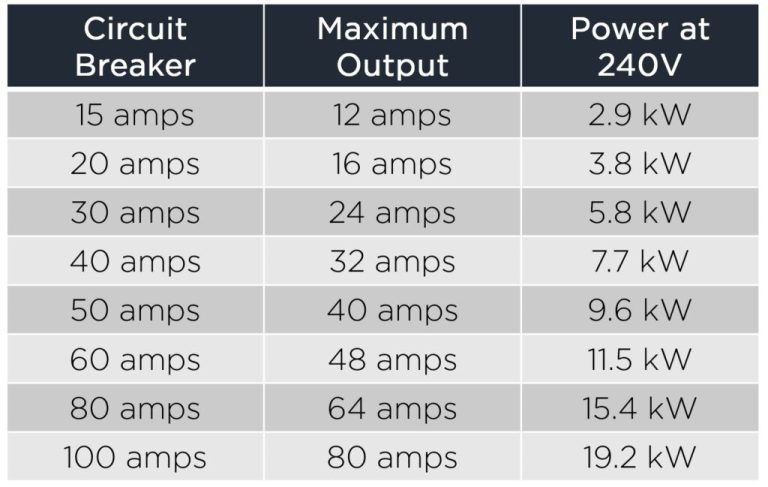
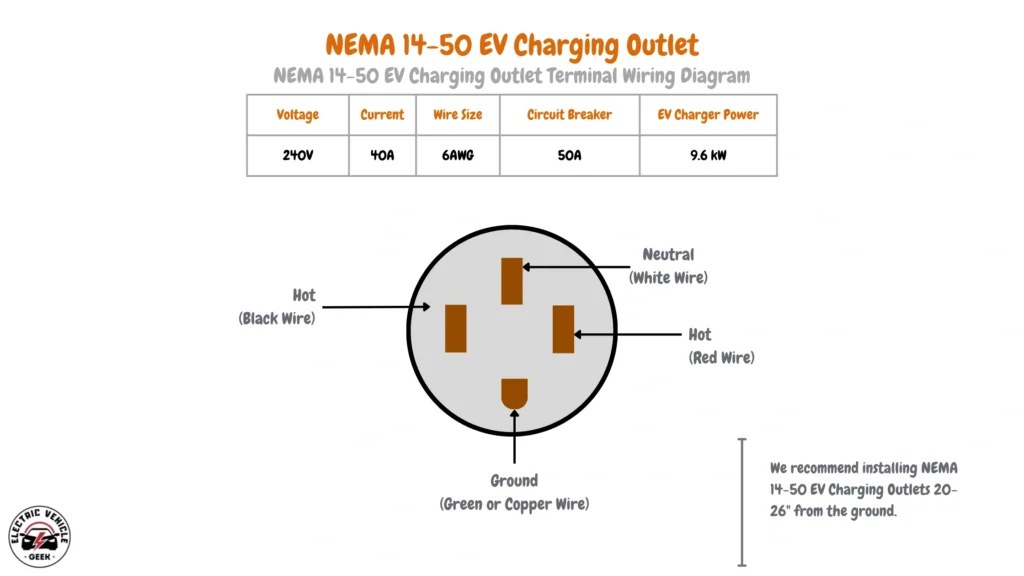
A NEMA 14-50 outlet supplies a 240 V, 50 A circuit that supports 40 A of continuous Level 2 charging — about 9.6 kW at the receptacle. Actual speed still depends on your EVSE setting and your vehicle’s onboard charger, and installation requires a load calculation and permits.
A NEMA 14-50 outlet for EV charging is a 240-volt, 50-amp receptacle that supplies a plug-in Level 2 EVSE. The circuit can support 40 amps of continuous current — roughly 9.6 kW — but how much of that reaches your battery depends on the EVSE setting, your vehicle’s onboard charger, and conditions on the day.
- Compatibility: The 14-50 is the wall side; the vehicle side is J1772 or NACS, and.
- Performance: 40 A continuous is roughly 9.6 kW, but the onboard charger often caps real.
- Safety: Use a dedicated 50 A circuit, verify the EVSE’s safety listing, and stop charging.
- Cost: Installation quotes vary widely with panel distance, permits, trenching, and whether a service upgrade.
NEMA 14-50 Outlet for EV Charging: The Short Answer for US Drivers in 2026
If a 14-50 receptacle already exists in your garage or on your driveway wall, you can plug in a compatible Level 2 EVSE and charge far faster than a standard 120-volt household outlet. If you do not have one, the real question is whether your electrical panel, your parking layout, and your daily mileage justify installing one.
What a NEMA 14-50 Receptacle Provides: 240 V, 50 A, and 40 A Continuous
The NEMA 14-50 is a four-pole receptacle: two hot conductors, one neutral, and one equipment ground. It is rated for a 50-amp branch circuit. Because EV charging is treated as a continuous load, the National Electrical Code limits the load to 80% of the circuit rating — 40 amps.
That 9.6 kW is a ceiling at the receptacle, not a promise at the battery. Charging losses, EVSE settings, and the vehicle’s onboard charger all reduce what actually arrives.
Why It Is Common for Home EV Charging—and What It Is Not
The 14-50 became the default home charging receptacle for practical reasons. It is a four-wire 240-volt circuit that many electricians already know well, it is the same plug pattern used at many RV campgrounds, and a large share of plug-in Level 2 EVSEs ship with a 14-50 plug attached. That combination makes it an easy retrofit for a garage that already has a dryer or range circuit nearby — though “nearby” and “compatible” are different things.
What it is not: it is not a charger. The charger is inside the vehicle. The 14-50 is a power source, and the EVSE is a safety device that negotiates current with the car. It is also not a DC fast charger, not a universal fit for every wall outlet that looks similar, and not automatically safe just because a receptacle is already installed. A 14-30 dryer outlet and an older 10-30 outlet look close enough to cause confusion, and they behave very differently.
Connector Reality: J1772, NACS, and the EVSE Cable
The 14-50 describes the wall side of the connection. The vehicle side is a separate question. Most non-Tesla EVs sold in the US use the J1772 connector for Level 2 AC charging. Tesla-origin vehicles and a growing number of new models use NACS, now standardized as SAE J3400, which handles both AC and DC through one port. CCS1 is a DC-only standard and has no role in a 14-50 setup.
Important: Physical fit alone does not prove every AC or DC charging mode is supported. Check the adapter’s rated current and the vehicle’s approved accessory list.
NEMA 14-50 Compatibility, Adapters, and Charging Limits
NEMA 14-50 vs NEMA 6-50, 14-30, and 10-30: Same Criteria Side by Side
| Receptacle | Wires | Circuit | Continuous EV current | Practical note |
|---|---|---|---|---|
| NEMA 14-50 | Two hots, neutral, ground | 50 A | 40 A (~9.6 kW) | Most common US plug-in EVSE receptacle |
| NEMA 6-50 | Two hots, ground | 50 A | 40 A (~9.6 kW) | Same power; EVSEs do not need the neutral |
| NEMA 14-30 | Two hots, neutral, ground | 30 A | 24 A (~5.8 kW) | Dryer outlet; requires a 24 A EVSE or current-limited adapter |
| NEMA 10-30 | Two hots, neutral, no ground | 30 A | 24 A (~5.8 kW) | Legacy ungrounded dryer outlet; generally not appropriate for EV charging |
The 14-50 and 6-50 deliver the same power. The difference is the neutral, which EV charging does not use. The 14-30 and 10-30 are lower-power and, in the case of the 10-30, lack an equipment ground — a meaningful safety limitation rather than a technicality.
Plug-In EVSE vs Hardwired EVSE: Costs, Power, Weather, and Who Each Fits
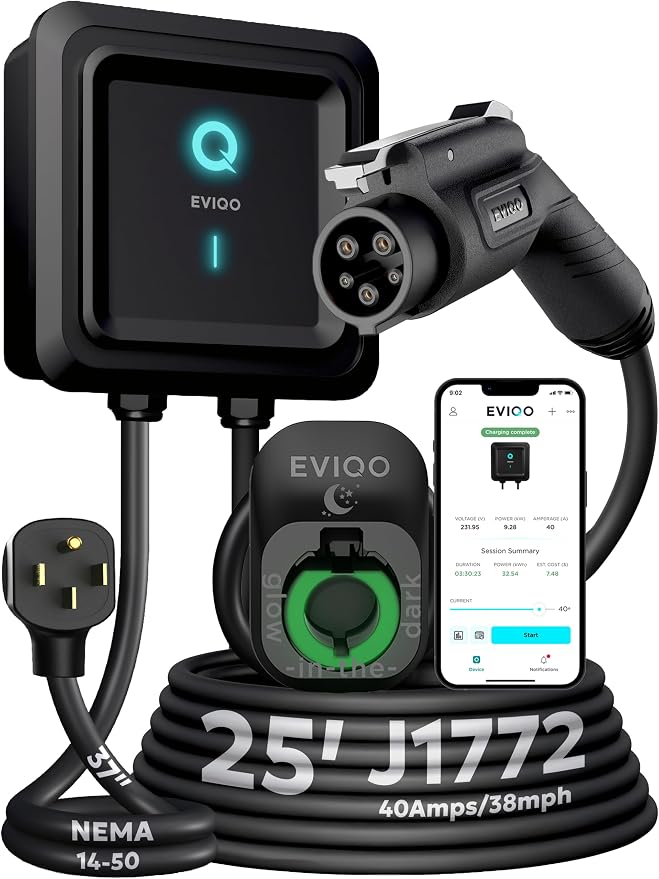
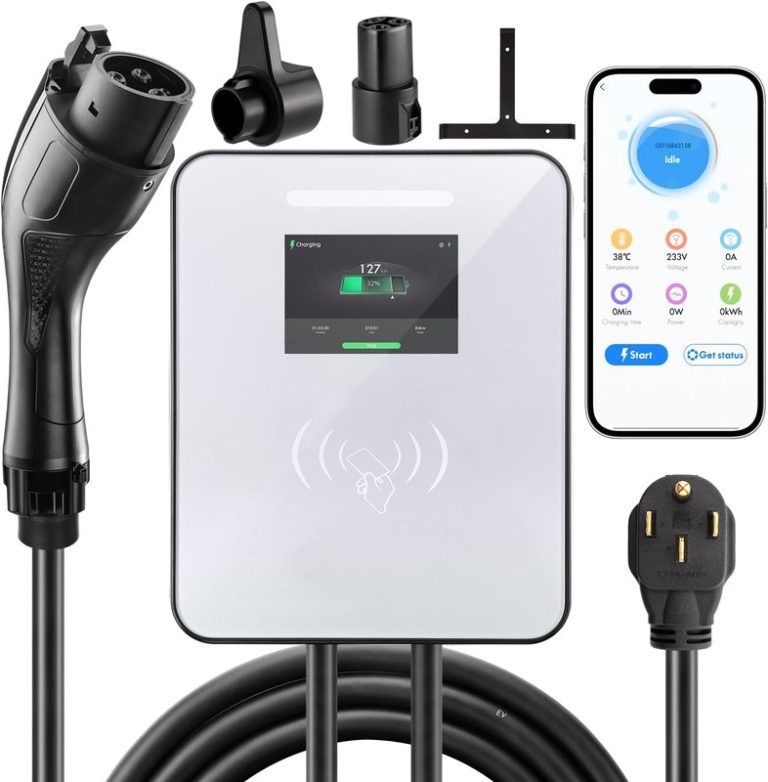
Uses the 14-50 receptacle, caps at 40 A continuous, and can move with you. Many code adoptions require GFCI protection on the receptacle, and the plug-and-receptacle connection is one more wear point.
Connects directly to the circuit and can run higher currents, such as 48 A on a 60 A circuit. Fewer connection points, often better for outdoor mounting, but not portable. See our breakdown of whether a 48 amp EV charger needs a 60 amp circuit.
Vehicle Onboard Charger Limits: Why a 14-50 May Not Mean 50 A to the Battery
The onboard charger converts AC from the wall into DC for the battery, and its rating is the hard ceiling on AC charging speed. Many mainstream EVs are equipped with onboard chargers in the roughly 7.2 kW to 11.5 kW range, and some are lower. If your car has a 7.2 kW onboard charger, a 9.6 kW-capable EVSE will simply be asked to deliver less. Our explainer on whether 40 amps is enough for a Level 2 charger covers how that math plays out in daily driving.
EVSE Amperage and kW: Reading the Spec Sheet Correctly
Three numbers get confused constantly: circuit rating, EVSE output setting, and vehicle acceptance. A 40-amp EVSE on a 50-amp circuit is correctly matched. A 48-amp EVSE on a 50-amp circuit is not — 48 amps exceeds the 80% continuous limit. Power in kW is simply amps multiplied by volts, divided by 1,000, so 40 A at 240 V is 9.6 kW. At 208 V, the same 40 A yields 8.3 kW, which is why apartment and condo buildings sometimes charge slower than expected.
Adapter Direction, Source/Destination Connectors, and AC vs DC Limits
Adapters are directional. A J1772-to-NACS adapter lets a NACS vehicle use a J1772 EVSE. A NACS-to-J1772 adapter lets a J1772 vehicle use a NACS EVSE. Reversing them is not a workaround. Never use a DC adapter on an AC source, and never assume an adapter rated for one current level is safe at a higher one.
Vehicle/Network Restrictions, Power Limits, Thermal Safety, and Firmware/Vendor Requirements
Some vehicles cap AC charging current below what the EVSE offers. Some adapters are only approved by specific manufacturers for specific models. Some EVSEs require a firmware update or an app-based commissioning step before they will deliver full current. Heat is the common thread: a warm receptacle, a warm plug, or a warm adapter is a signal to stop and have the setup inspected, not to push through.
Electrical Requirements, Installation, and Permits for a NEMA 14-50 Outlet
Circuit Breaker, Wiring, and Receptacle: Follow the Product Manual and Local Code
A 14-50 receptacle for EV charging is normally on a dedicated 50-amp, double-pole circuit. Conductor size depends on the conductor type, insulation temperature rating, run length, and voltage drop, so a blanket wire size is not appropriate — 6 AWG copper is common for a 50-amp circuit in many residential installations, but confirm with the manufacturer instructions and your electrician. Our guide to 48 amp EV charger wire size explains how those variables interact.
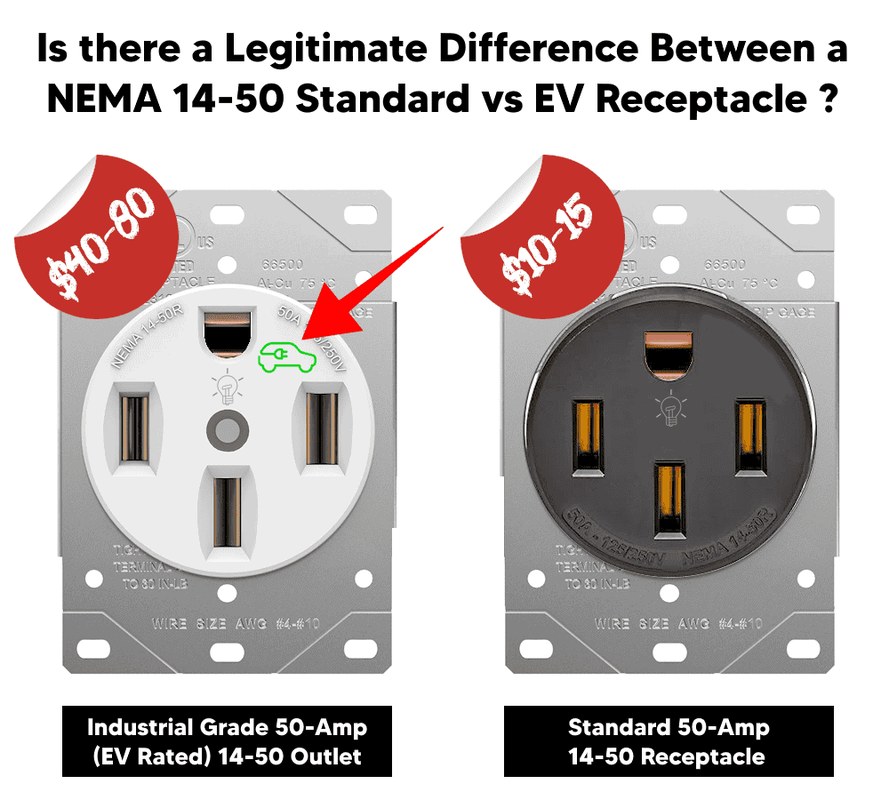
Receptacle quality matters more than most buyers expect. Repeated high-current cycling is harder on a receptacle than a dryer or range load, and some manufacturers recommend heavy-duty receptacles intended for that duty rather than the least expensive option on the shelf.
Panel Capacity, Load Calculations, and Service Upgrade Triggers
Adding a 50-amp circuit is a significant load. A 100-amp service may or may not have room after a load calculation, and a 200-amp service usually does. Triggers for a service upgrade include a panel with no open double-pole spaces, a calculated load that exceeds the service rating, and older panels with known limitations. Load management devices can sometimes avoid an upgrade by reducing EV charging current when the house is drawing heavily, but that is a design decision for a qualified electrician.
Indoor vs Outdoor Installation, Weather Suitability, and GFCI Considerations
Outdoor installations need a weather-resistant receptacle, an appropriate enclosure, and correct orientation so water cannot pool. Recent editions of the NEC require GFCI protection for receptacles installed to supply EVSEs; whether and when that applies to your project depends on the code edition your jurisdiction has adopted. The EVSE itself carries its own enclosure rating, which is separate from the receptacle’s weather protection.
Cable Length, Mounting Height, and Daily Ergonomics
Most plug-in EVSEs come with a cable in the 20 to 25 foot range, but measure your actual parking position rather than assuming. Mount the unit at a height that lets you coil the cable without dragging it on the floor, and plan the cable path so it does not cross a walkway or sit in a puddle.
Permits, Inspections, and Licensed Electrician Questions
Ask any electrician you interview: Will you pull a permit? How did you calculate the load? What receptacle and breaker are you specifying, and why? Is GFCI protection required here? What does the inspection process look like in this jurisdiction? A quote that skips the permit conversation is worth a second look.
Charging Speed, Range, and Efficiency with a NEMA 14-50 Outlet
From Outlet to Battery: EVSE kW, Onboard Charger, and Charging Losses
Energy is lost at each step — in the EVSE, the onboard charger, and the battery itself. Level 2 AC charging losses commonly land somewhere in the 5% to 15% range, though this varies by equipment and temperature. Those losses are why the kWh your utility bills you for is usually higher than the kWh added to the battery.
Miles per Hour Added: Assumptions and a Simple Formula
The formula is straightforward: miles per hour added equals charging power in kW, multiplied by vehicle efficiency in mi/kWh, multiplied by charging efficiency. The example below uses a 9.6 kW EVSE, a vehicle that accepts the full rate, 3.5 mi/kWh, and 90% charging efficiency. These are illustrative numbers, not a prediction for any specific car.
Estimate only. Assumes full vehicle acceptance, 3.5 mi/kWh, and 90% charging efficiency. Real results vary with onboard charger rating, temperature, and battery state.
mi/kWh or Wh/mi Context: Speed, Weather, HVAC, Elevation, Payload, Tires, and Battery Temperature
The mi/kWh figure you plug into that formula is not a constant. Highway speed, cold or hot weather, cabin heating and cooling, elevation change, passengers and cargo, tire pressure and tread, and battery temperature all move it. A vehicle that returns 4.0 mi/kWh in mild spring weather may return 2.8 mi/kWh on a winter highway run. That is a vehicle efficiency change, not a charging problem.
NEMA 14-50 Charging Costs: Electricity, Equipment, and Installation
Electricity Rate and Time-of-Use Pricing
Your marginal rate is what matters, not the average on your bill. Many utilities offer time-of-use plans that make overnight charging cheaper and evening charging more expensive, and some add demand charges for large residential loads. Verify current rates and plan terms with your utility before assuming overnight charging is the cheapest option.
kWh Delivered, Charging Losses, and Cost Formula
Cost equals energy drawn from the grid, multiplied by your effective rate, plus any fixed fees. Energy drawn equals energy added to the battery divided by charging efficiency. The example below uses a hypothetical rate and a 10% loss assumption.
Illustrative math only. Your rate, taxes, fees, time-of-use windows, and actual losses will differ.
Installation and Equipment Cost Ranges: What Changes the Quote
Installation quotes vary enormously because the variables do. Distance from the panel to the receptacle, whether the run is through finished walls, conduit requirements, trenching for a detached garage or pedestal, permit and inspection fees, and whether a service upgrade is needed all move the number. The EVSE itself ranges widely by amperage, cable length, smart features, and weather rating. Get at least two or three local quotes rather than relying on national averages.
When a 14-50 Outlet Beats Hardwiring on Total Cost—and When It Does Not
A 14-50 outlet often wins when you already have a suitable circuit, when you want to take the EVSE with you when you move, or when 40 amps is more than your vehicle can accept anyway. Hardwiring often wins when you need more than 40 amps, when the run is long or outdoor, when you want fewer connection points, or when local rules make GFCI protection on the receptacle expensive or awkward. Our roundup of 48 amp hardwired EV chargers covers the higher-power side of that decision.
Battery Health and Charging Habits When Using a NEMA 14-50 Outlet
Manufacturer Guidance vs General Patterns
Follow your vehicle manufacturer’s guidance first. General patterns about state of charge, daily charging limits, and DC fast charging frequency are useful context, but they are not a substitute for the owner’s manual, which is written for your specific battery system.
State of Charge, Temperature, Charging Power, Chemistry, and Thermal Management
Level 2 charging at 40 amps is a moderate rate for most modern packs, and many owners charge to a manufacturer-recommended daily limit rather than 100%. Battery chemistry and thermal management design differ meaningfully between models, so a habit that suits one vehicle may be unnecessary for another. Extreme ambient temperatures affect charging speed and, over time, battery condition — which is one reason a garage spot is often preferable to an exposed one.
DC Fast Charging Context and Convenience Trade-Offs
A 14-50 outlet is not a substitute for DC fast charging on a road trip, and DC fast charging is not a substitute for the overnight routine a 14-50 enables. Most owners use Level 2 at home for the bulk of their energy and DC fast charging only when traveling or on unusually long days.
Smart Features, Safety, Warranty, and Support for 14-50 EVSE
Smart Charging, Scheduling, Load Management, and Utility Programs
Many plug-in EVSEs offer scheduling, energy reporting, and utility demand-response integration. Ask what happens if the app or cloud service is unavailable — a charger that becomes a dumb charger is fine, but a charger that stops working is not. Check whether any features require a subscription.
Thermal Safety, Adapter Caveats, and Electrical Protection
Verify the EVSE’s safety listing directly from the manufacturer or a certification record rather than inferring it from marketing language. If you use an adapter, confirm it is rated for the current involved and approved for your vehicle. Any heat, discoloration, or burning smell at a plug or receptacle means stop charging and get the circuit inspected.
Warranty, Support, Firmware Updates, and Evidence Limits in Reviews
Warranty terms, US support quality, and firmware update history vary widely between brands and are hard to judge from a spec sheet. Published reviews, including those on this site, generally reflect documentation and owner-reported patterns rather than controlled measurement, so treat performance claims accordingly and verify current specifications close to purchase.
Who Should Choose a NEMA 14-50 Outlet for EV Charging?
Best Fit: Flexible, Moderate-Speed Home Charging for Many US Drivers
A 14-50 outlet is a strong fit for homeowners with garage or driveway parking, a panel that can support a 50-amp circuit, and a vehicle whose onboard charger is at or below roughly 9.6 kW. It is also the practical choice for anyone who wants to move the EVSE to a future home or keep the option open.
Less Ideal: High-Power EVs, Constrained Panels, Renters, and Shared Parking
Hardwiring makes more sense if your vehicle accepts more than 40 amps and you want the extra speed. If your panel cannot support the load, a load management device or a lower-amperage setup may be the realistic path. Renters and shared-parking users often cannot modify the electrical system at all, which makes a standard 120-volt outlet, a landlord-negotiated installation, or public charging the practical answer.
Final Checklist Before Buying an EVSE or Booking an Installation
- Confirm your vehicle’s inlet type and its maximum AC charging rate.
- Decide between plug-in (40 A max) and hardwired (potentially higher).
- Have an electrician run a load calculation before committing to a circuit size.
- Verify the receptacle type, breaker rating, and GFCI requirements in your jurisdiction.
- Measure your parking position and choose cable length accordingly.
- Check the EVSE’s safety listing, weather rating, warranty, and app requirements.
- Confirm whether a permit and inspection are required locally.
- Compare the total cost of the EVSE, installation, and any adapter against your actual daily mileage.
- Best for: Homeowners with garage or driveway parking, a panel that supports a 50 A circuit, and a vehicle that accepts up to about 9.6 kW of AC charging.
- Think twice if: Your EV accepts more than 40 A, your panel is constrained, or you rent and cannot modify the electrical system.
- Next step: Confirm your vehicle’s onboard charger rating and inlet type, then get a load calculation and local quotes before buying an EVSE.
Frequently Asked Questions
A 14-50 receptacle sits on a 50-amp circuit, and continuous loads are limited to 80% of the circuit rating, so the maximum continuous charging current is 40 amps. At 240 volts that works out to about 9.6 kW at the receptacle, before charging losses and before any limit imposed by the vehicle’s onboard charger.
Those are different receptacles. A dryer outlet is usually a NEMA 14-30 (30-amp circuit, 24 amps continuous) or an older NEMA 10-30, which lacks an equipment ground. A 14-50 EVSE will not physically fit either one, and using an adapter to force a fit creates current and grounding problems. Use an EVSE rated for the circuit you actually have, or have a dedicated circuit installed.
Recent editions of the National Electrical Code require GFCI protection for receptacles installed to supply EVSEs, but adoption varies by state and local jurisdiction, and the requirement can differ depending on whether the EVSE is plugged in or hardwired. Confirm the current rule with your local permitting authority or a licensed electrician before the work begins.
Neither is universally better. A 14-50 outlet caps you at 40 amps continuous but is portable and often cheaper if a suitable circuit already exists. Hardwiring allows higher current, such as 48 amps on a 60-amp circuit, reduces connection points, and is often preferred for outdoor or long cable runs. The right answer depends on your vehicle’s onboard charger and your panel capacity.
The most common reason is the vehicle’s onboard charger, which converts AC to DC and sets the ceiling for AC charging. Other factors include the EVSE’s configured output setting, supply voltage (208 V in some multi-unit buildings instead of 240 V), cold or hot battery temperature, and the vehicle tapering current as the battery fills.
Adapters exist in both directions, and direction matters. A NACS-to-J1772 adapter lets a J1772 vehicle use a NACS EVSE, and a J1772-to-NACS adapter does the reverse. Confirm the adapter is rated for the current involved and approved for your specific vehicle, and never use a DC-rated adapter on an AC source or vice versa.