EV Charger Installation Requirements: What You Need to Know
Home EV charger installation requires a dedicated 240 V circuit with adequate panel capacity, the right connector for your car, and an EVSE your vehicle’s onboard charger can actually use. The main limitation is your electrical service and local permit rules, so verify both with a licensed electrician before buying equipment.
EV charger installation requirements come down to four practical questions: does your electrical panel have capacity for a dedicated circuit, what connector does your car use, how much AC power can your vehicle actually accept, and what do your local code, permit, and inspection rules require? Get those four right, and everything else — amperage, cable length, weather rating, smart features — falls into place.
- Compatibility: Match the connector (J1772 or NACS/J3400) to your vehicle’s AC inlet and confirm adapter.
- Performance: Your onboard charger caps AC speed, so a higher-amperage EVSE only helps if the.
- Safety: Breaker, conductor, and installation requirements come from the manufacturer’s instructions plus your local code.
- Cost: Budget for the EVSE, electrical work, permits, possible panel upgrades, and charging losses on.
The Short Answer: Core EV Charger Installation Requirements
Every home installation has to satisfy four layers of requirements at the same time: the electrical supply (panel capacity, a dedicated circuit, correct overcurrent protection and conductors), the equipment (the EVSE manufacturer’s own installation instructions and safety listing), the vehicle (connector type and onboard charger limit), and the jurisdiction (permits, inspections, and local amendments to the electrical code). If any one of those is wrong, the result is unsafe, non-compliant, or simply slower than you expected.
Electrical Capacity, Dedicated Circuit, and Permits
Level 2 charging in the US typically runs on a 240 V dedicated branch circuit. EV charging is treated as a continuous load, so the circuit generally must be sized larger than the charger’s rated output current — the common pattern is 125% of the continuous charging current — though the exact requirement depends on the code edition your jurisdiction has adopted and on the equipment instructions. “Dedicated” means nothing else shares it: no garage outlets, no lighting.
Permits are local. Many US jurisdictions require an electrical permit and inspection for a new 240 V circuit, and some require utility notification as well. Others allow homeowner permits in limited cases. The only reliable answer comes from your local building or electrical department.
Plug-In vs. Hardwired: What Your Manual and Local Code Require
Both approaches can be code-compliant. The deciding factors are the EVSE’s instructions, the amperage you want, and what your local code permits.
Uses a specific receptacle type, so output is usually capped and portability is the main benefit. Receptacle installations often require GFCI protection under current NEC editions.
Connected directly to the circuit, which supports higher continuous output and removes the receptacle from the equation. Typically installed by a licensed electrician.
Verify both paths against the equipment manual and your local authority before buying, because the receptacle type and the amperage setting are tied together.
Connector Type and Vehicle Onboard Charger Limits
The connector must match your vehicle’s AC inlet — J1772 or NACS/SAE J3400 for Level 1 and Level 2 AC charging. Separately, your car’s onboard charger sets a ceiling no wall unit can exceed. Buying a 48 A EVSE for a vehicle that accepts 7.2 kW on AC means paying for capacity you may never use.
EVSE Amperage, kW, and Vehicle Onboard Charger Limits: Matching Charger to Car

Understanding EVSE Amperage and kW Ratings
An EVSE rating describes what the equipment can deliver, not what your car will accept. Output current is set by the unit — often through dip switches, a rotary dial, or the app — and must be supported by the circuit behind it. Approximate power is simple math: amps × volts. A 40 A EVSE on a 240 V supply works out to roughly 9.6 kW at the equipment level. For the full breakdown, see how many kilowatts a 48-amp Level 2 charger actually delivers.
Keep three numbers separate: the EVSE’s maximum output, the circuit’s capacity, and the vehicle’s acceptance rate. A 48 A charger on a 60 A circuit still only gives your car what the car asks for.
Why Your Vehicle’s Onboard Charger Caps AC Charging Speed
AC charging happens inside the car. The EVSE is essentially a smart, safety-controlled switch that signals how much current is available; the vehicle’s onboard charger converts AC to DC and manages the pack. The real ceiling is the lower of the two values. Many mainstream EVs accept roughly 7.2–11 kW on AC, and some accept less. If your car maxes at 7.2 kW, a 48 A unit and a 32 A unit can produce similar results. Whether 40 amps is enough for Level 2 charging depends entirely on that onboard limit and your daily mileage.
Plug-In vs. Hardwired: Power and Code Implications
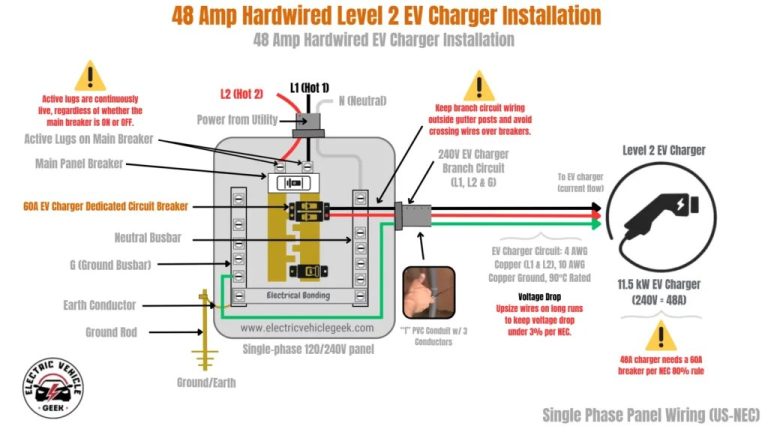
Higher-output EVSEs are commonly hardwired, because a 48 A continuous load needs a 60 A branch circuit and conductors sized for it — a combination plug-in receptacles rarely support. Plug-in units are typically limited by the receptacle type they use. The equipment instructions and local code decide what is permitted, not the product page.
Circuit, Panel, and Wiring: What a Licensed Electrician Must Verify
Load Calculation and Panel Capacity
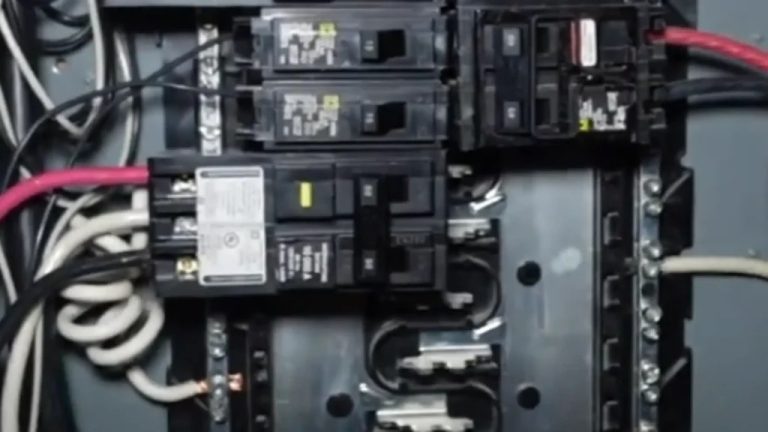
A licensed electrician performs a load calculation on the whole service, not just the new circuit. Current NEC editions include optional methods that can account for energy management systems, and some utilities and jurisdictions accept load-management devices that reduce the calculated load. Panel bus rating, available breaker spaces, and service size all matter. A 100 A service can sometimes support a Level 2 circuit and sometimes cannot — that is a field determination, not a web determination.
Breaker and Wire Sizing: Follow the Manual, Not Guesswork
Breaker size, conductor size, and conductor type come from the EVSE manufacturer’s instructions plus the applicable code. The common pattern is a breaker sized at 125% of the continuous charging current with conductors matched to it, adjusted for temperature and conduit fill. Copper versus aluminum, NM-B versus THHN in conduit, and run length all change the answer. Our guides to 48-amp EV charger wire size and whether a 48-amp EV charger needs a 60-amp circuit walk through those relationships in more detail.
Permit and Inspection Steps in the U.S.
Typical sequence: confirm local requirements, pull the permit, complete the work, schedule the inspection, then energize. Some utilities require notification or separate approval for a new large 240 V load. Rebate and utility programs often require documentation from a licensed installer, so ask before work begins rather than after.
Connectors, Adapters, and Compatibility for U.S. EV Charging
J1772, NACS, and CCS: Source and Destination Connectors
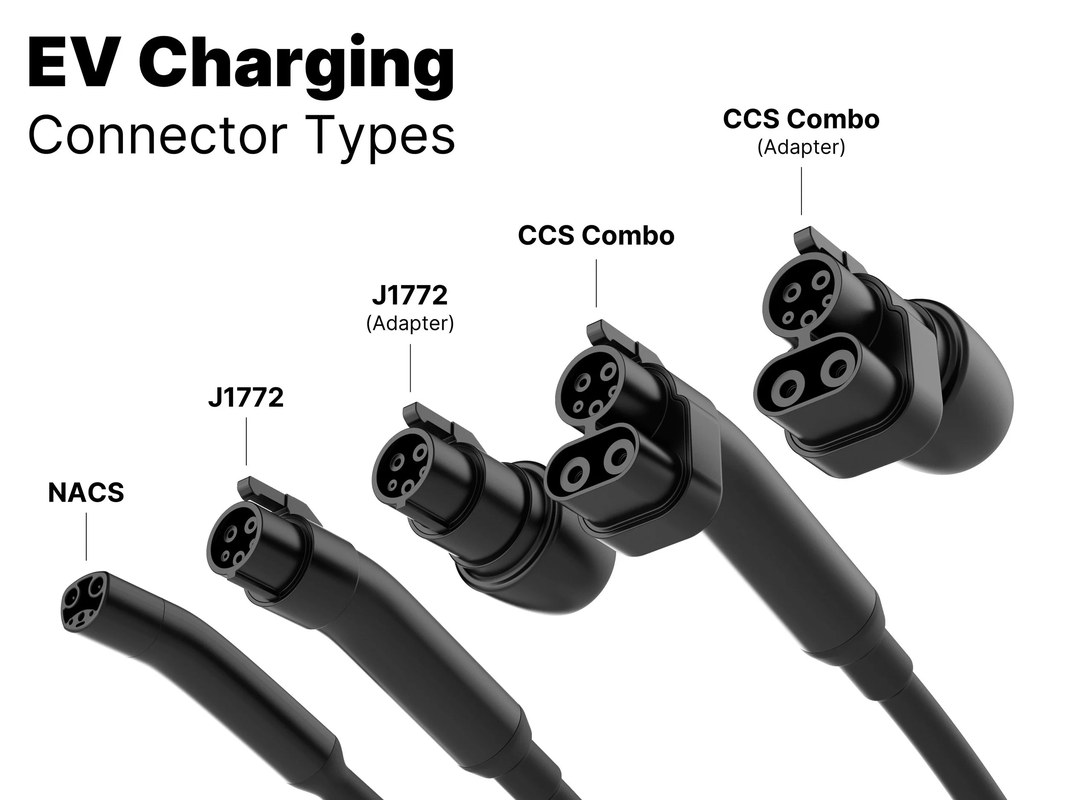
Think in terms of which side of the cable you are changing. J1772 is the long-standing US AC connector. NACS, standardized as SAE J3400, now appears on many newer US EVs for both AC and DC charging. CCS1 is a DC fast-charging connector built around the J1772 AC pin layout — a CCS1 vehicle AC charges on a J1772 connector and DC fast charges on CCS1.
Important: Physical fit alone does not prove every AC or DC charging mode is supported.
Adapter Direction, AC/DC Mode, and Power Limits
Passive AC adapters — for example, a NACS-to-J1772 adapter used for AC charging — mainly re-route pins. DC adapters are generally active devices with electronics, thermal management, and firmware, and are typically approved only for specific vehicle and charger combinations. Direction matters: the part that lets a NACS car use a J1772 charger is not the same part that lets a J1772 car use a NACS charger.
Vehicle and Network Restrictions, Thermal Safety, and Firmware
Even with a correct adapter, the vehicle may limit power, refuse the session, or require a software update. Charging networks may restrict adapter use, and some DC adapters require registration or a minimum firmware version. Adapters warm up during high-power sessions; if a connector or adapter becomes unusually hot, stop charging and check the manufacturer’s guidance. Never use a damaged or uncertified adapter.
Cable Length, Weather Suitability, and Smart Features
Cable Length and Mounting Location
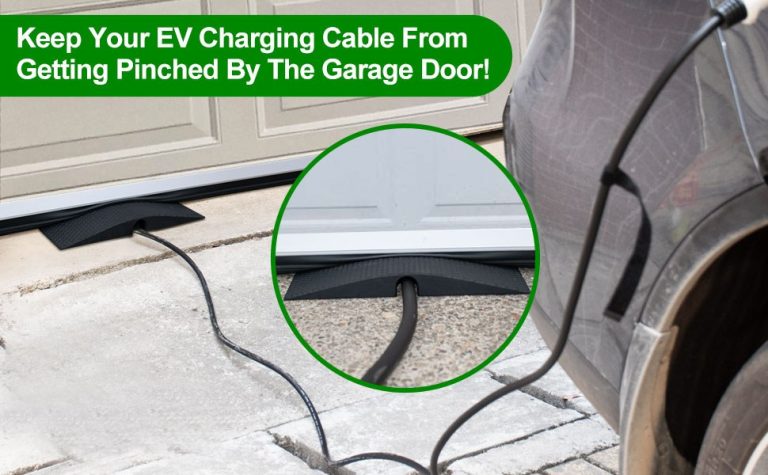
Measure from the actual parking position, not the garage door. Cable lengths vary by product, so verify the specific model rather than assuming a standard. Plan the mount so the cable reaches the charge port without crossing a walkway, and consider holster height and strain relief at the connector.
NEMA Ratings and Outdoor Installation
Outdoor suitability depends on the enclosure rating the manufacturer actually lists — commonly NEMA 4 or 4X for outdoor-capable units — plus operating temperature limits and connector storage guidance. A weather-rated EVSE still needs correct installation, and some manufacturers require the connector to sit in a holster rather than on the ground.
Smart Features, Wi-Fi, and Load Management
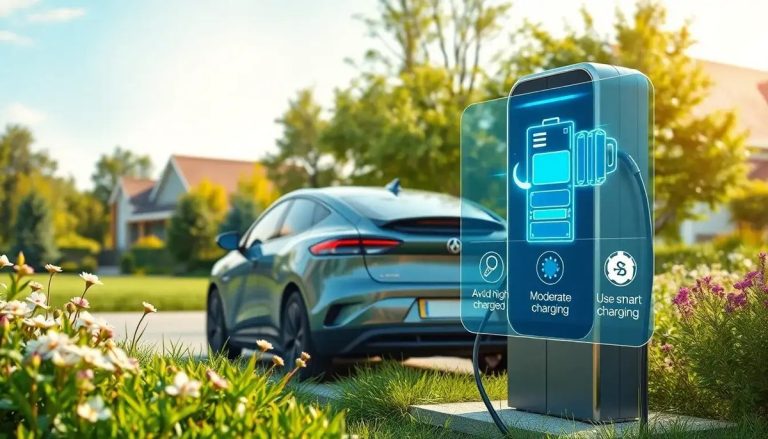
App control, scheduling, and utility demand-response programs can reduce costs, but they add dependencies: Wi-Fi coverage at the mounting point, an account, firmware updates, and cloud availability. Ask what the unit does when the internet is down — a good design should still charge at a default or scheduled rate. Load management hardware can allow a larger EVSE on a smaller service, but only where local code and the utility accept it.
Installation Costs and Charging Costs: Assumptions and Formulas
Equipment and Installation Cost Ranges (with assumptions)
Total cost has four parts: the EVSE, the electrical work, any panel or service upgrade, and permits. Equipment prices vary by output, cable length, and features. Installation cost depends mostly on run length, whether the circuit runs through finished walls, whether a subpanel or service upgrade is needed, and local labor rates. Rather than quoting a national figure that goes stale quickly, get two or three local quotes that itemize the circuit, conductors, permit, and any panel work. A long, difficult run can cost more than the charger itself.
Electricity Rate, kWh Delivered, and Charging Losses
The formula: charging cost = energy delivered to the battery ÷ charging efficiency × your all-in electricity rate. AC charging loses some energy in the onboard charger and as heat, so the kWh billed at the meter is usually higher than the kWh added to the battery. That difference commonly falls in the 5–15% range for Level 2 AC charging, but it varies with equipment and conditions.
Illustrative math only. Your rate, taxes, fees, time-of-use windows, and losses will differ; verify current rates with your utility.
Time-of-Use Pricing and Total Cost per Mile
If your utility offers time-of-use rates, overnight charging can be far cheaper than peak-hour charging, and demand charges on some plans change the math entirely. To get cost per mile, divide your all-in cost per kWh (including losses, taxes, and fees) by your vehicle’s mi/kWh. A car returning 3.5 mi/kWh at $0.15/kWh all-in works out to roughly 4.3 cents per mile — substitute your own numbers.
Battery Health, Charging Power, and Convenience Trade-Offs
Manufacturer Guidance vs. General Patterns
Follow your vehicle manufacturer’s charging guidance, which is written for your specific battery system. There is no universal 80% rule that applies to every EV, and no benefit to chasing a number your manual never mentions.
Temperature, State of Charge, and DC Fast Charging Context
Battery temperature and state of charge affect how much power the car accepts, especially at the extremes of the range and in cold weather. DC fast charging is a different mode with different stresses; frequent DC sessions in extreme temperatures are generally harder on cells than routine Level 2 charging, though modern thermal management has narrowed that gap considerably.
Chemistry, Thermal Management, and Daily Convenience
LFP packs and nickel-based packs behave differently, and liquid-cooled packs handle heat better than passively cooled designs. For most owners the practical question is simpler: does overnight Level 2 charging cover tomorrow’s driving? If yes, additional charging speed is mostly convenience, not necessity.
Charging Losses, mi/kWh, and Real-World Efficiency
Treat efficiency figures as estimates. Speed, temperature, HVAC use, elevation, payload, tire condition and pressure, and battery state all move the number, and charging losses sit on top of driving efficiency. Two identical cars in different climates can post very different mi/kWh.
Warranty, Support, and a Step-by-Step Installation Checklist for 2026
What to Check in the Warranty
Look for the US warranty term, what it covers (unit only versus installation), whether outdoor installation affects coverage, whether commercial use is excluded, and how long the cable and connector are covered. Confirm the safety listing on the unit label or in the certification record rather than trusting marketing language.
Support and Firmware Updates
Check whether firmware updates are automatic or manual, whether the app is required for basic charging, what happens if the company discontinues cloud service, and whether phone support operates in your time zone. A charger that still works without an account is a real long-term advantage.
Pre-Installation Assessment and Professional Installation
Before anyone drills holes: photograph the panel, note the service size, measure the cable run, confirm the mounting location, and verify the required breaker and conductor sizes from the manual.
- Confirm your vehicle inlet and AC versus DC compatibility
- Check the vehicle’s maximum AC charging capability
- Verify EVSE amperage, voltage, and circuit requirements
- Confirm cable length, mounting, and indoor/outdoor suitability
- Verify safety listing, warranty, app requirements, and support
- Budget for installation, adapters, permits, and electricity
Post-Installation Testing and Registration
After the inspection passes: confirm the EVSE powers up, set the output current to match the circuit, run a short charging session, and verify the vehicle reports the expected power level. Check the connector and adapter for warmth after a while — warm is normal, hot is not. Then register the product for warranty, connect the app if you want scheduling, and submit any utility or rebate paperwork.
Frequently Asked Questions
Often yes, but it depends on your jurisdiction. Many US cities and counties require an electrical permit and inspection for a new 240 V circuit, while others have different thresholds or allow limited homeowner permits. Contact your local building or electrical department, since code adoption and permitting rules vary by location.
Some homeowners do install plug-in units on an existing, correctly rated receptacle where local rules allow it. New 240 V circuits, hardwired installations, panel work, and anything involving load calculations are safety-sensitive and generally require a licensed electrician plus a permit. Follow the manufacturer’s instructions and applicable code rather than improvising.
It depends on the EVSE’s rated output current and its installation instructions. The common pattern is a breaker sized at 125% of the continuous charging current, so a 40 A charger typically pairs with a 50 A circuit and a 48 A charger with a 60 A circuit. Confirm the exact requirement in your manual and with your electrician.
No. AC adapters are generally passive and depend on the vehicle and EVSE combination, while DC adapters are usually active devices approved only for specific vehicles and chargers. Direction matters, and some vehicles or networks restrict adapter use entirely. Check the adapter manufacturer and your vehicle maker’s guidance first.
There is no reliable national number, because cost depends on cable run length, wall construction, panel capacity, whether a service upgrade is needed, permit fees, and local labor rates. Equipment price is separate. Get two or three local quotes that itemize the circuit, conductors, permit, and any panel work.
Only if your vehicle’s onboard charger can accept the higher current. If the car’s AC limit is lower than the EVSE’s output, the extra capacity goes unused. Charging speed also depends on battery state of charge, temperature, and charging losses, so real session times rarely scale in a straight line.