EV Charger Wire Size Chart: Amps, AWG, and Breaker Guide
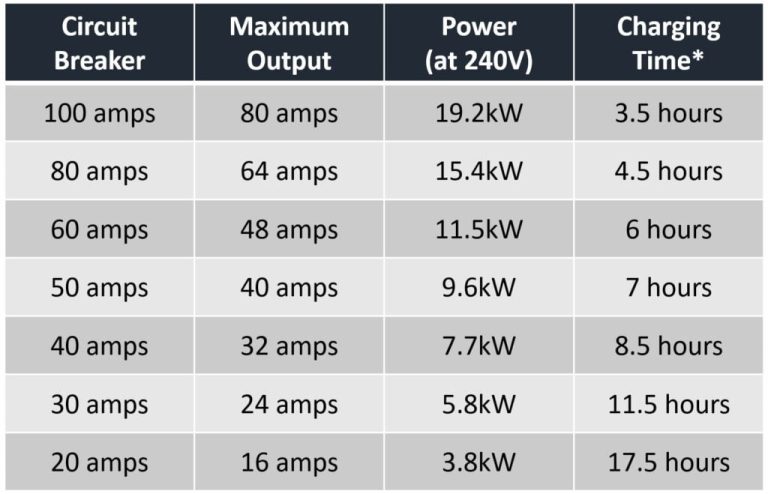
An EV charger wire size chart maps Level 2 EVSE amperage to a typical breaker and copper AWG using the 125% continuous-load rule — for example, 48 A on a 60 A breaker with 6 AWG copper. The chart is a planning reference only; your EVSE manual, panel capacity, run length, and local code decide the final install.
An EV charger wire size chart is the fastest way to translate a Level 2 charging amperage into the copper conductor, circuit breaker, and receptacle or hardwire setup an electrician will actually install. The catch is that the chart is a starting point, not a permit — your equipment instructions, panel capacity, run length, and local code adoption decide the final number.
- Compatibility: Match wire and breaker to the EVSE’s rated output, not the vehicle’s onboard-charger limit.
- Performance: A bigger EVSE will not charge faster than the car’s onboard AC charger allows.
- Safety: Continuous-load rules require 125% sizing — 48 A EVSE on a 60 A breaker.
- Cost: Long runs, hot environments, and panel upgrades can push wire size and total cost.
EV Charger Wire Size Chart: Quick Answer for Common Amperages
Why There’s No Universal Wire Size (Manual and Local Code First)
Two homes with the same 48-amp EVSE can legally end up with different wire because conductor sizing depends on the equipment listing, the insulation temperature rating, ambient temperature, conduit fill, and how your local authority has adopted the National Electrical Code (NEC). The manufacturer’s installation manual and the authority having jurisdiction (AHJ) always override a generic chart.
Treat any published table — including the one below — as a planning reference. Confirm final sizing with a licensed electrician who can read your panel label, measure the run, and apply the code edition your city or county enforces.
Typical AWG and Breaker Sizes for 16A to 80A EVSE
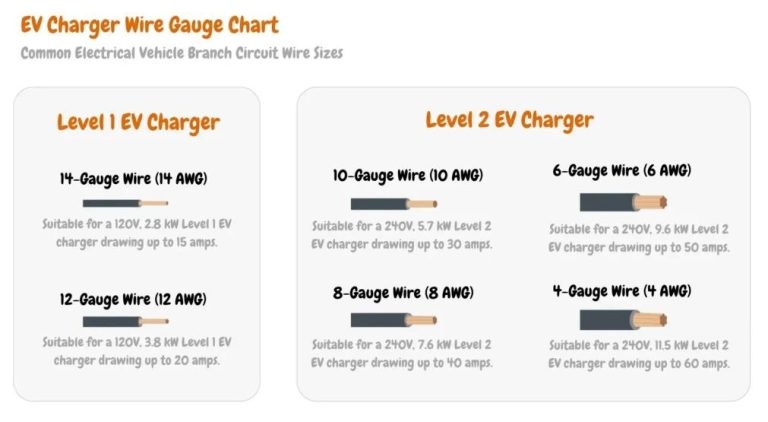
The values below reflect common 75°C copper conductor ampacities and the continuous-load rules most US jurisdictions apply to EVSE circuits. They assume a normal-length run, copper conductors, and no unusual derating.
| EVSE output | Typical circuit / breaker | Typical copper AWG (75°C) |
|---|---|---|
| 16 A | 20 A | 12 AWG |
| 24 A | 30 A | 10 AWG |
| 32 A | 40 A | 8 AWG |
| 40 A | 50 A | 8 AWG (6 AWG for long runs) |
| 48 A | 60 A | 6 AWG |
| 80 A | 100 A | 3 AWG |
If you want a deeper breakdown of the 48-amp case, see our guide to 48 amp EV charger wire size. For the 40-amp scenario, the same logic is covered in what size wire for a 40 amp EV charger.
Copper vs. Aluminum: What the Chart Doesn’t Tell You
Aluminum conductors are permitted in many feeder and branch-circuit applications, but they need roughly two AWG sizes larger than copper for the same ampacity, plus an antioxidant compound and a torque wrench at terminations. Many EVSE terminals are only listed for copper, so check the manual before assuming aluminum is an option.
Aluminum can make sense for a long subpanel feeder. It rarely makes sense for the final EVSE whip, where copper’s smaller bend radius and broader termination compatibility usually win.
How to Read an EV Charger Wire Size Chart (Amps, AWG, Breaker)
The 80% Rule and 125% Breaker Sizing for Continuous Loads
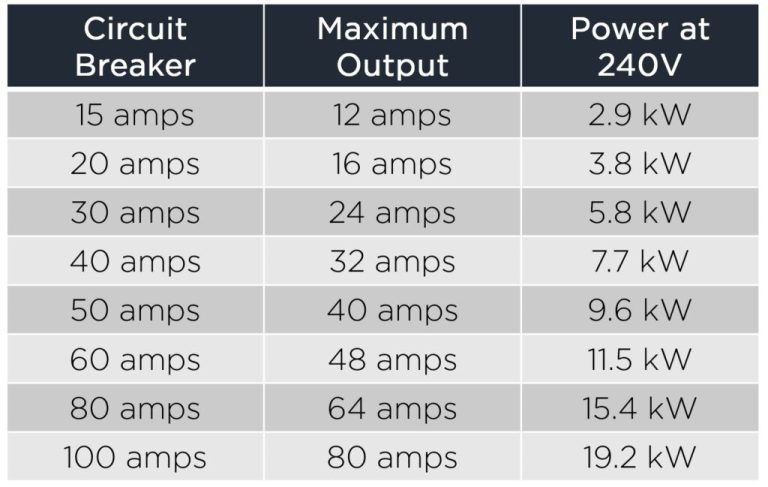
EV charging is treated as a continuous load because sessions routinely run three hours or more. Under NEC continuous-load rules, the branch circuit and overcurrent device must be sized at 125% of the EVSE’s rated output. That is why a 48-amp charger sits on a 60-amp breaker, not a 50-amp one.
The inverse is the “80% rule”: a 60-amp circuit can continuously deliver 48 amps. If your EVSE lets you dial down the current, you can legally install a higher-rated unit on a smaller circuit and set it to the lower amperage — but only if the manual explicitly permits that configuration.
Voltage Drop, Distance, and Derating Factors
Long runs add resistance, which shows up as voltage drop and heat. A common design target is to keep voltage drop under about 3% on the branch circuit, which may push you one AWG size larger than the ampacity table alone would suggest. A 100-foot run to a detached garage is a very different job from a 15-foot run inside the same wall.
Derating also matters. Bundled conductors in a hot attic, conduit filled near capacity, or an ambient temperature above the table’s baseline all reduce the conductor’s usable ampacity. These are the reasons a chart number and a real installation number sometimes disagree.
Insulation Temperature Ratings and Conduit Fill
Conductors are rated 60°C, 75°C, or 90°C, and the ampacity you can use depends on the weakest link in the chain — the conductor, the terminal, and the breaker. Most modern EVSE terminals are rated 75°C, so the 75°C column is the common planning reference.
Conduit fill matters too. Once you exceed the fill thresholds in the code, you must derate ampacity, which can force a larger wire. Leave room in the conduit for future pulls and heat dissipation.
Wire Size by EVSE Amperage: Level 2 Charging Scenarios
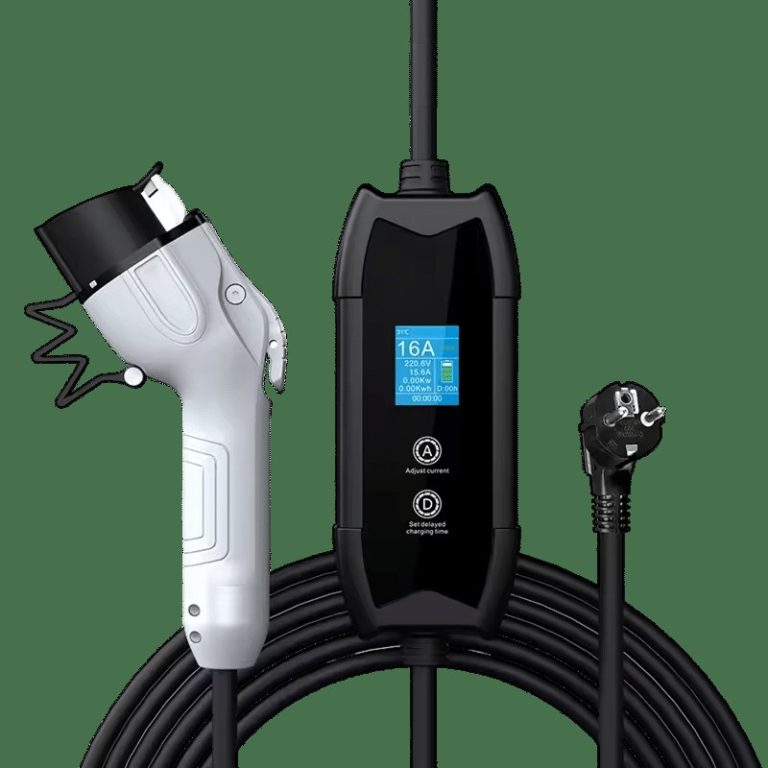
16A to 32A Plug-in Chargers: NEMA 14-50 and 6-20
Portable Level 2 chargers often ship with a NEMA 14-50 or 6-20 plug. A 32-amp unit on a 14-50 plug is common, but the 14-50 receptacle itself is rated 50 amps, so the circuit, breaker, and wire must support 40 amps of continuous draw. A 6-20 setup tops out around 16 amps and is often the easiest retrofit for older garages.
Plug-in units trade a bit of safety margin and code flexibility for portability. Hardwired installs typically allow higher amperage and avoid receptacle wear.
40A to 48A Hardwired Chargers: 6 AWG vs. 4 AWG
This is the sweet spot for most US homes. A 48-amp hardwired charger on a 60-amp circuit usually calls for 6 AWG copper at 75°C. If the run is long, in a hot environment, or you want headroom, 4 AWG is a common upgrade.
Our article on whether a 48 amp EV charger needs a 60 amp circuit walks through the math. For the breaker side, see 40 amp EV charger breaker size.
80A and Higher: Subpanel or Service Upgrade?
An 80-amp EVSE needs a 100-amp circuit and 3 AWG copper, which is a serious load for most 200-amp residential services. If the panel is already crowded with electric range, dryer, heat pump, and AC, a load calculation may force a subpanel or a service upgrade.
Some utilities offer managed-charging programs that cap the EVSE’s draw during peak periods, which can reduce the service impact. Verify current program terms with your utility before designing around them.
Circuit Breaker, Panel, and Connector Requirements
Load Calculation and Panel Capacity for EV Charging
A load calculation compares your existing connected load against the service rating. EVSE is added as a continuous load, and the result tells you whether the panel can absorb it. A 200-amp service with gas appliances often has room; an all-electric home with a 100-amp service usually does not.
NEMA 14-50 vs. Hardwired: Receptacle, Connector, and Safety
A NEMA 14-50 receptacle is convenient and familiar, but it is a 50-amp device that is often used for a 40-amp continuous load. Hardwiring removes the plug-and-receptacle interface entirely, which eliminates a common heat and wear point and typically allows higher continuous current.
Uses a receptacle such as NEMA 14-50 or 6-20. Portable, easier to move, but limited by plug and receptacle ratings and subject to wear.
Direct connection to the branch circuit. Typically supports higher continuous amperage, fewer failure points, and a cleaner outdoor install.
Cable Length, Weather Suitability, and Installation Location
Choose cable length based on where the vehicle actually parks, not where the charger looks best on the wall. Extra length adds cost and can create trip hazards or strain on the connector. For outdoor installs, verify the enclosure rating, the operating temperature range, and the manufacturer’s connector storage guidance.
Vehicle Onboard Charger Limits and EVSE Amperage
Why Your Car May Not Accept the Full EVSE Amperage
The EVSE is the wall-mounted supply; the onboard charger lives inside the vehicle and converts AC to DC for the battery. If the car’s onboard charger is rated 11 kW, a 48-amp EVSE and an 80-amp EVSE will both deliver roughly the same peak rate to that car. Buying a bigger EVSE does not raise the vehicle’s limit.
Before sizing wire, confirm the vehicle’s maximum AC acceptance rate in its manual. That number, not the EVSE nameplate, determines your real-world charging speed.
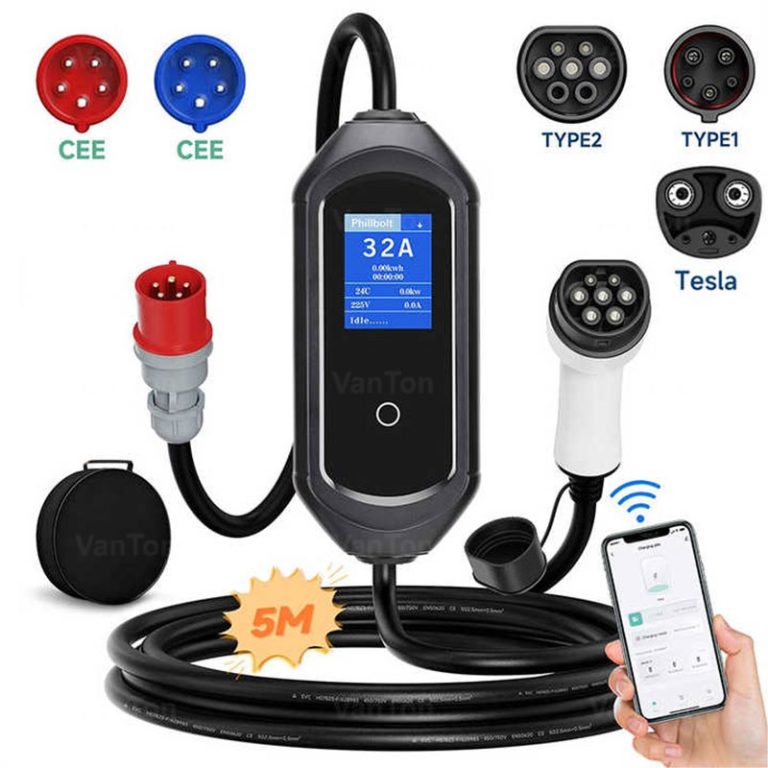
Connector Types (J1772, NACS) and Adapter Direction
Most Level 2 charging in the US happens on J1772 or NACS / SAE J3400 connectors. Adapters exist in both directions, but adapter direction is not symmetric — an AC adapter and a DC adapter are different products with different electrical paths.
Important: Physical fit alone does not prove every AC or DC charging mode is supported.
Adapter Safety: AC vs. DC, Power Limits, Vehicle/Network Restrictions, and Firmware
Adapters must match the charging mode, the vehicle’s inlet, and the EVSE or network’s rules. Some networks restrict third-party adapters; some vehicles require a firmware update before a new connector type is recognized. Never force a connector, and never use a DC adapter for AC charging or vice versa.
If an adapter overheats, trips a fault, or is not listed for the amperage you are pulling, stop and consult the vehicle and adapter manufacturer. Adapter safety is a thermal and protocol issue, not just a plug-shape issue.
Installation Costs, Permits, and Code Compliance
What Electricians Check: Load Calc, Permit, and Inspection
A qualified electrician will run a load calculation, verify panel busbar and main breaker ratings, confirm grounding and bonding, check for GFCI requirements where applicable, and pull the permit. Inspection typically happens before the circuit is energized or immediately after.
Cost Breakdown: Equipment, Labor, Permits, Panel Upgrades
Total cost depends on four buckets: the EVSE itself, the branch-circuit labor and materials, permits and inspection fees, and any panel or service upgrade. A short run near the panel is the cheapest scenario; a detached garage, a long trench, or a service upgrade changes the math dramatically.
Because prices vary by region and change over time, get at least two local quotes and ask each contractor to itemize the wire, breaker, conduit, permit, and labor lines separately.
Smart Features, Warranty, and Support Considerations
Smart EVSEs add scheduling, load management, utility integration, and usage reporting. Those features depend on the app, the account, and the cloud service — so check what happens if the app is discontinued or the Wi-Fi drops. Also verify the safety listing, the US warranty term, and how support is handled.
Charging Costs and Efficiency: Beyond Wire Size
Charging Cost Formula: Electricity Rate × kWh ÷ Charging Efficiency
The basic formula is: cost = electricity rate × energy added (kWh) ÷ charging efficiency. Level 2 AC charging typically loses some energy to heat and onboard conversion, so the wall meter usually reads a bit more than the battery receives.
Replace the example values with your utility rate and measured energy. Rates, taxes, time-of-use pricing, demand charges, and losses vary.
Time-of-Use Pricing and Installation Cost Amortization
Time-of-use plans can cut the per-kWh cost of overnight charging substantially, but they sometimes raise peak-hour rates. Compare your actual driving and charging window against the plan’s schedule before switching. Amortizing the installation cost over several years of fuel savings is a common way to judge whether a higher-amp install pays off.
Range and Efficiency: mi/kWh, Speed, Weather, HVAC, Elevation, Payload, Tires
Wire size does not change vehicle efficiency, but it does change how quickly you can replace energy. Real-world mi/kWh depends on speed, temperature, HVAC use, elevation change, payload, tire pressure and tread, and battery state. Cold weather and highway speeds are the two biggest range reducers for most US drivers.
Battery Health and Charging Power: What to Know
Manufacturer Guidance vs. General Patterns for SOC, Temperature, and Chemistry
There is no universal state-of-charge rule that fits every EV. Manufacturers publish guidance in the owner’s manual, and that guidance varies by chemistry, thermal management design, and model year. Some packs are happiest in a middle SOC band for daily use; others are less sensitive. Follow the vehicle manual first.
DC Fast Charging Context, Thermal Management, and Convenience Trade-offs
DC fast charging bypasses the onboard charger and delivers power directly to the pack, which is why it is much faster than any Level 2 setup. Frequent DC sessions can add thermal stress on some packs, but modern thermal management systems are designed to handle them. For most owners, the convenience of DC fast charging on road trips outweighs the battery-health trade-off.
- Best for: Homeowners planning a dedicated Level 2 circuit who want a realistic starting point before talking to an electrician.
- Think twice if: Your panel is near capacity, your run is long, or your EVSE manual specifies unusual conductor or breaker requirements.
- Next step: Confirm your vehicle’s onboard-charger limit, then have a licensed electrician run a load calculation and size the wire to your actual install conditions.
Frequently Asked Questions
A 48-amp EVSE typically uses 6 AWG copper conductors on a 60-amp circuit at 75°C. Long runs, high ambient temperatures, or conduit derating can push that to 4 AWG. Always confirm against the EVSE manual and your local code before ordering wire.
Yes, in many installations 8 AWG copper at 75°C supports a 40-amp continuous load on a 50-amp circuit. However, voltage drop on long runs or additional derating may require 6 AWG. Verify with your electrician and the equipment instructions.
EV charging is a continuous load, so the circuit and breaker must be sized at 125% of the EVSE output. 48 A × 1.25 = 60 A. That is why a 48-amp unit pairs with a 60-amp breaker rather than a 50-amp one.
Aluminum is permitted in some feeder and branch-circuit applications, but it needs larger gauge than copper and an antioxidant compound at terminations. Many EVSE terminals are only listed for copper, so check the manual before choosing aluminum.
Only if the EVSE allows you to set the output to 40 amps or lower, and only if the manual explicitly permits that configuration. Running a 48-amp charger at full output on a 50-amp circuit violates continuous-load sizing rules.
No. The vehicle’s onboard AC charger caps the actual charge rate. If your car accepts 11 kW, a 48-amp and an 80-amp EVSE will deliver roughly the same peak power to that vehicle. Check the vehicle manual for its maximum AC acceptance rate.