48 Amp EV Charger Breaker Size: What You Need to Know
A 48 amp EV charger usually points to a 60-amp dedicated circuit, but the manual and local code control the final breaker size. The main check is whether your EV can accept 48 amps and whether your panel has enough capacity.
48 amp ev charger breaker size is usually a 60-amp dedicated circuit, but the correct answer always starts with the charger manual, the vehicle limits, and your local electrical code. In practice, the breaker, wire, receptacle or hardwire method, and panel capacity all have to line up before you buy or install anything.
- Compatibility: A 48 amp EVSE only helps if your vehicle can accept that much AC.
- Performance: Expect about 11.5 kW before losses, with real range gains varying by vehicle and.
- Safety: Breaker, wire, receptacle or hardwire, and permits must follow the manual and local code.
- Cost: Installation can cost more than the charger itself if panel work, trenching, or upgrades.
48 Amp EV Charger Breaker Size: The Short Answer for U.S. Homeowners
For many U.S. Level 2 home charging setups, a 48 amp EVSE is treated as a continuous load and commonly requires a 60-amp circuit. That is the typical sizing outcome, not a universal rule, because manufacturer instructions and local code always control.
Charging current: 48 A. Circuit / breaker: commonly 60 A for a continuous load when the equipment instructions and local rules allow it. Follow the charger manual and applicable electrical requirements.
Why the breaker size must follow the charger manual, continuous-load rules, and local code
EV charging is a continuous load when it runs for three hours or more, so the circuit is generally sized above the charger’s maximum output. The common 125% rule means 48 amps of output typically maps to a 60-amp circuit, but the EVSE manual and jurisdictional code adoption still come first.
How a 48 amp EVSE typically translates to circuit sizing in real-world installs
A 48 amp EVSE usually delivers about 11.5 kW on a 240-volt circuit, which is why owners often compare it with how many kW a 48 amp Level 2 EV charger delivers. If the unit is hardwired, the electrician still has to verify breaker size, conductor sizing, panel capacity, and any permit or inspection requirements.
What a 48 Amp Charger Actually Means: EVSE Amperage, Power, and Connector Basics

A “48 amp charger” is really a 48 amp EVSE output rating, not a guarantee that your vehicle will charge at that exact rate. The vehicle’s onboard AC charger, the connector standard, and the installation all affect the final result.
48 amp output vs. the vehicle’s onboard charger limit
If your EV can only accept 32 amps or 40 amps on AC, a 48 amp EVSE will simply be capped by the vehicle. That is normal and safe when the equipment is properly matched; the EVSE does not force extra current into the car.
How kW is calculated and why the plug type matters more than many buyers expect
Power is roughly volts multiplied by amps, divided by 1,000. At 240 volts and 48 amps, the math lands near 11.5 kW before charging losses. Plug type matters because the connector must match the vehicle inlet and the charging mode, not just the physical shape.
J1772 and NACS considerations for 2026 U.S. home charging setups
Many AC home chargers still use J1772, while more products now ship with native NACS or SAE J3400 support. The key question is whether your vehicle-side inlet and the EVSE-side connector match for AC charging; a physical adapter does not automatically expand power limits or change protocol support.
Important: Physical fit alone does not prove every AC or DC charging mode is supported.
Breaker, Wire, and Panel Requirements: What Homeowners Need to Check Before Buying
Before you compare charger brands, verify the electrical path from the panel to the EVSE location. A 48 amp unit can be a straightforward install in one home and a panel-capacity problem in another.
Why the product manual and local permit rules come before any generic sizing chart
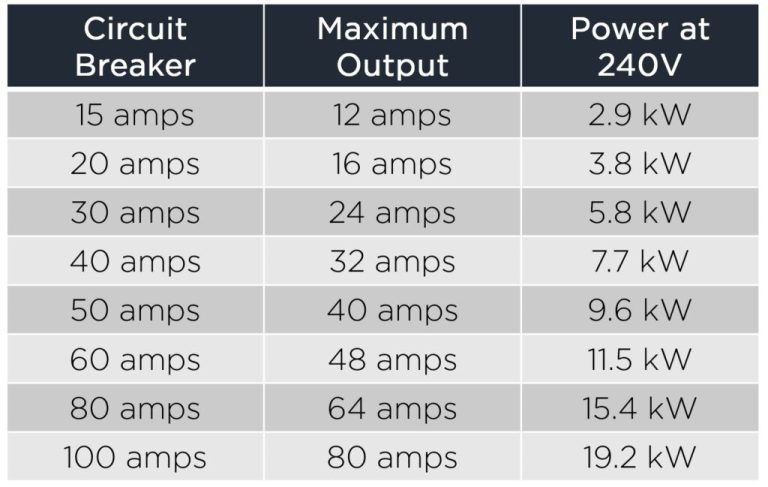
Generic charts are useful for orientation, but they are not installation instructions. The exact breaker size, conductor type, receptacle requirements, and whether plug-in or hardwired installation is allowed should come from the manufacturer documentation and the local authority having jurisdiction.
Panel capacity, load calculations, and when a service upgrade may be needed
Even if a 60-amp circuit is the right size for the EVSE, your main panel may not have enough spare capacity. A licensed electrician may need to run a load calculation, check existing large loads, and determine whether a service upgrade or load-management solution is necessary.
Plug-in vs. hardwired installation: code, convenience, and long-term reliability
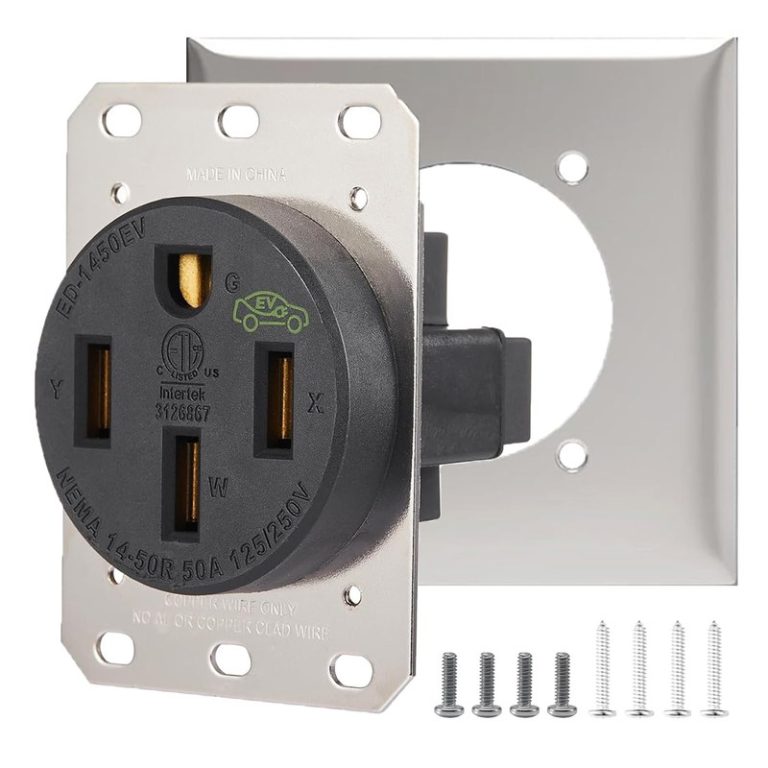
Useful when the manual allows a receptacle installation and you want easier serviceability or future relocation.
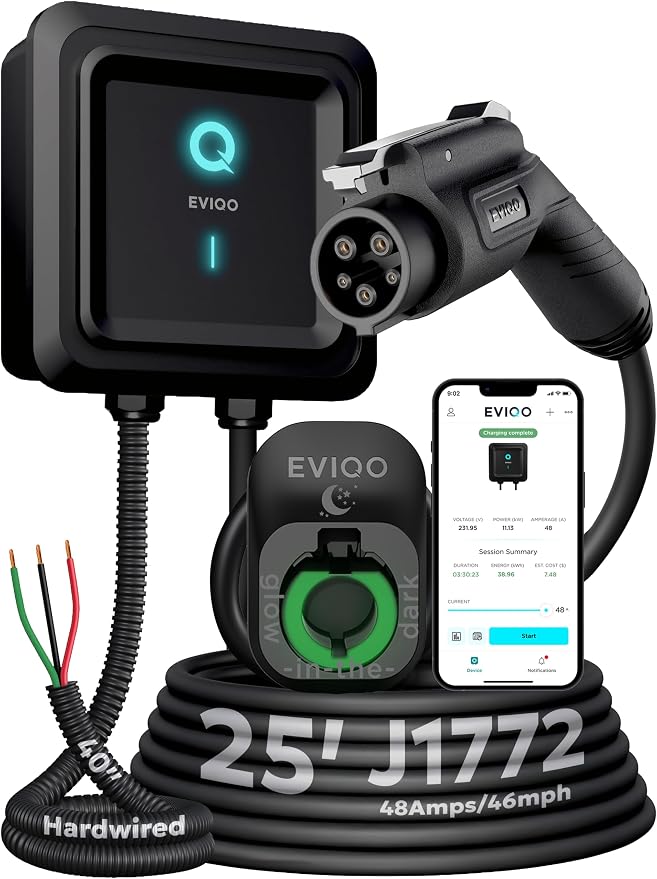
Often preferred for higher-output home EVSEs, outdoor installs, or when the manual and electrician recommend a fixed connection.
If you are still comparing lower-output options, our guide to 40 amp EV charger breaker size is a helpful side-by-side reference.
Cable length, mounting location, and weather-rated equipment for garages and outdoor installs
Choose a cable long enough to reach the vehicle’s charge port without strain, especially if you park nose-in, back-in, or across multiple spaces. For outdoor use, verify the enclosure rating, operating temperature limits, connector storage guidance, and any manufacturer restrictions before installation.
Will a 48 Amp Charger Work With Your EV? Compatibility and Charging Limits

Compatibility is not just about connector shape. Your vehicle’s onboard charger, AC acceptance limit, and any adapter requirements determine whether a 48 amp EVSE will actually charge at 48 amps.
How to confirm your vehicle’s onboard charger can accept 48 amps
Check the owner’s manual or charging specifications for the maximum AC input current. If the vehicle lists a lower limit, that is the ceiling even if the EVSE can supply more.
What happens when the EV limits charging below the EVSE’s maximum output
The EVSE and vehicle negotiate a safe current level. If your EV only accepts 32 amps, the charger will typically deliver 32 amps or less. That does not mean the 48 amp EVSE is defective; it means the vehicle is the limiting factor.
Using adapters: source connector, destination connector, direction, and power limits
Adapters must match the source side, destination side, and charging mode. For example, a J1772-to-NACS adapter for AC home charging is not the same thing as a DC adapter, and it does not magically increase the vehicle’s onboard charger limit.
AC charging vs. DC fast charging: why the adapter and firmware rules are different
AC home charging relies on the vehicle’s onboard charger, while DC fast charging bypasses it and uses a different protocol. That is why an adapter that works for AC home charging may not be allowed, safe, or compatible for DC use.
48 Amp vs. Lower-Amperage Chargers: Which Option Fits Which Driver?
Not every household needs 48 amps. The right choice depends on commute length, overnight parking time, household load, and whether more than one EV needs charging.
48 amp vs. 40 amp vs. 32 amp: same criteria side by side
| Item | Verified value | Why it matters |
|---|---|---|
| 48 amp EVSE | Typically 60-amp circuit | Best when you want faster AC charging and have panel headroom |
| 40 amp EVSE | Typically 50-amp circuit | Often easier to fit in older panels |
| 32 amp EVSE | Typically 40-amp circuit | Good for light daily driving and smaller electrical capacity |
For a deeper comparison with mid-tier home chargers, see is 40 amps enough for a Level 2 EV charger.
Who benefits most from faster home charging and who does not need the extra capacity
Drivers with long commutes, large battery packs, or two-EV households may value the extra overnight recovery. If you drive modest daily miles and plug in for many hours each night, a lower-amperage charger may already cover your needs.
Daily commute, multi-EV households, and overnight turnaround scenarios
48 amps can be especially useful when one vehicle returns late and another needs to leave early the next morning. It can also help when you want a larger range buffer before weekend trips, bad-weather driving, or unexpected errands.
Charging Speed, Range, and Efficiency: What 48 Amps Really Adds
Charging speed is best understood as an estimate, not a promise. Real results depend on the vehicle, battery state, temperature, and charging losses between the wall and the battery.
mi/kWh and Wh/mi context for estimating added range per hour
Label estimates and state vehicle, onboard-charger, battery, temperature, and loss assumptions.
If your EV is efficient, the added range per hour can be strong. If it is a larger, less efficient SUV or truck, the same kW may translate into fewer miles per hour.
How temperature, HVAC use, speed, elevation, payload, tires, and battery temperature affect results
Cold weather, cabin heating, high speeds, steep terrain, heavy payloads, and underinflated tires can all reduce miles gained per kWh. Battery temperature and state of charge also influence how quickly the vehicle can accept power.
Charging losses and why wall-to-battery energy is not the same as the EVSE output
Some energy is lost in the EVSE, cable, and vehicle electronics. That means a 48 amp charger’s wall output will not equal the exact energy stored in the battery. If you are estimating cost or range, use a loss assumption instead of assuming 100% efficiency.
Battery Health Considerations: Is 48 Amp Charging Safe for the Battery?
For most modern EVs, AC home charging at the vehicle’s supported rate is a normal use case. Battery health depends more on heat, time spent at high state of charge, and charging habits than on the mere existence of a 48 amp EVSE.
Manufacturer guidance vs. general battery patterns across lithium-ion chemistries
Always start with the vehicle maker’s guidance. Some battery systems tolerate frequent AC charging very well, while others benefit from more conservative daily charge targets or temperature-aware scheduling.
AC home charging, state of charge, and thermal management trade-offs
AC charging is generally gentler than DC fast charging, but charging to a high state of charge and leaving the car full for long periods can still be a trade-off. If your EV has scheduled charging or charge-limit settings, those features may be worth using.
When slower charging may be preferable and why DC fast charging is a different conversation
Slower charging can make sense when you have plenty of overnight time, want to minimize electrical upgrades, or simply do not need the extra speed. DC fast charging is a separate topic because it has different power levels, thermal behavior, and battery-management rules.
Installation Cost, Electricity Cost, and Smart Features to Compare Before You Buy
The charger’s sticker price is only part of the total cost. Installation, permits, cable length, panel work, and software features can change the ownership experience more than the amperage number alone.
Electricity cost formula: rate, kWh delivered, charging losses, and time-of-use pricing
State assumptions; rates, taxes, time-of-use pricing, and losses vary.
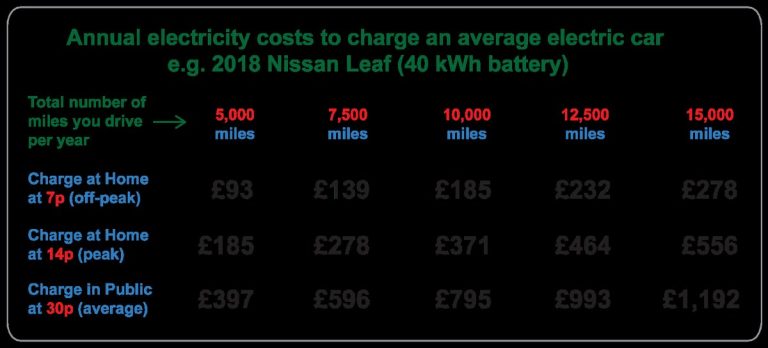
To estimate your own cost, multiply your utility rate by the wall energy used, not just the battery energy added. If your utility offers off-peak pricing, scheduling can materially lower charging cost.
Equipment and installation cost drivers: panel work, permits, labor, trenching, and distance
Installation cost often rises with long conduit runs, outdoor trenching, panel upgrades, difficult routing, or permit-driven work. A simpler garage install near the panel is usually far less expensive than a detached garage or a long driveway run.
Smart features to look for in 2026: scheduling, load management, app controls, and energy monitoring
Useful features include scheduled charging, current adjustment, energy reports, and utility integration. If the charger depends on an app or cloud service, check what still works if the app is unavailable or the company changes software support.
Warranty, support, and what matters in a review when first-hand testing evidence is limited
Source: Manufacturer installation manual, vehicle charging specifications, and local code authority. Checked: Verify close to publication when specs or code matter. Supports: Circuit sizing, connector compatibility, installation type, and feature claims only when documented.
When no first-hand testing evidence is available, the most useful review criteria are documentation quality, compatibility clarity, safety listing, warranty terms, support reputation, and whether the product’s installation requirements are realistic for typical U.S. homes.
- Best for: Homeowners who want fast overnight AC charging and have panel capacity for a properly installed dedicated circuit.
- Think twice if: Your panel is tight, your EV only accepts lower AC amperage, or you do not need the extra speed.
- Next step: Confirm your vehicle’s maximum AC charging rate, then verify the EVSE manual and have an electrician check the panel and circuit plan.
Frequently Asked Questions
Many 48 amp EVSEs are installed on a 60-amp dedicated circuit because EV charging is typically treated as a continuous load. Always follow the charger manual and local electrical requirements.
No. A 48 amp Level 2 EVSE is not a standard plug-in appliance for a household outlet. It usually requires a dedicated 240-volt circuit and either a proper receptacle or hardwired installation, depending on the product manual.
Only if your vehicle’s onboard AC charger supports that current. If the vehicle limit is lower, the EVSE will typically charge at the vehicle’s maximum supported rate instead.
For most modern EVs, AC charging at the vehicle’s supported rate is normal. Battery health depends more on heat, charging habits, and time at high state of charge than on the charger’s maximum rating alone.
Not always, but you do need enough spare capacity for a dedicated circuit. A licensed electrician should confirm the load calculation and determine whether the existing panel can support the install.
It can be worth it if you need faster overnight recovery, have a larger EV battery, or share charging across multiple vehicles. If your driving pattern is light, a 40 amp or even 32 amp unit may be enough.

One Comment