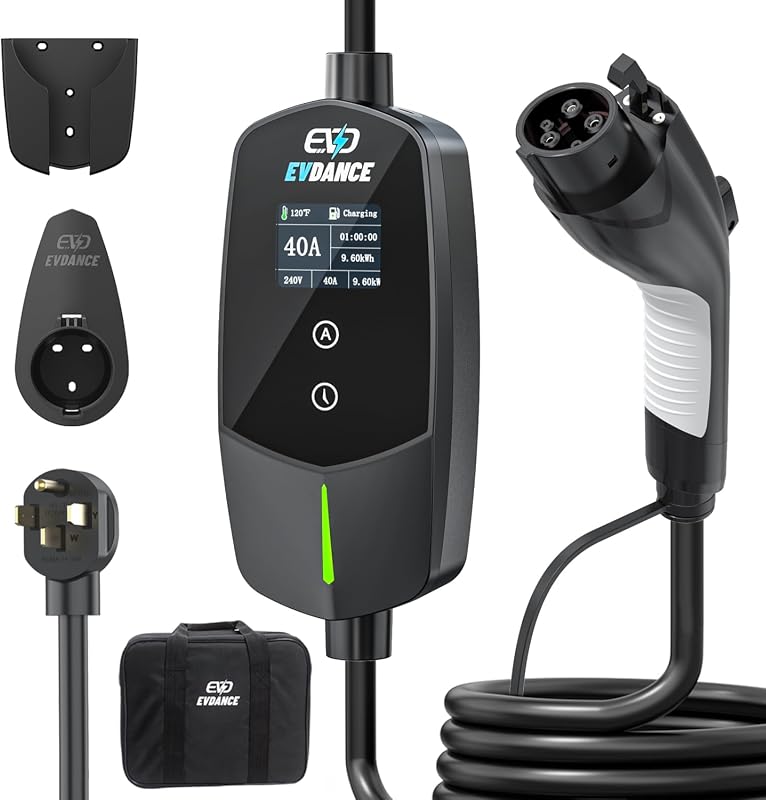
Does a Hardwired EV Charger Need GFCI? What to Know
In most US jurisdictions, a hardwired Level 2 EVSE does not require a GFCI breaker because NEC 625.54 applies to receptacles, not permanently connected equipment. The main check is your charger’s installation manual and your local code amendments, which can add a GFCI requirement.
Whether a hardwired EV charger GFCI is required depends less on the charger itself and more on how it connects to your home’s electrical system. In most US jurisdictions, a permanently connected (hardwired) Level 2 EVSE does not trigger the National Electrical Code’s GFCI rule for EV charging receptacles — but manufacturer instructions, local amendments, and your authority having jurisdiction can override that default.
- Code trigger: NEC 625.54 requires GFCI for personnel on EV charging receptacles rated 150–250 V, not.
- Built-in protection: Hardwired units rely on their own listed personnel protection system under NEC 625.22, commonly.
- Threshold gap: Class A GFCI trips near 5 mA; many EVSE ground-fault devices trip closer to.
- Overrides matter: Manufacturer instructions, local amendments, and AHJ discretion can require GFCI even on a hardwired.
The Short Answer: Do Hardwired EV Chargers Need GFCI?
For most hardwired Level 2 installations in the United States, the answer is no. The NEC’s EV-specific GFCI requirement is written around receptacles, and a hardwired EVSE has none. What replaces it is ground-fault protection built into the charging equipment itself, required by a different section of the same code.
What the NEC requires for EV charging receptacles
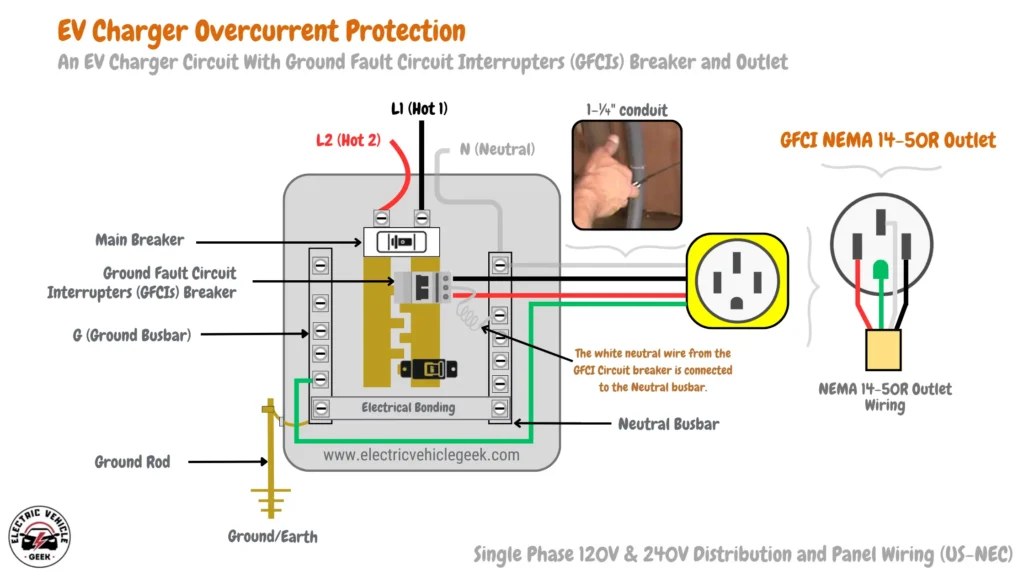
NEC 625.54 addresses GFCI protection for personnel on single-phase receptacles rated 150 V to 250 V that are installed for electric vehicle charging. In practical terms, that covers the NEMA 14-50 and NEMA 6-50 outlets many homeowners use for a plug-in Level 2 charger. Install one of those receptacles for EV charging, and it needs GFCI protection — typically a GFCI circuit breaker at the panel, since 240 V GFCI receptacles are uncommon in residential use.
The requirement first appeared in the 2017 NEC and has carried forward, with wording revisions in later editions. That matters because the exact text your electrician must follow depends on which edition your state or local jurisdiction has adopted.
Why permanently connected (hardwired) EVSE is treated differently
A hardwired EVSE is permanently connected equipment. There is no receptacle, no plug, and no user-accessible outlet on the circuit. Because 625.54 is triggered by the presence of a receptacle, a hardwired installation does not activate that requirement.
Instead, NEC 625.22 requires the EVSE to include a listed system of protection against electric shock of personnel. That protection lives inside the unit and is commonly called CCID (charge circuit interrupting device). The safety layer still exists — it simply comes from the equipment rather than from the breaker.
Plug-In vs Hardwired EVSE: How the GFCI Rule Changes

Uses a NEMA 14-50 or 6-50 receptacle. The receptacle triggers NEC 625.54, so GFCI protection for personnel is required. Portable, but often limited to lower continuous current.
Wiring lands directly on the EVSE terminals. No receptacle means no 625.54 trigger. Higher amperage is possible, but the unit stays fixed in place.
Plug-in setups: NEMA 14-50, 6-50, and the GFCI breaker requirement
A plug-in Level 2 charger depends on a receptacle, and that receptacle is what the code cares about. If you install a 14-50 or 6-50 outlet specifically for EV charging, expect a GFCI circuit breaker on that circuit in jurisdictions that have adopted the 2017 NEC or later.
This is one reason some owners choose hardwiring even when a plug-in unit would be simpler. A GFCI breaker adds cost, and on a plug-in EVSE it can occasionally interact with the charger’s own internal ground-fault sensing.
Hardwired setups: no receptacle, no 625.54 trigger
Hardwiring removes the receptacle from the equation entirely. The branch circuit conductors terminate inside the EVSE enclosure, so there is nothing for 625.54 to apply to. The circuit still needs correct overcurrent protection, grounding, and conductor sizing — those requirements do not go away.
What you gain is a cleaner electrical interface and, in many cases, access to higher continuous current. You also lose portability, and you take on a fixed installation that requires a permit and inspection in most areas.
GFCI vs CCID: Two Different Layers of Ground-Fault Protection
5 mA vs 20 mA trip thresholds and what each one protects
A Class A GFCI is designed to trip at roughly 4 mA to 6 mA of ground-fault current. That low threshold is aimed squarely at protecting people from electric shock. It is the protection 625.54 is asking for at a receptacle.
EVSE built-in ground-fault protection is a different device with a different job. Many units use a CCID that trips in the 20 mA range, which is oriented toward equipment protection and fault detection rather than shock protection at the lowest possible threshold. Some EVSE documentation describes tighter personnel-protection thresholds, so the specific number depends on the model and the standard it was listed to — check the manufacturer’s documentation rather than assuming.
Why stacking a GFCI breaker on a hardwired unit causes nuisance trips
When two ground-fault sensing devices sit on the same circuit, small leakage currents can accumulate. A hardwired EVSE with its own sensing circuitry, combined with a GFCI breaker, sometimes produces repeated trips that are not caused by a real fault. This is a widely reported owner pattern rather than a universal outcome — plenty of installations coexist without issue.
If it does happen, the fix is not to remove protection. It is to diagnose the actual leakage source and follow the equipment instructions and local code.
When a Hardwired EV Charger May Still Need GFCI
Manufacturer instructions and warranty language that overrides assumptions
Code is a floor, not a ceiling. If an EVSE manufacturer’s installation instructions call for GFCI protection on the supply circuit, that instruction governs the installation — and in many jurisdictions, listed instructions are enforced alongside the code. Ignoring them can also create warranty problems if a failure is later traced to the installation.
This is why the honest answer to “does hardwired need GFCI” is “usually not, but read your specific unit’s manual.”
Local amendments, AHJ discretion, and special locations
Some jurisdictions amend the NEC, and some inspectors apply stricter interpretations in garages, carports, detached structures, or outdoor locations. Others may require GFCI where equipment is within reach of a wet location. There is no single national answer once local amendments enter the picture.
The practical move is a short phone call or email to your building department before the work starts. Ask what they require for a hardwired EVSE at your specific address.
Code, Permits, and Inspection: What to Expect in 2026
Which NEC edition your state has adopted
NEC adoption is a state-by-state process, and some states or localities lag several editions behind. A requirement that exists in the 2023 NEC may not apply where the 2017 edition is still enforced, and vice versa. Because adoption status changes over time, verify the current edition with your local building department rather than relying on a national summary.
What inspectors typically ask for on a hardwired installation
Common inspection points include a dedicated circuit of the correct size, proper conductor and overcurrent protection sizing for a continuous load, correct grounding and bonding, appropriate mounting and cable routing, and a permit pulled before work began. Inspectors also frequently ask to see the manufacturer’s installation instructions on site.
Circuit, Panel, and Load-Sizing Basics for Hardwired Charg
ers

The 125% continuous-load rule and why it shapes breaker and wire choices
EV charging is treated as a continuous load under the NEC, which means the branch circuit must be sized at 125% of the EVSE’s maximum current. A 48 A charger therefore needs a 60 A circuit, not a 48 A one. This single rule drives the breaker size, the conductor gauge, and often the panel capacity decision.
If you are working through those numbers, our breakdown of whether a 48 amp EV charger needs a 60 amp circuit walks through the math, and the 48 amp EV charger breaker size guide covers how that translates into panel hardware.
Panel capacity, service upgrades, and load management devices
Before choosing amperage, have the panel evaluated. Available capacity, bus rating, and existing large loads all matter. Where capacity is tight, a load management device that reduces EVSE current when household demand spikes can sometimes avoid a full service upgrade — but it must be a listed, code-recognized solution and acceptable to your AHJ.
Equipment Factors That Shape the GFCI Decision
Amperage, kW, and your vehicle’s onboard charger limit
The EVSE sets the ceiling, but your vehicle’s onboard AC charger determines what you actually receive. A 48 A hardwired unit on a 60 A circuit delivers roughly 11.5 kW at 240 V, but a car limited to 32 A will only draw about 7.7 kW. Buying more amperage than your vehicle can accept does not shorten charge times.
If you are weighing whether a smaller circuit is sufficient, see our discussion of whether 48 amps is enough for a Level 2 charger.
Connector type, cable length, and weather rating
Most US hardwired Level 2 EVSE use a J1772 connector, while NACS (SAE J3400) is increasingly common on newer vehicles. A physical connector fit does not by itself confirm AC charging support — verify both the vehicle inlet and the EVSE connector. Cable length matters for parking position, and any outdoor mounting should be checked against the manufacturer’s stated enclosure rating and operating temperature limits.
Smart features, warranty, and support
Smart chargers add scheduling, utility program integration, and energy reporting, but they also add app dependencies, firmware updates, and cloud connectivity considerations. Ask what happens if the cloud service is unavailable. Warranty length and US-based support are worth comparing, and a current safety listing from a recognized testing laboratory should be verified from the manufacturer or the certification record rather than assumed from appearance.
Cost Implications: GFCI Breaker vs Hardwired Installation
Equipment and installation cost assumptions
A GFCI circuit breaker for a 240 V circuit generally costs more than a standard breaker of the same rating, and that difference is one line item in a plug-in installation. Hardwiring typically removes the GFCI breaker and the receptacle from the parts list, but it may add labor for conduit, disconnects, or longer cable runs.
Rather than quoting national averages that go stale quickly, get two or three local quotes that itemize the breaker, conductors, conduit, permit fees, and labor separately. That makes the comparison meaningful.
Electricity cost math: rate, kWh delivered, charging losses, and time-of-use
Charging cost is a separate calculation from installation cost. The formula is your delivered electricity rate multiplied by the energy actually drawn from the wall, which is higher than the energy that reaches the battery because of charging losses.
Illustrative example only. Rates, taxes, fees, time-of-use windows, demand charges, and actual losses vary by utility and equipment. Verify current rates with your utility.
Time-of-use plans can change the picture substantially. If your utility offers an overnight rate, shifting charging to that window may matter more to your annual cost than the difference between a GFCI breaker and a standard one.
Troubleshooting GFCI Trips and Charging-Speed Questions
Diagnosing repeated trips on a hardwired circuit
If a hardwired circuit trips repeatedly, treat it as a fault signal, not an inconvenience. Possible sources include moisture intrusion at the connector or enclosure, a damaged conductor, insulation issues, or cumulative leakage that exceeds the device threshold. Stop using the circuit and have a qualified electrician diagnose it.
Does GFCI affect charging speed, range, or battery health?
No. GFCI and CCID devices monitor ground-fault current; they do not regulate charging power. Charging speed is set by circuit capacity, EVSE output, and your vehicle’s onboard charger. Range and battery health are influenced by temperature, state of charge, charging habits, and the manufacturer’s guidance for your specific vehicle — not by the presence of a GFCI breaker.
- Best for: Hardwired installations where the EVSE provides listed personnel protection and local code does not add a GFCI requirement.
- Think twice if: Your EVSE manual specifies a GFCI breaker, or your AHJ or local amendment requires one — those instructions govern.
- Next step: Check your charger’s installation manual and confirm the adopted NEC edition and any local amendments with your building department before work begins.
Frequently Asked Questions
Usually not. NEC 625.54 requires GFCI protection for personnel on single-phase receptacles rated 150 V to 250 V installed for EV charging, and a hardwired EVSE has no receptacle. However, if the manufacturer’s installation instructions call for a GFCI breaker, or your local code amendment requires one, that requirement applies regardless of the general rule.
Hardwired EVSE must include a listed system of protection against electric shock of personnel under NEC 625.22. That protection is often described as CCID and is built into the unit. It is not identical to a Class A GFCI, which trips at a much lower current threshold. Check your specific model’s documentation for the listed protection type and threshold.
Repeated tripping usually points to cumulative leakage current, moisture in the connector or enclosure, damaged conductors, or a genuine ground fault. It can also happen when a GFCI breaker is stacked on an EVSE that already has its own ground-fault sensing. Do not remove or upsize the breaker — have a qualified electrician diagnose the circuit.
In jurisdictions that have adopted the 2017 NEC or a later edition, yes. NEC 625.54 requires GFCI protection for personnel on single-phase receptacles rated 150 V to 250 V installed for EV charging, which covers a NEMA 14-50 outlet used for that purpose. Because adoption varies, confirm with your local building department.
No. GFCI and CCID devices monitor ground-fault current and interrupt the circuit when a fault is detected. They do not limit charging power during normal operation. Charging speed is determined by the circuit rating, the EVSE’s configured output, and your vehicle’s onboard AC charger limit.
In many jurisdictions, yes, provided the installation meets the equipment listing requirements, the manufacturer’s instructions, and all applicable local amendments. Some areas add stricter requirements for garages, carports, or outdoor locations. Confirm the adopted code edition and any local amendments with your AHJ before the work is permitted.