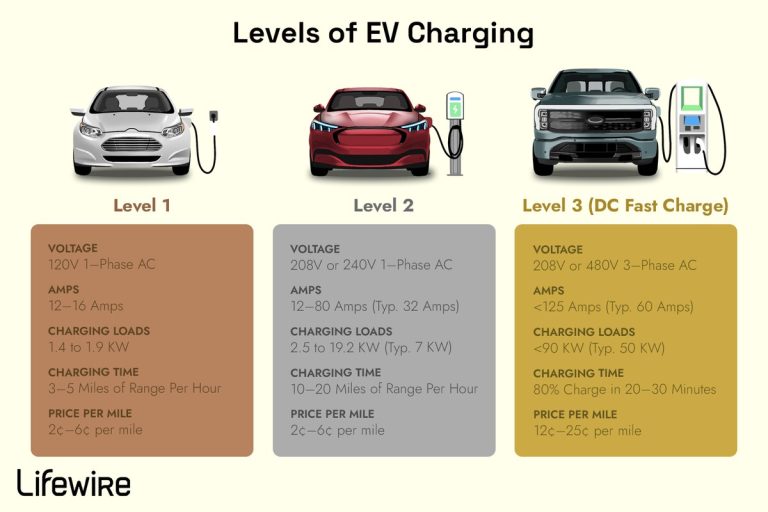
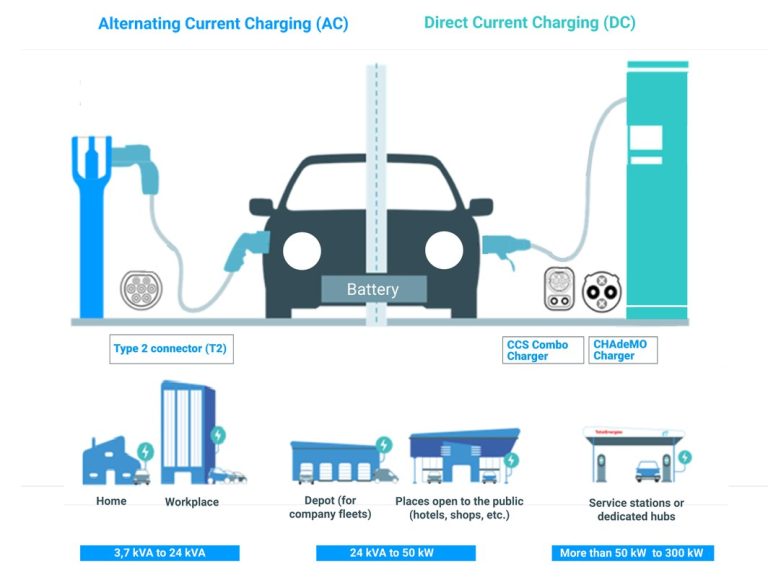
What Is NACS Charging? EV Charging Standard Explained
NACS, standardized as SAE J3400, is a connector that carries both AC and DC charging through one compact plug — it is an interface standard, not a charging network. The main check is whether your vehicle inlet, adapter direction, network access, and onboard charger limits actually line up before you rely on it.
If you have ever asked what is NACS charging, the short answer is this: NACS — the North American Charging Standard, now published as SAE J3400 — is a single connector design that carries both AC and DC charging through the same plug. It is a physical and electrical interface, not a charging network, and what it delivers to your battery still depends on your vehicle, the equipment, and the site.
- Compatibility: Native NACS vehicles need an adapter for CCS1 DC stations, and CCS1 vehicles need.
- Performance: A 350 kW station rating does not mean 350 kW to your pack —.
- Safety: AC and DC adapters are different products and are not interchangeable; use only adapters.
- Cost: Home charging cost is kWh added × your rate ÷ charging efficiency, plus separate.
What Is NACS Charging? The 2026 Definition, Connector, and AC/DC Modes
NACS Is a Connector Standard, Not a Charging Network
NACS describes the shape, pin layout, and communication interface of the plug and inlet. It says nothing about who owns the station, what it costs, or how much power it can supply. A NACS connector can appear on a home wall unit, a hotel Level 2 pedestal, or a high-power DC fast charger.
That distinction matters because owners often say “NACS charger” when they mean “Tesla Supercharger.” Tesla’s network, home Wall Connector, and destination chargers all use the NACS connector, but they are different products with different capabilities and access rules.
NACS vs. J1772 and CCS1: What Changed Physically
J1772 is an AC-only connector with five pins. CCS1 keeps the J1772 shape and adds two large DC pins below it, which is why CCS1 cars can AC charge from a J1772 station but need the full CCS1 plug for DC fast charging.
NACS collapses both jobs into one compact connector. The same inlet handles AC charging and DC fast charging, so there is no separate DC plug to add. That smaller footprint is a large part of why automakers adopted it.
Important: Physical fit alone does not prove every AC or DC charging mode is supported.
Why the Tesla Plug Became the North American Charging Standard
Tesla opened its connector design in late 2022 and named it the North American Charging Standard. SAE International then worked it into a formal standard, published as J3400, which gave other automakers and equipment makers a documented target to build to.
Adoption accelerated because the Tesla Supercharger network was already large and reliable, and because a single connector simplifies vehicle design. Starting with the 2026 model year, several US automakers began shipping vehicles with native NACS inlets instead of CCS1.
NACS Compatibility and Adapters: Vehicles, Chargers, and Direction Rules
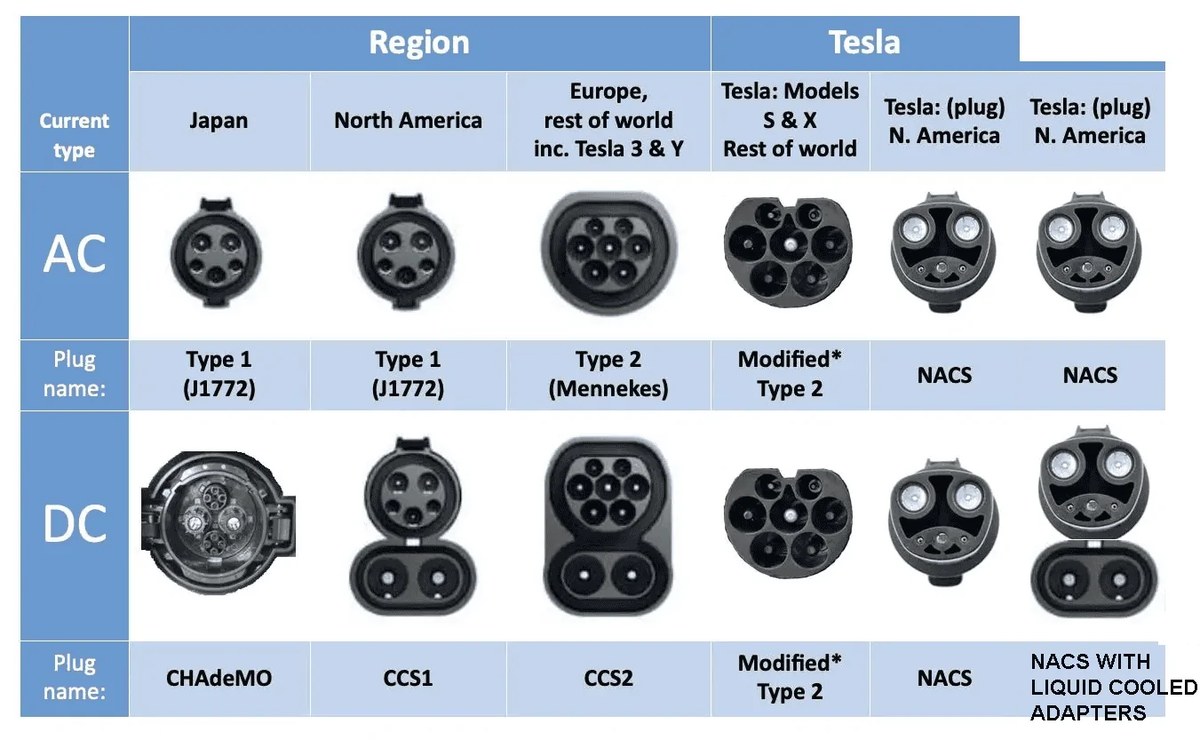
Native NACS EVs vs. CCS1 EVs in the United States
By 2026, the US market is split. Some EVs have a native NACS inlet, some still have CCS1, and many older models use CCS1 only. Both groups can usually charge at both connector types, but the path differs.
A native NACS vehicle uses NACS stations directly and needs an adapter for CCS1 DC stations. A CCS1 vehicle uses CCS1 stations directly and needs an adapter for NACS DC stations, plus network authorization from the vehicle manufacturer.
Adapter Direction, Source/Destination Connectors, AC/DC Mode, and Power Limits
Adapters are directional. A NACS-to-CCS1 adapter lets a CCS1 vehicle plug into a NACS DC charger. A CCS1-to-NACS adapter lets a NACS vehicle plug into a CCS1 DC charger. AC adapters are separate products and are not interchangeable with DC adapters.
Power limits are set by the weakest link in the chain: the station, the adapter, the cable, the inlet, and the battery. Some adapters are rated for lower current than the station can deliver, and some vehicles cap DC intake regardless of the plug.
Vehicle, Network, Firmware, and Safety Restrictions
Supercharger access is not automatic. It depends on agreements between the automaker and Tesla, vehicle software versions, and account setup. Some sites remain Tesla-only, and some older stations are not open to other brands.
Thermal behavior also matters. Adapters and connectors can heat during sustained high-power sessions, and equipment monitors temperature for a reason. Follow the adapter manufacturer’s instructions, use only adapters listed for your vehicle and charging mode, and stop using any adapter that shows damage, discoloration, or heat damage.
How NACS Charging Power Works: EVSE Output vs. Onboard Charger Limits
AC Charging: Amperage, kW, and the Vehicle’s Onboard Charger
For AC charging, the wall unit is only half the story. The vehicle’s onboard charger converts AC to DC and sets the ceiling. A 48-amp EVSE on a 240-volt circuit works out to roughly 11.5 kW, but a car with a 7.2 kW onboard charger will never take all of it.
If you are working through amperage math, our breakdown of how many kW a 48-amp Level 2 charger produces walks through the calculation and where the vehicle limit applies.
This is arithmetic, not a promise. Circuit capacity, EVSE settings, and the vehicle’s onboard charger all cap the real number.
DC Fast Charging: Station Rating, Pack Limits, and the Charging Curve
DC fast charging bypasses the onboard charger and feeds the pack directly, so the station and the battery management system negotiate the rate. A station rated at 350 kW is a capability statement, not a guarantee.
Most EVs follow a charging curve: high power at low state of charge, tapering as the pack fills. Cold packs, hot packs, and packs near full all pull less than the peak figure on the label.
Why a 350 kW NACS Station May Not Mean 350 kW to Your EV
Four things can hold you back: the vehicle’s maximum DC acceptance rate, the battery’s state of charge and temperature, the station’s shared power architecture when another car is plugged in, and cable or connector thermal limits. The connector standard does not override any of them.
NACS Home Charging Installation: Plug-In vs. Hardwired, Circuit, Panel, and Weather
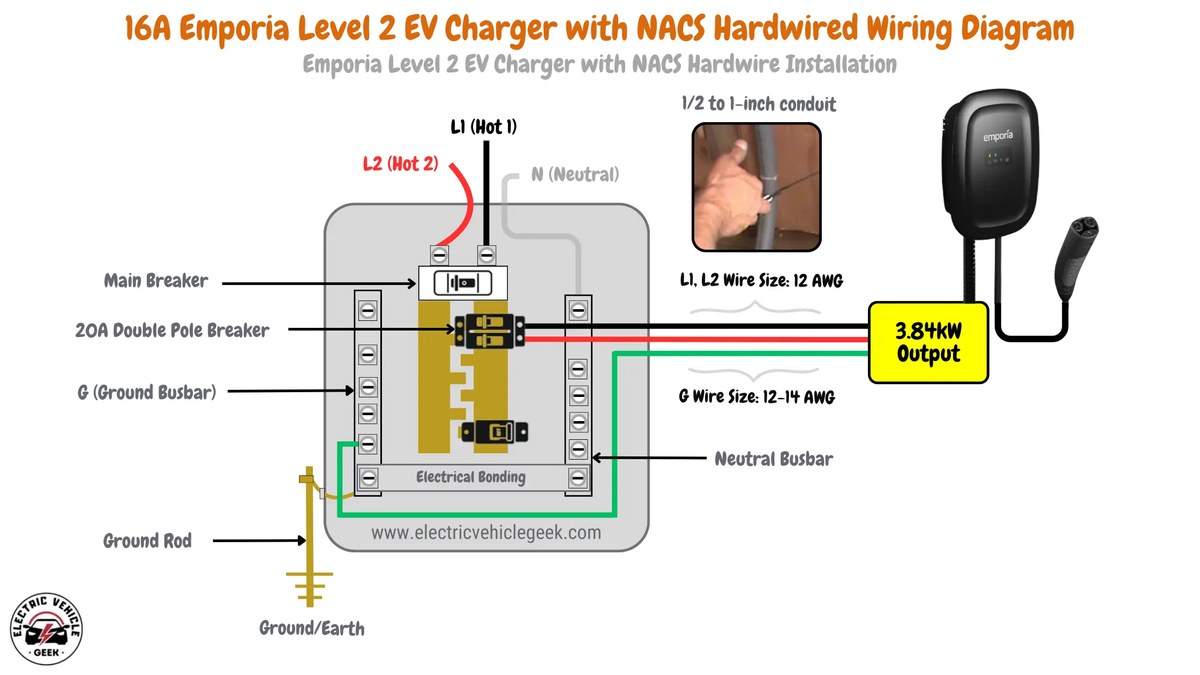
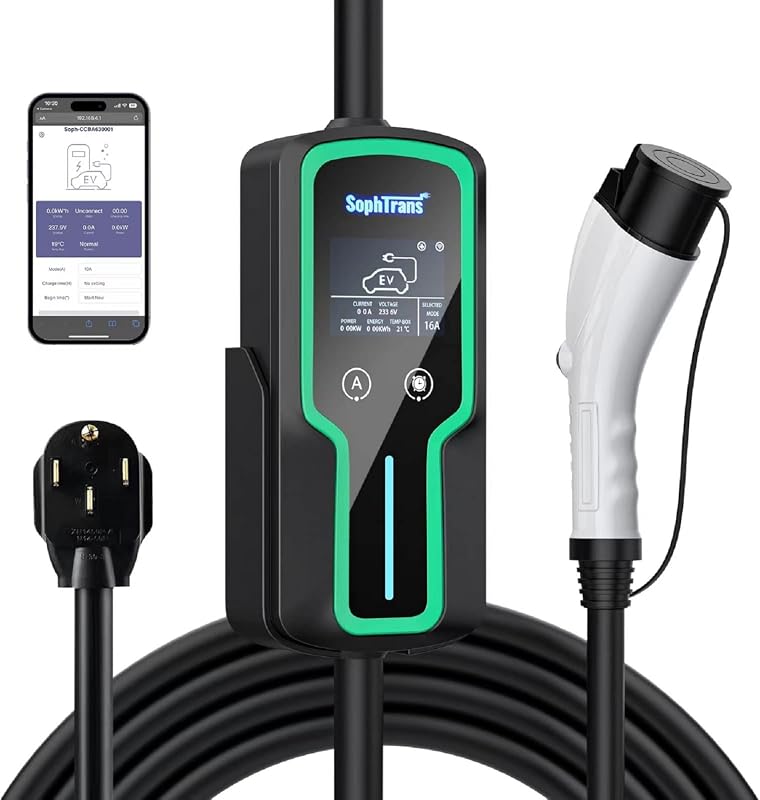
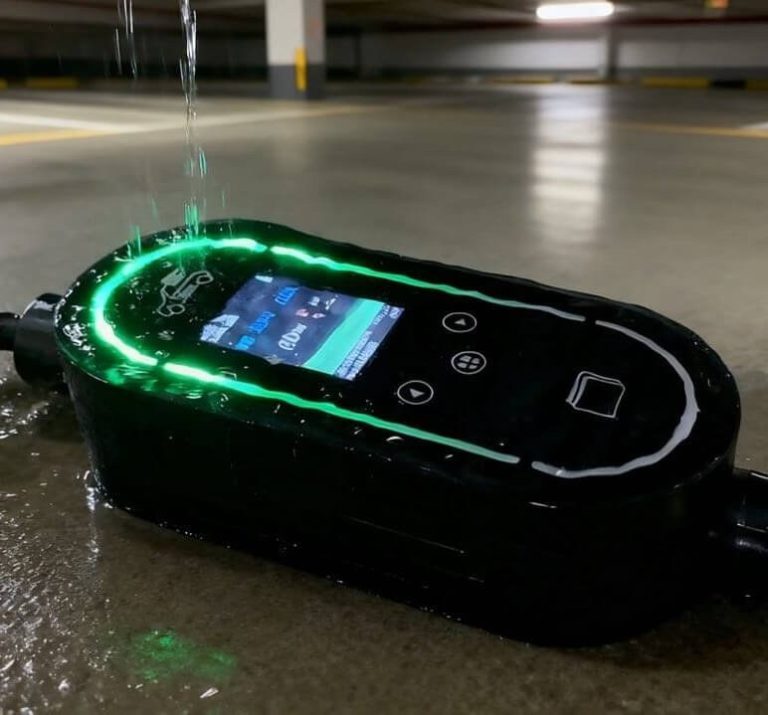
Plug-In vs. Hardwired NACS EVSE, Cable Length, and Weather Suitability
Uses a matching receptacle and can be moved, but is typically limited to lower amperage and adds a plug-and-outlet connection point. Verify the receptacle type and rating in the manufacturer instructions.
Wired directly to a dedicated circuit, usually allowing higher continuous current and a cleaner outdoor install. Requires a qualified electrician and a permit in many jurisdictions.
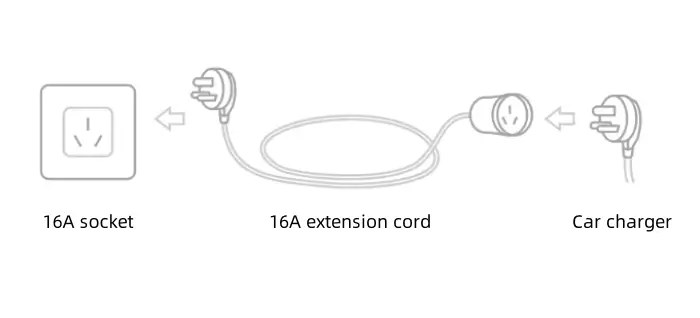
Cable length is a practical constraint, not a spec-sheet afterthought. Measure the actual path from the unit to your parking position, including any doorways or posts the cable must route around. If you need flexibility rather than a fixed unit, a portable EV charger may cover travel and temporary setups, though usually at lower power.
Circuit, Breaker, and Panel Implications: Manual and Local Code First
EVSE draws continuous current for hours, which is why manufacturer instructions and local electrical requirements usually call for a dedicated circuit sized with that in mind. Whether your panel has capacity for another 40- or 60-amp circuit is a question for a licensed electrician, not a forum thread.
Wire sizing, breaker rating, and receptacle type must come from the equipment instructions and the adopted code in your area. Our guide to wire size for a 40-amp EV charger explains why those numbers are not interchangeable.
Smart Features, Warranty, Support, and Permit Checks
Smart NACS units add scheduling, load management, and utility program integration, but most depend on an app account and cloud connectivity. Ask what still works if the service or your Wi-Fi goes down, and whether scheduling is stored locally or remotely.
Also confirm the safety listing on the certification record rather than the marketing page, check the US warranty term, and verify whether your utility or local authority requires a permit and inspection before energizing the circuit.
NACS Charging Costs: Electricity Rate, kWh Delivered, Losses, and Installation
Cost Formula: kWh Delivered × Rate ÷ Charging Efficiency
The useful formula is straightforward: energy added to the battery, multiplied by your electricity rate, divided by charging efficiency. AC charging typically loses more energy in conversion than DC charging, so the same kWh into the pack can cost slightly more at home than the meter suggests.
Illustrative only. Rates, taxes, fees, time-of-use windows, demand charges, and real losses vary by utility and equipment.
Time-of-Use Pricing, Off-Peak Charging, and Demand Charges
Many US utilities offer time-of-use plans where overnight electricity costs less than evening peak power. If your utility offers one, shifting charging to off-peak hours is often the single largest lever on home charging cost.
Demand charges are mostly a commercial and DC fast charging concern, where a site pays based on its peak draw in a billing window. Residential customers rarely see them, but the rate structure on your bill is the authority.
Equipment and Installation Costs for NACS Home Charging
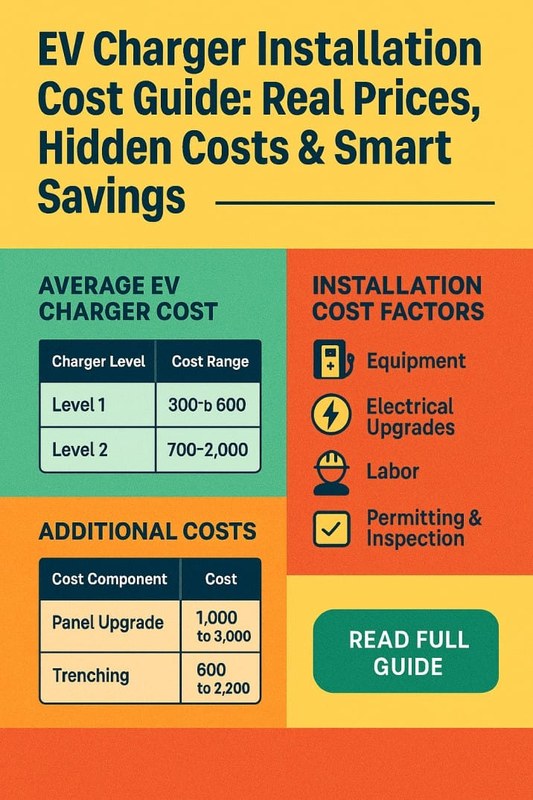
Budget for three separate line items: the EVSE itself, the electrical work, and any permit or inspection fees. Hardwired installs with a long cable run, a subpanel, or a panel upgrade cost considerably more than a short run next to the panel.
Do not assume a rebate or tax credit applies. Incentive programs change and are often tied to specific equipment lists, installers, or income thresholds. Verify current terms with your utility or the relevant authority before counting on them.
NACS Charging, Battery Health, and Range/Efficiency in Real Conditions
Manufacturer Guidance vs. General Patterns for Temperature, SOC, and Power
There is no universal charging-percentage rule that fits every EV. Follow your manufacturer’s guidance, which accounts for your specific chemistry, thermal management design, and warranty terms.
General patterns still hold: very cold or very hot packs accept less power, and DC fast charging tapers as state of charge climbs. Neither is a defect — both are the battery management system protecting the pack.
DC Fast Charging, Chemistry, Thermal Management, and Convenience Trade-Offs
Liquid-cooled packs generally tolerate repeated fast charging better than older passively cooled designs. If your routine is a 20-minute top-up twice a week, that is a very different pattern from daily 10% to 90% sessions.
For most owners, home AC charging covers daily needs and DC fast charging covers road trips. That split tends to be both cheaper and easier on the pack.
Wh/mi, mi/kWh, Speed, Weather, HVAC, Elevation, Payload, Tires, and Losses
Range figures are estimates, not constants. Highway speed, cold temperatures, cabin heating, elevation change, roof cargo, payload, tire pressure and tread, and battery temperature all move the number. Charging losses add another layer between what you pay for and what reaches the pack.
NACS vs. CCS1 vs. J1772: Side-by-Side Comparison and What to Check Before You Rely on It
Connector, AC/DC Support, Adapter Needs, and Power Limits Compared
| Item | NACS / J3400 | CCS1 | J1772 |
|---|---|---|---|
| Charging modes | AC and DC | AC and DC | AC only |
| Connector size | Compact, single plug | Large, two DC pins added | Compact, AC only |
| Adapter needed | For CCS1 DC stations | For NACS DC stations | For NACS AC inlets |
| Power ceiling | Set by vehicle and EVSE | Set by vehicle and EVSE | Set by onboard charger |
| Typical use | New US EVs, Tesla, home and public | Older US EVs, public DC | Home and public Level 2 |
Who Each Option Fits: Home, Public, and Road-Trip Drivers
Homeowners who mostly charge overnight should focus on the EVSE, circuit, and onboard charger limit rather than the connector label. Public and road-trip drivers should focus on which networks their vehicle can actually activate.
If your car has a native NACS inlet, NACS public charging is the simplest path. If it has CCS1, plan around CCS1 stations and confirm adapter availability and network access before a long trip.
Pre-Flight Checklist: Vehicle, Adapter, Network, Firmware, Code, Warranty, Cost, Battery
Before you commit to a plan or a purchase, run through the basics: confirm your inlet, confirm the connector on the equipment, confirm AC or DC mode, confirm adapter direction and rating, confirm network access, update vehicle firmware, check local code and permits, review warranty terms, estimate cost, and think about your battery’s typical state of charge.
If you are choosing a home unit, our guide to whether 48 amps is enough for a Level 2 charger helps you match amperage to your actual daily driving rather than to the biggest number on the box.
- Best for: Drivers who want one connector for home AC charging and public DC fast charging.
- Think twice if: Your vehicle uses CCS1 and you have not confirmed adapter compatibility and network access.
- Next step: Check your vehicle inlet, your onboard charger limit, and which networks your car can authorize before buying hardware or planning a trip.
Frequently Asked Questions
No. NACS is the connector and interface standard. Tesla Superchargers use that connector, but so do many home wall units and other public chargers. Network access, pricing, and power levels are separate from the connector itself, and not every Supercharger site is open to non-Tesla vehicles.
Usually yes for DC fast charging, if you have a NACS-to-CCS1 adapter rated for the station’s output and your automaker has arranged network access. AC charging is a separate case: a CCS1 car’s AC inlet is J1772, so it needs a J1772-to-NACS AC adapter, not a DC adapter.
The connector does not set charging speed. Power comes from the station’s capability, the vehicle’s maximum DC acceptance rate, battery state of charge, and pack temperature. A NACS plug on a 350 kW station will still deliver only what your car will accept.
Yes, NACS home EVSE is available, and many units come in both plug-in and hardwired versions. The bigger questions are your panel capacity, circuit and breaker sizing, permit and inspection rules in your area, and the maximum AC charging rate your vehicle’s onboard charger supports. A qualified electrician should confirm the electrical details.
Yes, for DC fast charging you need a CCS1-to-NACS adapter, and it must be rated for the current the station can deliver. Confirm vehicle compatibility and any network requirements before relying on it, and check the adapter for heat or damage after high-power sessions.
J1772 remains widely used for AC Level 2 charging and is still the AC portion of the CCS1 connector, so it will be around for years. The shift is mainly at the DC fast charging connector, where NACS is replacing CCS1 on new US vehicles.