What Is J1772 Charging? AC EV Charging Explained
J1772 is the SAE standard for AC charging in North America, covering both 120 V Level 1 and 240 V Level 2 through a five-pin connector that cannot deliver DC fast charging. The main check is your vehicle’s onboard charger limit, since a higher-amperage EVSE will not speed up a car that cannot accept the extra current.
The short answer to what is J1772 charging: it is the North American standard for AC charging, defined by SAE J1772, that covers both 120-volt Level 1 and 240-volt Level 2 charging through a five-pin connector. It is not a DC fast-charging standard, and the connector shape alone never proves how much power your specific vehicle can actually accept.
- Compatibility: J1772 is AC-only; DC fast charging requires CCS1, NACS, or a manufacturer-approved DC adapter.
- Performance: Effective speed is the lowest of circuit capacity, EVSE setting, and your vehicle’s onboard.
- Safety: Size the circuit per the manufacturer instructions and local code, and verify the EVSE’s.
- Cost: Home cost is rate × kWh ÷ charging efficiency; installation cost depends mainly on.
What Is J1772 Charging? The Short Answer
SAE J1772 is the connector and signaling standard that most non-Tesla EVs in the United States have used for AC charging. When an owner says “J1772,” they usually mean the round five-pin plug on the end of a home or public Level 1 or Level 2 cable.
The J1772 Connector, Pins, and AC-Only Design
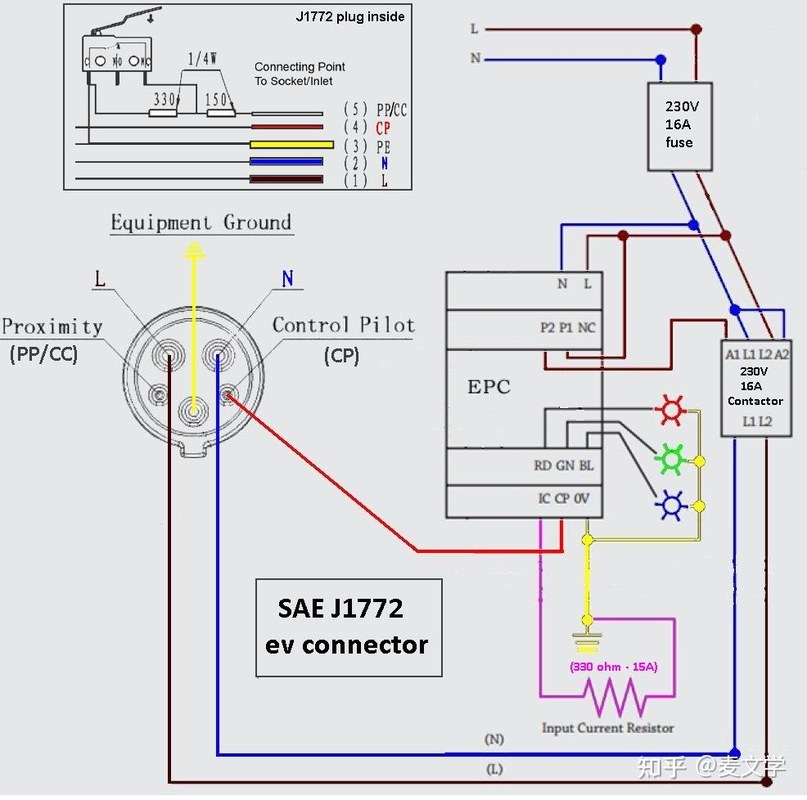
The connector carries five pins: two current-carrying conductors, a ground, a control pilot pin, and a proximity pilot pin. The control and proximity pins are what let the vehicle and the charging equipment talk before any current flows. There are no dedicated DC power pins, which is the core reason J1772 is an AC-only interface.
J1772 vs. Level 1, Level 2, and DC Fast Charging in 2026
J1772 is a connector standard, not a charging level. Level 1 and Level 2 describe voltage and power, and both use J1772 on North American vehicles. DC fast charging uses a different interface — either CCS1, which adds two DC pins beneath a J1772-shaped top section, or NACS / SAE J3400.
J1772 in 2026: NACS, Tesla, and Legacy EVs
NACS has become the dominant native port on new North American EVs, but J1772 remains on millions of older EVs, plug-in hybrids, and public AC charging stations. That installed base is why J1772 still matters for anyone buying a home EVSE or adapter in 2026.
How J1772 Charging Works: EVSE, Onboard Charger, and Losses
The equipment on your wall and the equipment inside your car do two different jobs. Confusing them is the most common reason owners overestimate how fast a new charger will be.
The EVSE Is Not the Charger: Onboard Charger Limits and Amperage Negotiation
The box on the wall — the EVSE, or Electric Vehicle Supply Equipment — is essentially a smart, safety-rated switch. The actual AC-to-DC conversion happens in your vehicle’s onboard charger. If your car has a 32-amp onboard charger, a 48-amp EVSE will not charge it any faster; the vehicle simply will not request more current.
Pilot Signaling, Ground Fault Protection, and Safety
Before current flows, the EVSE sends a 1 kHz pilot signal whose duty cycle tells the vehicle the maximum current available. The vehicle responds by closing its internal contactors only when conditions are correct. The EVSE also includes ground-fault protection, so a fault trips the equipment rather than energizing the connector.
AC-to-DC Conversion and Where Charging Losses Happen
Some energy is lost as heat in the onboard charger, in the battery’s internal resistance, and in thermal management. AC charging losses are commonly estimated in the roughly 10% range, but that figure varies by vehicle, temperature, and charge rate — treat it as a planning assumption, not a fixed number.
J1772 Charging Speed: Amps, kW, and Miles per Hour
Charging speed is the product of voltage, amperage, and the lowest limit in the chain: circuit capacity, EVSE setting, or the vehicle’s onboard charger.
Estimates assume roughly 90% charging efficiency and about 3.5 mi/kWh. Your vehicle, battery temperature, and climate settings will change the result.
Level 1 vs. Level 2 J1772: 120V and 240V Side by Side
| Item | Level 1 (120 V) | Level 2 (240 V) |
|---|---|---|
| Typical amperage | 12–16 A | 16–48 A common; higher exists |
| Approx. power | ~1.4–1.9 kW | ~3.8–11.5 kW |
| Typical use | Standard household outlet | Dedicated 240 V circuit |
| Best fit | Low daily mileage, PHEVs | Daily commuting, overnight refills |
Reading EVSE Amperage, Vehicle Limits, and Circuit Capacity
Three numbers matter. The EVSE has a settable or fixed output. The vehicle has a maximum AC acceptance rate. The circuit has a capacity the EVSE must respect. The effective rate is the lowest of the three. If you are weighing 40 A versus 48 A hardware, our breakdown of whether 48 amps is enough for a Level 2 charger walks through the practical differences.
Breaker and Wire Sizing: Manual First, Local Code and Permit Second
EV charging is a continuous load, and the widely applied convention is that the EVSE’s charging current should not exceed 80% of the circuit rating. That is why a 40 A EVSE typically pairs with a 50 A circuit. Conductor sizing, breaker type, and receptacle requirements depend on the equipment instructions and your local authority — verify both before buying materials.
If you are still choosing hardware, our guide to wire sizing for a 40 amp EV charger covers the conductor question in more detail.
Real-World Range Added per Hour: mi/kWh, Weather, and HVAC
Miles added per hour equals usable power delivered multiplied by your vehicle’s mi/kWh. A car that returns 4.0 mi/kWh in mild weather may drop to 2.5 mi/kWh in freezing conditions. The charger does not change that — your efficiency does.
Why Charging Slows: Cold, Heat, Shared Circuits, and Load Management
Cold packs accept less current until they warm up. Hot packs may throttle to protect themselves. Some homes use load management or a shared circuit, which reduces available current when other appliances run. None of these indicate a broken charger.
J1772 Charger Hardware and Installation: Plug-In vs. Hardwired, Cable, Weather, and Smart Features
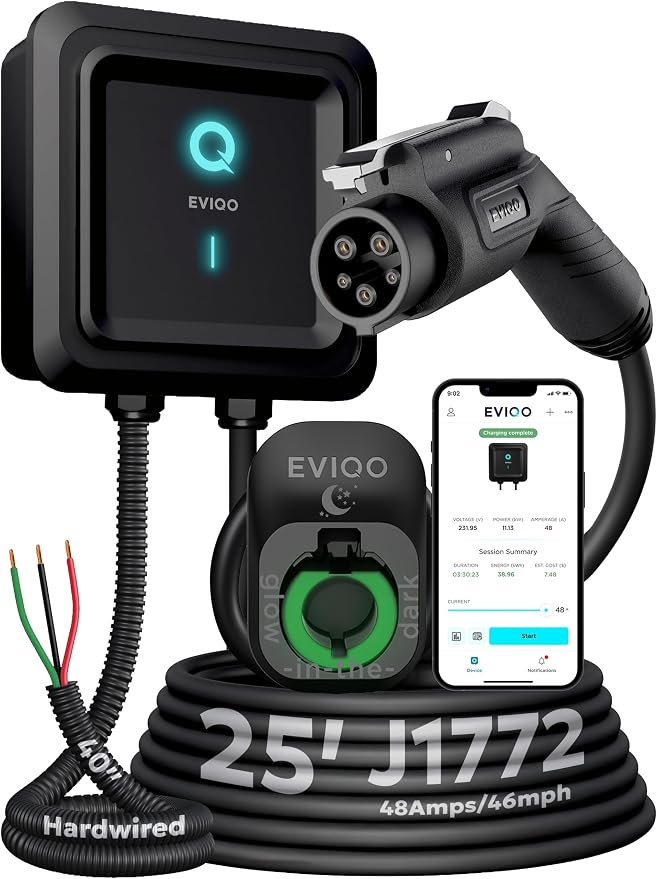
Most J1772 home EVSEs are available in plug-in and hardwired versions, and the choice affects both installation cost and maximum output.
Plug-In vs. Hardwired J1772 EVSE: Panel, Permit, and Convenience Trade-Offs
Plug-in units use a dedicated 240 V receptacle and can be moved if you relocate. Hardwired units eliminate the receptacle, are often required for the highest amperage settings, and typically need a permit and inspection. A portable plug-in unit is a reasonable starting point for renters; see our explainer on what a portable EV charger is and how it works.
Cable Length, Mounting, and Outdoor Weather Suitability
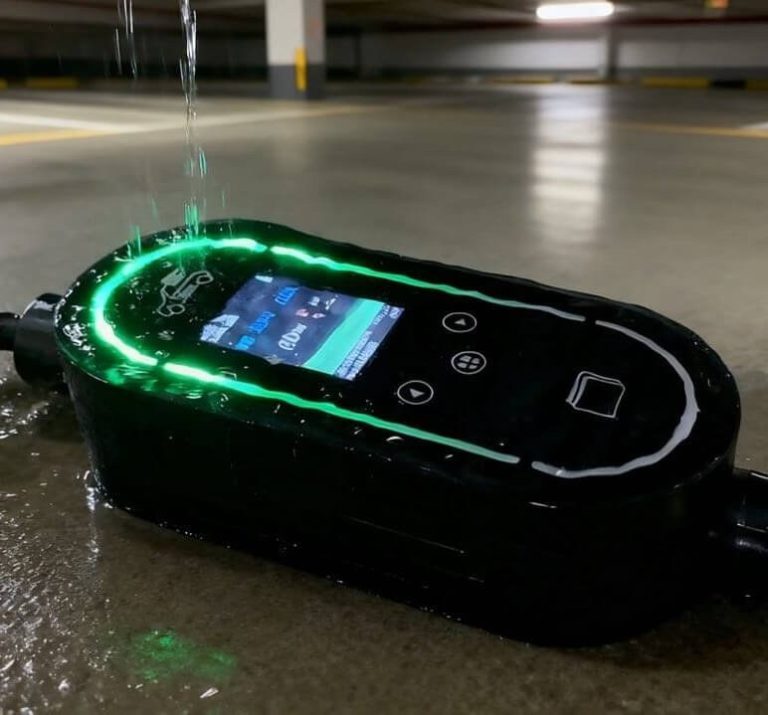
Standard cables usually run 18 to 25 feet, which covers most driveways but not every layout. Verify the enclosure’s weather rating and operating-temperature limits from the manufacturer before mounting outdoors, and follow the connector storage guidance rather than leaving the plug in standing water or snow.
Smart Features: Scheduling, Time-of-Use, Load Sharing, and App Support
Wi-Fi EVSEs can schedule off-peak charging, participate in utility programs, and share power across two units. Check whether the app requires an account, whether features depend on cloud connectivity, and what happens to your schedule if the service is unavailable.
Warranty, Support, and Installation Details to Verify
Confirm the US warranty term, whether it covers labor, how support is reached, and whether the unit carries a recognized safety listing. Verify the listing from the manufacturer or the certification record — never infer it from marketing language.
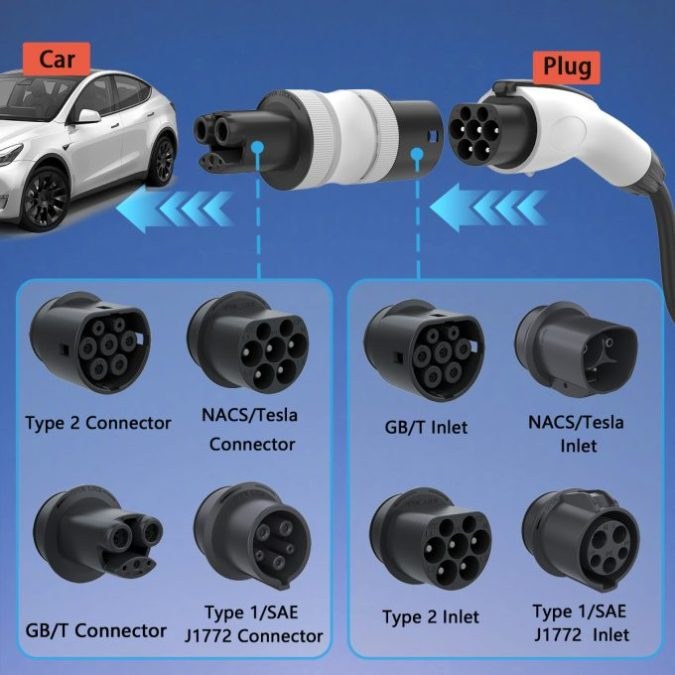
J1772 Adapters and Compatibility in 2026: Tesla, NACS, and Other EVs
Adapters solve physical fit, not protocol. Direction and AC/DC mode matter more than the plug shape.
Important: Physical fit alone does not prove every AC or DC charging mode is supported.
Adapter Direction: J1772 to Tesla/NACS vs. NACS to J1772
A J1772-to-NACS adapter lets a NACS-port vehicle use a J1772 AC charger. A NACS-to-J1772 adapter lets a J1772-port vehicle use a NACS AC charger, such as a Tesla Destination charger. These are two different products and are not interchangeable.
AC vs. DC Adapter Rules: Why J1772 Cannot Access DC Fast Charging
Because J1772 has no DC power pins, no adapter can turn a J1772 inlet into a DC fast-charging inlet. DC fast charging on a non-Tesla vehicle requires a CCS1 or NACS inlet, or an approved DC adapter specified by the vehicle manufacturer.
Vehicle and Network Restrictions: Public J1772, Tesla Destination, and App Activation
Some public J1772 stations require an app, an RFID card, or a network account before they will release current. Tesla Destination chargers may be restricted to certain vehicles depending on the property’s settings. Confirm activation requirements before you arrive.
Power Limits, Thermal Safety, and Firmware or Vendor Requirements
Adapters have their own current ratings and thermal limits. Use only adapters specified or approved by your vehicle manufacturer, respect the lowest rated component in the chain, and check whether a firmware update is required for the vehicle to recognize a given adapter.
What J1772 Charging Costs: Home Electricity, Public Rates, and Installation
Home charging cost is mostly arithmetic. Installation cost is where the surprises live.
Illustrative example only. Rates, taxes, time-of-use windows, demand charges, and real losses vary by utility and vehicle.
Cost Formula: Electricity Rate × kWh Delivered ÷ Charging Efficiency
If you pay $0.17 per kWh and need 40 kWh into the battery at roughly 90% efficiency, you draw about 44.4 kWh from the grid, or about $7.55. Always divide by efficiency rather than multiplying — losses increase the electricity you buy.
Time-of-Use Pricing, Off-Peak Scheduling, and Demand Charges
Many US utilities offer time-of-use rates with cheaper overnight windows. Scheduling charging to those hours is one of the largest controllable savings. Some commercial or residential plans also apply demand charges based on peak draw, which can matter more than the per-kWh rate.
Equipment and Installation Cost Factors: Circuit Run, Panel, Permits, and Labor
The biggest variables are the distance from your panel to the mounting location, whether your panel has spare capacity, whether a subpanel or service upgrade is needed, and local permit and inspection fees. Get a written quote that itemizes these before committing.
Public J1772 Pricing vs. Home Charging: Session Fees, Idle Fees, and Per-kWh Rates
Public AC charging may bill per kWh, per hour, or with a flat session fee, and many networks add idle fees once charging completes. Home charging is usually cheaper per kWh, but only if you already have a suitable circuit.
J1772 Charging and Battery Health: Manufacturer Guidance vs. General Patterns
Your owner’s manual is the authority here. General advice from forums or videos should never override manufacturer guidance for your specific model.
State of Charge, Temperature, and Charging Power: Follow Your Manual
Some manufacturers recommend a daily charge limit for regular use and a higher limit for trips. Others publish different guidance for LFP versus nickel-based chemistries. Charging power also tapers at high or low state of charge and in extreme temperatures.
Does AC J1772 Charging Wear Out a Battery? DC Fast Charging in Context
AC charging is generally gentler than DC fast charging because it operates at lower power and produces less heat in the pack. That does not make it risk-free at extreme temperatures or very high states of charge, but routine Level 2 charging is not typically the main concern in battery-degradation discussions.
Chemistry, Thermal Management, and Convenience Trade-Offs
Vehicles with liquid-cooled packs tolerate a wider range of conditions than air-cooled designs. Practically, most owners should optimize for convenience and follow the manual — not chase perfect habits that make the car harder to live with.
J1772 Charging Efficiency and Range: What Changes Your Miles per kWh
Charging efficiency and driving efficiency are separate numbers, and both affect your real-world cost per mile.
Wh/mi and mi/kWh Benchmarks for Planning, Not Promising
A mid-size EV might return roughly 3.0 to 4.0 mi/kWh in mixed driving, which is about 250 to 333 Wh/mi. Treat any single number as an example, not a guarantee for your route or climate.
Speed, Weather, HVAC, Elevation, Payload, and Tires
Highway speed increases aerodynamic drag sharply. Cold weather reduces usable range and increases cabin-heating draw. Elevation gain, roof racks, extra passengers, underinflated tires, and worn tires all push consumption upward.
Charging Losses and Preconditioning: Where the Electricity Goes
Some grid energy never reaches the battery — it goes to conversion losses, pack heating or cooling, and, in cold conditions, preconditioning. That is why the energy you pay for is usually higher than the energy your dashboard reports.
Who J1772 Charging Is For in 2026: A Practical Buyer’s Guide
J1772 remains the right answer for a large share of US EV owners, but not all of them.
Best Fit: Older EVs, PHEVs, and Standard Public AC Charging
If your vehicle has a J1772 inlet, a J1772 EVSE is the straightforward choice. Plug-in hybrids with smaller batteries often do fine on Level 1 or a modest Level 2 unit, and public J1772 AC stations remain common in workplaces and parking garages.
When to Choose Hardwired 40-48A vs. Plug-In 32-40A
Choose hardwired 40–48 A if your vehicle accepts that current, your panel supports it, and you want the fastest overnight refill. Choose plug-in 32–40 A if you rent, may relocate, or your daily mileage is modest. Confirm your vehicle’s onboard charger rating before paying for extra amperage you cannot use.
When a Different Connector or DC Fast Charging Makes More Sense
If you regularly drive long distances, home AC charging does not replace DC fast charging — it complements it. If your vehicle has a NACS inlet, a NACS EVSE avoids an adapter at home entirely.
Installation Checklist: Manual First, Local Code and Permit Second
- Confirm your vehicle’s inlet and maximum AC charging rate
- Verify the EVSE’s amperage setting and required circuit
- Check panel capacity with a licensed electrician
- Confirm cable length, mounting, and indoor/outdoor suitability
- Verify safety listing, warranty, app requirements, and support
- Budget for permits, labor, and electricity cost per mile
Frequently Asked Questions
No. J1772 is a connector and signaling standard, while Level 1 and Level 2 describe voltage and power. In North America, both Level 1 (120 V) and Level 2 (240 V) charging typically use the J1772 connector on non-Tesla vehicles.
Yes, for AC charging. Tesla vehicles have long shipped with a J1772 adapter for AC charging, and newer Tesla models with NACS ports can use a J1772-to-NACS adapter. DC fast charging is a separate case and requires different hardware.
No. The J1772 connector has no dedicated DC power pins, so no adapter can make a J1772 inlet accept DC fast charging. CCS1 and NACS are the interfaces used for DC fast charging in North America.
Level 1 typically delivers roughly 1.4 to 1.9 kW, while Level 2 commonly ranges from about 3.8 kW to 11.5 kW depending on amperage. Actual range added per hour depends on your vehicle’s efficiency, battery temperature, and the lowest limit in the charging chain.
Yes. A J1772-port vehicle needs a NACS-to-J1772 adapter to connect to a Tesla Destination charger. Some properties restrict access, so confirm availability and activation requirements before relying on one.
Only if the manufacturer rates the enclosure for outdoor use and you follow its operating-temperature and connector-storage guidance. Verify the weather rating from the manufacturer’s documentation rather than assuming outdoor suitability from appearance.