NEMA 6-50 Outlet for EV Charging: What You Need to Know
A NEMA 6-50 outlet can charge an EV at up to 40 amps continuous — about 9.6 kW — if your EVSE has a matching plug or is hardwired on that circuit. The main catch is that NEMA 14-50 dominates the US EVSE market, so your equipment choices are narrower.
A NEMA 6-50 outlet for EV charging is a 240-volt, 50-amp receptacle that can supply a Level 2 EVSE at up to 40 amps continuous — about 9.6 kW — when the circuit, breaker, wiring, and charging equipment all match. It works well for many home setups, but it is not the most common EV receptacle in the United States, so plug compatibility, adapter direction, and local electrical rules deserve a close look before you commit.
- Compatibility: A 6-50 works for Level 2 AC charging, but you need an EVSE with.
- Performance: 40 amps continuous is the ceiling on a 50-amp circuit; your vehicle’s onboard charger.
- Safety: Confirm conductor size, breaker rating, EVSE amperage setting, and any GFCI or permit requirement.
- Cost: Charging cost depends on your rate, kWh added, and charging losses — not on.
What Is a NEMA 6-50 Outlet for EV Charging?
NEMA 6-50 is a receptacle and plug standard published by the National Electrical Manufacturers Association. The “6” identifies a 250-volt, two-pole, three-wire grounding configuration, and “50” identifies a 50-amp rating. In a typical US home, that means a 240-volt branch circuit with two hot conductors and one equipment ground.
The 6-50 family has been used for decades for welders, plasma cutters, and similar 240-volt shop equipment. That history is exactly why some EV owners ask about it: a garage may already have a 6-50 receptacle from a previous owner, and reusing it can look simpler than running a new circuit.
NEMA 6-50 Connector Basics: Pins, Voltage, and Amperage
A NEMA 6-50 plug has three pins: two hots and a ground. There is no neutral pin, which is the key difference from the four-pin NEMA 14-50. Because Level 2 EV charging is a 240-volt, two-pole load that does not require a neutral, the missing neutral is not a functional problem for an EVSE.
The receptacle is rated 250 volts and 50 amps. Under the continuous-load rules that apply to EV charging, a 50-amp circuit supports a maximum 40-amp charging current — 80% of the branch-circuit rating. That works out to roughly 9.6 kW at a nominal 240 volts.
How NEMA 6-50 Compares to Other EV Charging Outlets (NEMA 14-50, 6-20, 5-15)
These four receptacles show up most often in US EV charging conversations. The table below compares the outlet itself — not the vehicle connector, which is a separate topic covered later.
| Outlet | Configuration | Why it matters for EV charging |
|---|---|---|
| NEMA 14-50 | 240 V, 50 A, two hots + neutral + ground | Widely used for EVSE and RVs; supports up to 40 A continuous on a 50 A circuit. |
| NEMA 6-50 | 240 V, 50 A, two hots + ground | Same 40 A continuous ceiling as 14-50, but no neutral and a less common EVSE plug. |
| NEMA 6-20 | 240 V, 20 A, two hots + ground | Supports up to 16 A continuous, roughly 3.8 kW — a modest Level 2 rate. |
| NEMA 5-15 | 120 V, 15 A, hot + neutral + ground | Level 1 charging only, up to 12 A continuous, roughly 1.4 kW. |
Primary Answer: Can You Use a NEMA 6-50 Outlet for EV Charging?
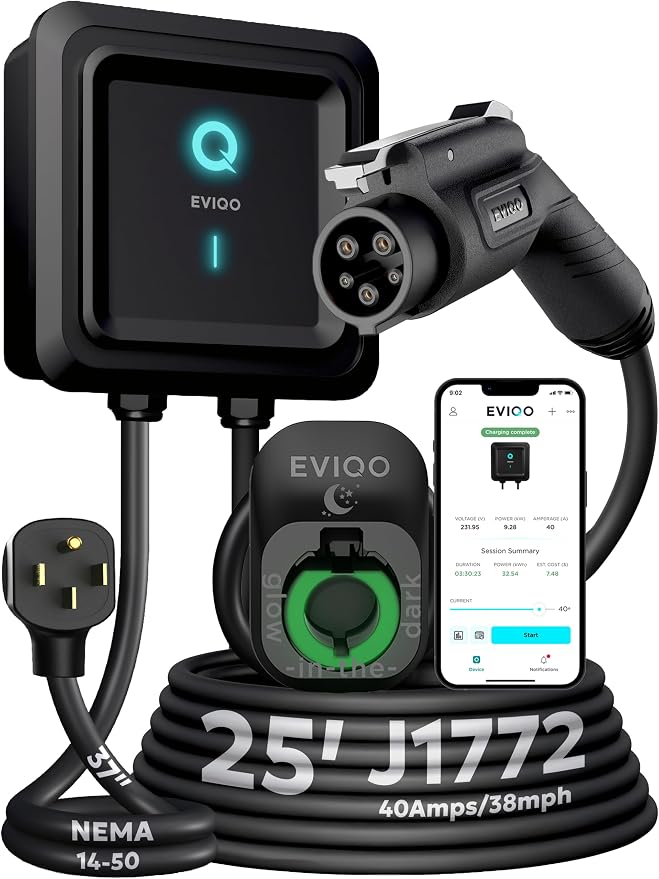
Yes — provided the EVSE you plan to use is designed for a NEMA 6-50 plug, or you are hardwiring the EVSE and the 6-50 is simply the existing circuit you are replacing. Several EVSE makers offer 6-50 plug variants alongside their 14-50 versions, and the two are electrically equivalent for EV charging purposes.
The practical catch is availability. NEMA 14-50 dominates the US EVSE market, so the 6-50 selection is narrower. If you already own a 6-50 receptacle, that may not matter. If you are starting from scratch, it usually does.
EV Charging Equipment Compatibility with NEMA 6-50

Two different connectors get confused in these discussions. The wall plug — NEMA 6-50 — connects the EVSE to the building wiring. The vehicle connector — J1772 or NACS — connects the EVSE to the car. They are unrelated, and matching one does not guarantee anything about the other.
EVSE Connector Types and Adapter Options for NEMA 6-50
On the wall side, some EVSE models ship with a 6-50 plug, and some ship with a 14-50 plug. On the vehicle side, most US Level 2 EVSE today use a J1772 connector, while a growing share use NACS (SAE J3400). Many EVSE with a NACS connector also include or support a J1772 adapter, but adapter direction and support vary by manufacturer.
Wall-side adapters exist that convert a 6-50 receptacle to a 14-50 plug, or the reverse. Because an EVSE does not use the neutral, a 6-50-to-14-50 adapter can work electrically for charging. That does not make it universally safe or code-compliant, and it is not the same as adapting a 14-50 receptacle for an RV, which does need the neutral.
Vehicle Onboard Charger Limits and NEMA 6-50 Power Delivery
The outlet does not decide your charging speed. The vehicle’s onboard AC charger does. A 6-50 circuit can deliver up to about 9.6 kW, but a car with a 7.2 kW onboard charger will never draw that much regardless of the EVSE.
Common onboard charger ratings in the US market include roughly 7.2 kW, 9.6 kW, 11 kW, and 19.2 kW. If your car tops out at 7.2 kW, a 40-amp EVSE on a 6-50 circuit already exceeds what the car can accept. If your car accepts 11 kW or more, a plug-in 6-50 setup becomes the bottleneck. Our breakdown of whether 40 amps is enough for a Level 2 EV charger covers that trade-off in more detail.
Plug-In vs. Hardwired EVSE: Which Fits a NEMA 6-50 Circuit?
Requires a matching 6-50 receptacle on a dedicated circuit. Portable and easy to replace, but typically capped at 40 A continuous and subject to the receptacle and GFCI rules your jurisdiction applies.
Removes the receptacle entirely and connects the EVSE directly to the branch circuit. This is how higher-output units reach 48 A and beyond, and it avoids plug and receptacle wear points.
Electrical Requirements, Circuit Design, and Installation for NEMA 6-50 EV Charging
Everything in this section is safety-sensitive and jurisdiction-dependent. The EVSE manufacturer’s instructions and your local authority having jurisdiction govern the actual installation. The notes below describe general US practice, not a substitute for either.
Circuit Breaker and Wire Sizing: Manual and Local Code First
A NEMA 6-50 receptacle is normally installed on a 50-amp, two-pole branch circuit. Because EV charging is treated as a continuous load, the EVSE must be configured to draw no more than 40 amps on that circuit. A 40-amp EVSE set to 40 amps on a 50-amp breaker is the standard pairing.
Conductor sizing depends on the ampacity tables, the conductor material, the insulation temperature rating, and the terminations at both ends. Six-gauge copper is a common choice for 50-amp circuits, but the correct answer comes from the equipment instructions and the applicable code edition. Our guide to 48 amp EV charger wire size explains how conductor selection changes when you move up to a 60-amp circuit for a hardwired 48-amp unit.
Panel Capacity, Load Calculations, and Permitting in the U.S.
A 40-amp continuous load is a significant addition to a residential service. Before any work begins, a load calculation determines whether the existing panel and service can support it. If they cannot, the options range from a panel upgrade to a load-management device that pauses charging when household demand peaks — but the acceptable approach depends on what your local code edition and utility allow.
Permits and inspections are handled at the local level. Some jurisdictions require a permit for a new 240-volt branch circuit; others also require inspection before the circuit is energized. Skipping that step can complicate insurance claims and resale, so confirm the process with your city or county before scheduling work.
Installation Costs and Equipment Considerations for 2026
Installed cost varies too widely for a single national figure to be meaningful. The main drivers are the distance from the panel to the mounting location, whether the run is through finished walls or an unfinished garage, whether the panel needs upgrading, whether a permit and inspection are required, and the price of the EVSE itself.
Reusing an existing 6-50 circuit is usually the least expensive scenario because the wiring and breaker are already in place. A long conduit run through finished space, or a service upgrade, is at the other end of the range. Getting two or three local quotes with the same scope is the only reliable way to compare.
Charging Costs and Efficiency with a NEMA 6-50 Outlet
Charging cost depends on your electricity rate, how much energy actually reaches the battery, and the losses along the way — not on the shape of the plug.
Electricity Rate, kWh Delivered, and Charging Losses: A Simple Formula
The formula is straightforward: cost equals energy drawn from the grid multiplied by your effective rate. Energy drawn from the grid is the energy added to the battery divided by charging efficiency. Level 2 AC charging typically loses a single-digit to low-double-digit percentage to onboard charger conversion, cable resistance, and thermal management, though the exact figure varies by vehicle and conditions.
Illustrative only. Your rate, taxes, fees, time-of-use windows, and real-world losses will differ.
Time-of-Use Pricing and Off-Peak Charging Savings
Many US utilities offer time-of-use plans with a lower overnight rate. Because a 6-50 circuit delivers roughly 9.6 kW at full output, an EV can add a large amount of energy during a short off-peak window — often enough to cover a full day of driving in a few hours. Scheduling charging through the EVSE app or the vehicle itself is what unlocks that saving.
Check whether your plan includes demand charges, which bill based on your highest short-term usage rather than total energy. A demand charge can change the math considerably, especially in households that also run electric heating, a heat pump, or an electric range.
Range and Efficiency Context: mi/kWh, Weather, Speed, HVAC, Elevation, and Payload
Charging cost per mile depends on vehicle efficiency in mi/kWh, which swings widely. Cold temperatures reduce usable range and increase charging losses. Highway speed raises aerodynamic drag. Cabin heating and cooling draw energy. Elevation gain, payload, tire pressure, and tire type all move the number too. Any per-mile cost you calculate is an estimate tied to specific conditions, not a fixed property of the outlet.
Battery Health and Charging Power on a NEMA 6-50 Outlet
Level 2 AC charging at 40 amps is a moderate rate for a modern EV battery. It is well below DC fast charging and is generally the gentlest practical way to charge at home.
Manufacturer Guidance vs. General Patterns for AC Charging
Follow your vehicle manufacturer’s charging guidance first. Some automakers publish specific daily charging recommendations; others do not. General patterns from battery research — avoiding prolonged time at very high or very low state of charge, and preferring moderate charge rates — are useful context but should not override the manual that came with your car.
Temperature, State of Charge, and Thermal Management
Battery temperature matters more than charge rate for most daily-driving scenarios. A vehicle with active liquid thermal management will precondition or cool the pack as needed during AC charging. A vehicle with passive thermal management has less control. Extreme cold slows charging and reduces range; extreme heat accelerates degradation over time. Parking in a shaded or climate-controlled space helps in both cases.
DC Fast Charging Context and Convenience Trade-Offs
A NEMA 6-50 outlet cannot deliver DC fast charging. It is an AC connection, and the vehicle’s onboard charger converts the AC to DC. DC fast charging bypasses the onboard charger and uses a different connector and protocol entirely. For daily home charging, the slower AC rate is usually an advantage; for road trips, it is simply irrelevant.
NEMA 6-50 Outlet Safety, Weather Suitability, and Adapter Cautions
Thermal and Safety Considerations for Plug-In EVSE
A plug-in EVSE concentrates a continuous 40-amp load at the receptacle and plug interface. That interface is a wear point. A receptacle that is loose, discolored, or warm to the touch after charging indicates a problem that should be investigated by a qualified electrician before further use. Hardwired connections eliminate that interface.
Outdoor and Garage Installation: Weather Ratings and Cable Length
Cable length is a practical constraint that is easy to underestimate. Measure the actual path from the mounting location to the vehicle charge port, including any routing around a parked second car. Most EVSE ship with a cable in the 18- to 25-foot range, but confirm the specific model’s length rather than assuming.
Adapter Direction, AC/DC Mode, Power Limits, and Firmware Requirements
Adapters are where most of the risk lives. A 6-50-to-14-50 adapter used to feed an EVSE is a wall-side adapter and does not change the AC charging mode. An adapter used to connect a NACS vehicle to a J1772 EVSE is a vehicle-side adapter and must be rated for the current involved. An adapter that claims to convert an AC outlet into a DC fast-charging connection does not exist and should be treated as a red flag.
Some EVSE require a firmware setting or a physical amperage configuration to match the circuit. If the unit is left at a higher setting than the circuit supports, the breaker will trip at best. Confirm the setting before the first charge.
Smart Features, Warranty, and Support for NEMA 6-50 EVSE
Smart Charging Features and Network Restrictions
Smart EVSE add scheduling, energy monitoring, and utility demand-response participation. These features depend on a cloud account and a network connection. If the manufacturer’s service is discontinued or your Wi-Fi is down, the unit may fall back to a default charging behavior rather than your saved schedule. Check what the manufacturer documents about offline operation before relying on smart features for off-peak savings.
Warranty, Support, and Long-Term Reliability
Warranty terms for Level 2 EVSE commonly run from one to three years in the US, though this varies by brand and model. Verify the term, what it covers, and whether installation by a licensed electrician is a condition of coverage. Also check whether the manufacturer has a US-based support channel and whether replacement parts such as cables and holsters are sold separately.
Who Should Choose a NEMA 6-50 Outlet for EV Charging?
Fit for Renters, Homeowners, and Multi-EV Households
A 6-50 outlet makes the most sense when the circuit already exists and the EVSE you want is available with a 6-50 plug. Homeowners who already have a 6-50 receptacle for a welder or shop tool are the clearest fit. Renters generally cannot modify the electrical system, so a plug-in setup on an existing circuit is the only realistic option — and even then, landlord permission and local rules apply.
Multi-EV households should think about total daily energy rather than peak rate. A single 40-amp circuit can usually cover two commuter EVs overnight if charging is scheduled, but two long-range vehicles with heavy daily use may justify a second circuit or a hardwired unit with load sharing.
Alternatives to Consider: NEMA 14-50, Hardwired, and Portable Chargers
NEMA 14-50 is the safer default for a new installation because the EVSE selection is far larger and the receptacle is familiar to electricians and inspectors. Hardwiring is the better choice if you want 48 amps or more, want to avoid the plug interface entirely, or live in a jurisdiction with strict receptacle rules. A portable Level 2 EVSE that plugs into an existing outlet is the flexible option for renters and travelers. If you are shopping for higher-output equipment, our roundup of the best 48 amp Level 2 EV chargers for home charging covers the hardwired side of that decision.
- Best for: Owners who already have a dedicated 50-amp NEMA 6-50 circuit and can find an EVSE with a matching plug.
- Think twice if: You are installing new wiring — NEMA 14-50 or a hardwired setup usually offers more equipment choice and fewer adapter questions.
- Next step: Confirm your vehicle’s onboard charger limit, then verify the EVSE’s plug type, amperage setting, and installation requirements against the manufacturer instructions and your local electrical authority.
Frequently Asked Questions
No. The EVSE must have a NEMA 6-50 plug, or you must hardwire it to the circuit. Most US Level 2 EVSE ship with a NEMA 14-50 plug or are hardwired only, so check the specific model’s plug configuration before buying.
Electrically they are very similar for EV charging: both are 240-volt, 50-amp configurations supporting up to 40 amps continuous. The difference is the neutral pin. NEMA 14-50 has one; NEMA 6-50 does not. EVSE do not use the neutral, so either works for charging, but the plug shapes are not interchangeable without an adapter.
A 50-amp branch circuit supports a maximum of 40 amps continuous for EV charging, which is about 9.6 kW at 240 volts. Your vehicle’s onboard charger may limit you to less — common ratings include 7.2 kW, 9.6 kW, and 11 kW.
Adapters exist, and because an EVSE does not use the neutral, a 6-50-to-14-50 adapter can function electrically for charging. However, adapters add a connection point and may not be permitted by your local code or covered by the EVSE warranty. Confirm with the manufacturer and your local electrical authority before relying on one.
Permit requirements are set locally and vary widely. Many US jurisdictions require a permit for a new 240-volt branch circuit and an inspection before it is energized. Check with your city or county building department, and confirm whether GFCI protection is required for the receptacle in your area.
Hardwiring is generally the better choice for a new installation because it removes the plug and receptacle interface, allows higher outputs such as 48 amps, and avoids receptacle-specific code requirements. A NEMA 6-50 outlet makes sense mainly when the circuit already exists and you want a plug-in setup.