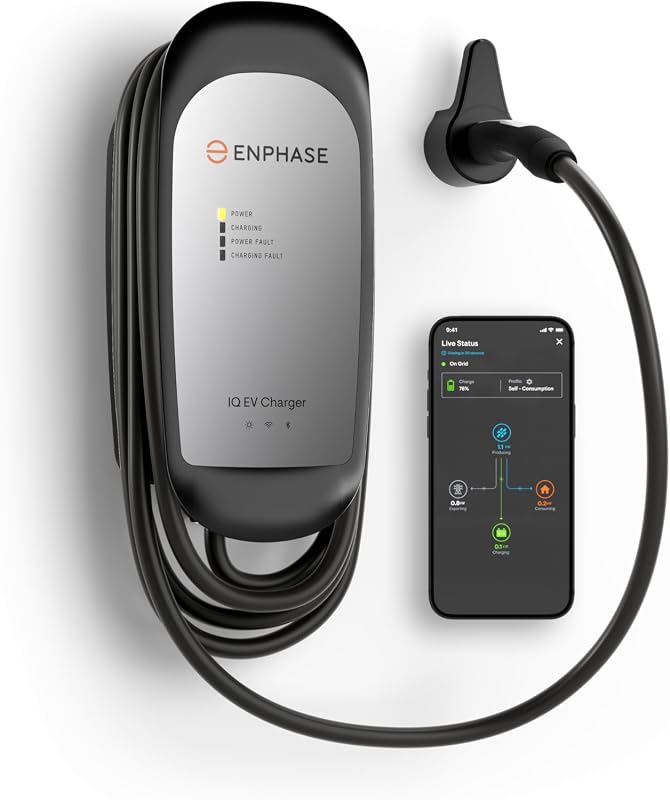
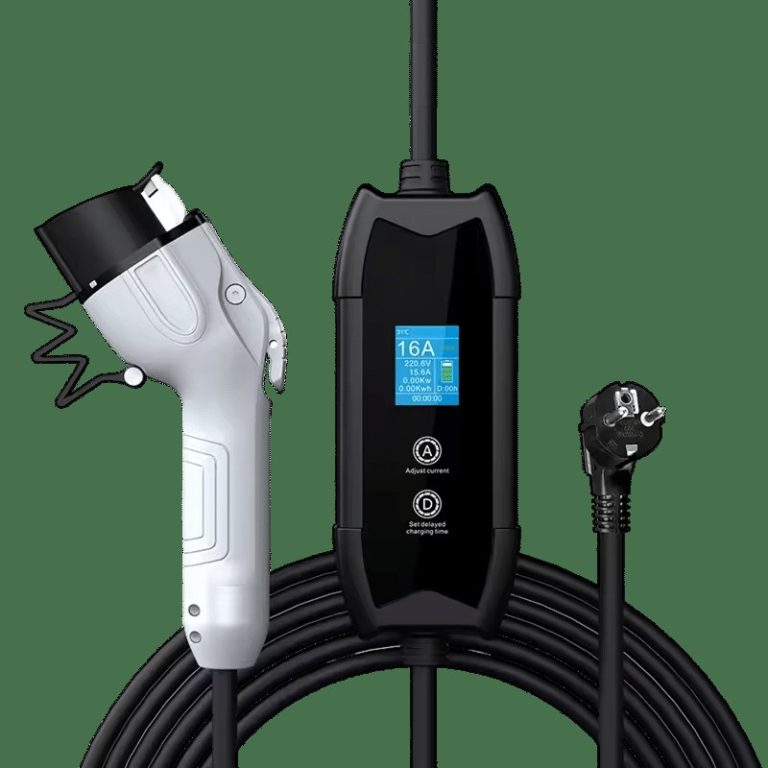
Can You Run an EV Charger Cable Under a Garage Door?
You can physically run a charging cable under a garage door, but it is only reasonable as a temporary fix — a closing door can crush the jacket and most EVSE manuals prohibit it. The safer long-term answer is an exterior 240V outlet, a wall pass-through, or a hardwired outdoor EVSE.
Running an EV charger cable under garage door is technically possible, and plenty of owners do it for a few hours at a time. But whether it is safe, code-compliant, and good for the cable depends almost entirely on how you route it, what the door does to it, and what your EVSE manufacturer says.
This guide breaks down the real risks, the routing methods that actually hold up, the alternatives that are usually better, and the electrical and cost questions you should answer before you plug in.
- Compatibility: EVSE amperage and your vehicle’s onboard AC charger both cap charging speed; the lower.
- Performance: Cable routing does not change charging power, battery health, or DC fast-charging speed.
- Safety: Never let the door close on the cable, never use a household extension cord.
- Cost: Under-door routing is free upfront but risks cable, seal, and warranty costs; an exterior.
Can You Run an EV Charger Cable Under a Garage Door? The Short Answer
Yes, you can physically run a charging cable under a closed or partially closed garage door, and many owners do it temporarily. No universal US code rule specifically bans it, but that does not make it automatically safe or compliant.
What matters is whether the cable is being crushed, abraded, pinched, or exposed to standing water while energized. A cable that is gently passing over a smooth threshold with a protective ramp and no weight on it is a very different situation from a cable crushed between a concrete slab and a steel door bottom.
The practical answer: treat it as a temporary or occasional solution, not a permanent installation. If you need to charge this way every night for years, a dedicated outdoor outlet or a hardwired EVSE is the better long-term answer.
The Real Risks of Running a Charger Cable Under a Garage Door

Most of the damage happens slowly, which is why owners get away with it for months and then run into trouble. Here is what actually goes wrong.
Pinching and Abrasion: What Happens to the Cable
A garage door bottom seal is designed to compress against concrete. When a cable sits in that gap, the door applies constant pressure to a small section of the jacket. Over time, that pressure can flatten the jacket, crack the insulation, or break strands inside the conductors.
Damaged insulation on a 240V cable is a shock and fire hazard, not just a performance problem. It also voids most EVSE warranties, since manufacturer instructions almost always prohibit routing the cable through a closing door.
Weather and Moisture Exposure
The section of cable outside the door sees rain, snow, ice melt, and UV. Even a cable rated for outdoor use has limits, and the connector end is the most vulnerable part. Manufacturer guidance on connector storage and operating temperature matters here — check the manual rather than assuming “outdoor rated” means “leave it in a puddle.”
Water pooling at the threshold is common on sloped driveways. If the cable sits in that water while energized, you are relying entirely on the EVSE’s ground-fault protection and the integrity of the jacket.
Tripping Hazards and Damage to the Door Seal
A cable crossing a driveway is a trip hazard for anyone walking to the car, and it can snag on bicycles, strollers, or snow shovels. The door seal itself also takes damage: repeated compression over a hard cable deforms the rubber, which then leaks air, water, and pests into the garage.
Safe Methods for Routing an EV Charger Cable Under a Garage Door
If you are going to do this, these are the approaches that reduce risk the most. None of them eliminate the need to follow your EVSE instructions.
Using a Cable Protector or Ramp
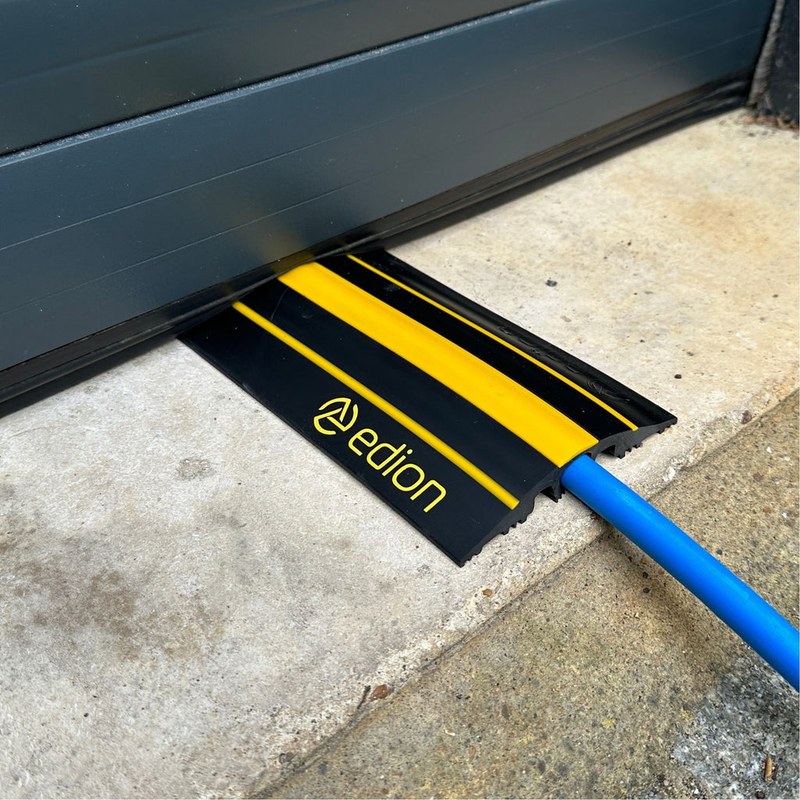
A purpose-made cable ramp or drop-over protector spreads the load and keeps the cable off the concrete. The door should not be closing on the ramp itself unless the ramp is designed for that. Look for a ramp rated for vehicle traffic if the cable crosses a driveway, and check that the channel is wide enough that the cable is not pinched against the walls of the channel.
Adjusting the Garage Door Travel or Seal
Some owners raise the door’s down-limit slightly so the seal rests on the threshold without full compression, leaving a small gap. This can reduce crush force, but it also defeats the seal’s weather and pest function and may affect the door opener’s safety reversal behavior.
If you go this route, have a garage door technician confirm the door still meets its safety requirements, including the auto-reverse test. Do not disable safety features to make room for a cable.
Installing a Pass-Through or Conduit
The most durable under-door solution is not under the door at all — it is through the wall. A weather-rated pass-through, a service entrance fitting, or a short conduit run through the garage wall lets the cable exit cleanly at a fixed height with no crush point and no trip hazard.
This is a permanent modification to the building envelope, so it needs proper sealing, flashing, and in most jurisdictions a permit and inspection. It is also the option that best preserves your EVSE warranty, because the cable is never loaded or abraded.
Alternatives to Running Cable Under the Garage Door
In most cases, one of these three options is cheaper over the long run than replacing a damaged cable or repairing a door seal.
Installing a New 240V Outlet Near the Garage Door
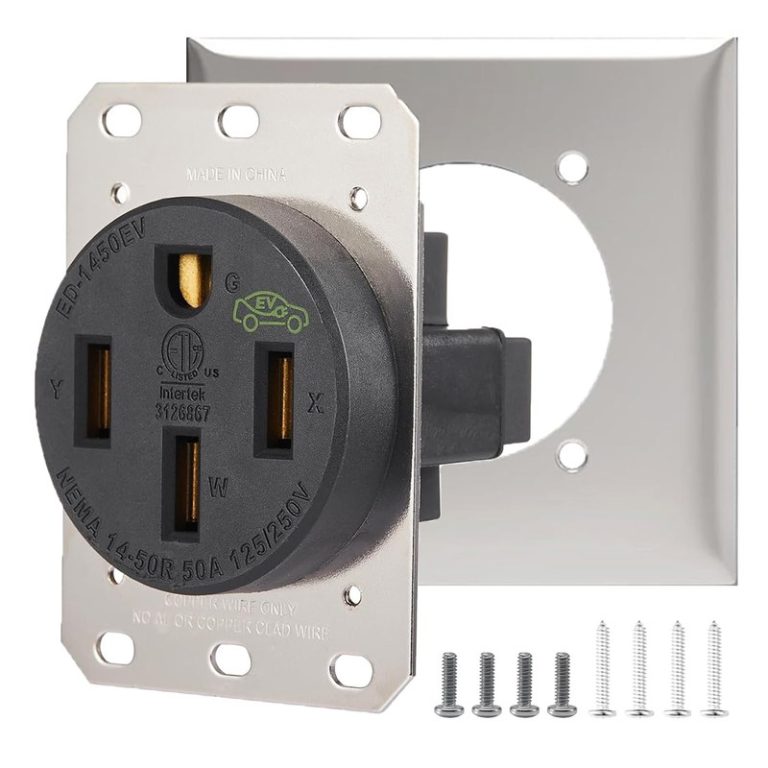
A dedicated 240V receptacle mounted on the exterior wall near the driveway lets you park the EVSE outside or use a portable unit without any cable crossing the door line. This requires a dedicated circuit, appropriate overcurrent protection, and a receptacle type matched to your EVSE’s plug.
Outdoor receptacles need weather-rated covers and GFCI protection where required by the applicable code and the equipment instructions. Your local authority having jurisdiction is the final word on what applies to your installation.
Hardwiring an EVSE Outside
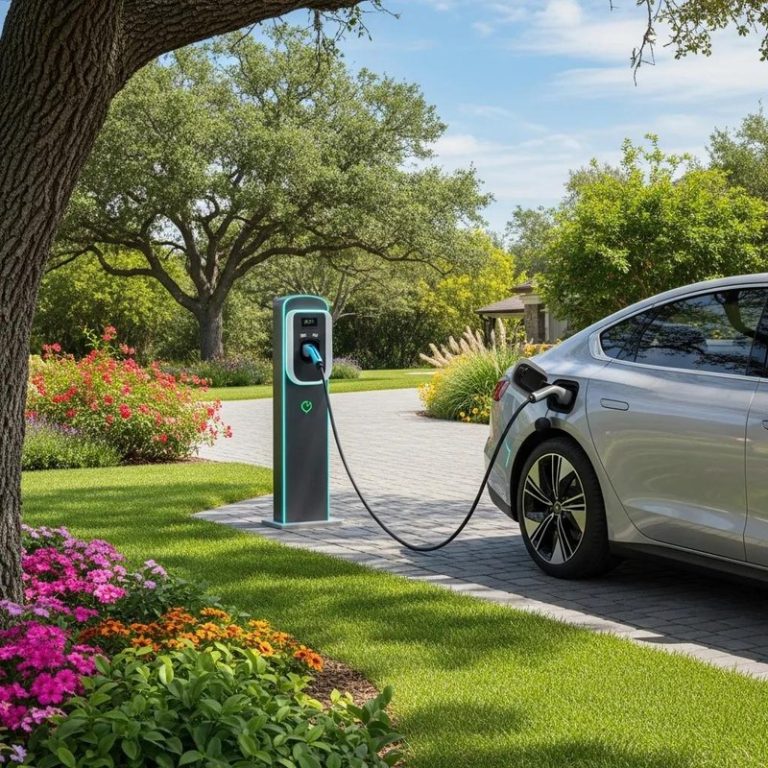
A hardwired outdoor EVSE removes the plug-and-receptacle interface entirely, which is often the weakest link in an outdoor setup. Hardwiring typically allows higher continuous current settings than a plug-in unit on the same circuit, and it eliminates a connection point that can corrode or overheat.
The trade-off is that hardwired units are not portable and the installation is more involved, usually requiring a licensed electrician, a permit, and an inspection.
Using a Longer EVSE Cable (Within Manufacturer Limits)
Some EVSEs are available with longer cables, and repositioning the unit closer to the door opening can solve the reach problem without any under-door routing. The key constraint is that you cannot extend the cable yourself.
Splicing, adding a cord, or using an aftermarket cable extension on an EVSE is not something manufacturers support, and it creates real thermal and voltage-drop risk. If reach is the problem, buy the right cable length up front or move the unit.
Side-by-Side Comparison: Under-Door vs. Alternatives
| Approach | Main advantage | Main limitation | Best for |
|---|---|---|---|
| Under-door routing | No installation cost, uses existing EVSE | Cable crush, abrasion, weather, trip hazard, likely warranty issue | Occasional or short-term charging only |
| Exterior 240V outlet | No cable across the door line; keeps EVSE portable | Requires dedicated circuit, permit, and weather-rated hardware | Owners who want flexibility and a permanent fix |
| Hardwired outdoor EVSE | Fewest connection points; typically supports higher current | Higher install cost; not portable | Long-term daily charging on a dedicated circuit |
| Wall pass-through / conduit | Eliminates crush point and trip hazard | Building modification; sealing and permit required | Owners who want to keep one EVSE serving both sides |
EVSE and Electrical Requirements for Under-Door Routing
Before you decide on routing, get the electrical side right. These are the variables that determine whether your setup works at all.
Plug-in vs. Hardwired EVSE: Which Fits Your Setup?
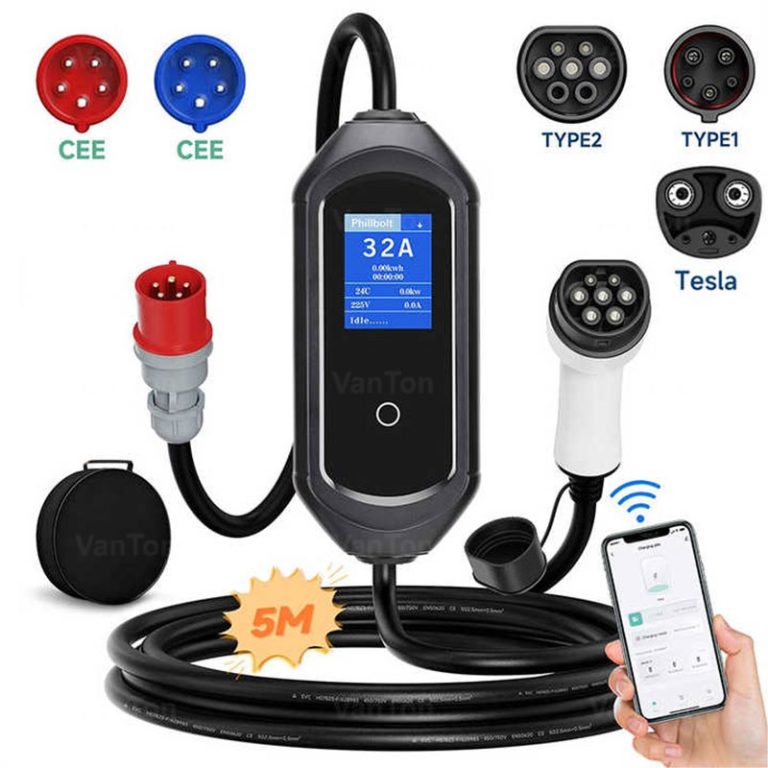
Uses a matching 240V receptacle and plug. Portable and easier to relocate, but adds a plug connection that must stay dry and correctly rated. Verify receptacle type, circuit rating, and any GFCI requirement.
Wired directly to a dedicated circuit. Fewer connection points, better suited to permanent outdoor use, and often the only way to reach the highest current settings. Requires a licensed electrician and typically a permit.
If you are comparing portable versus fixed options, our breakdown of what a portable EV charger is and how it works covers the practical differences.
Circuit and Panel Implications: Consult a Licensed Electrician
Continuous EV charging loads are treated differently from intermittent loads, and the circuit, breaker, and conductor sizing must match both the EVSE’s maximum setting and the manufacturer’s instructions. Panel capacity, available breaker spaces, service size, and load calculations all matter.
If you are working out whether a 48-amp unit fits your panel, this explanation of whether a 48-amp EV charger needs a 60-amp circuit is a useful starting point before you talk to an electrician.
Cable Length, Gauge, and Voltage Drop
Longer runs increase voltage drop, which reduces delivered power and makes the conductors run warmer. Undersized conductors on a continuous load are a genuine fire risk, not a minor efficiency issue.
Conductor sizing depends on the charging current, the run length, the insulation temperature rating, and the termination ratings of the equipment. Our guide to 48-amp EV charger wire size walks through how those variables interact.
Connector Types and EVSE Amperage: Matching Your Vehicle’s Onboard Charger
Two separate limits govern your charging speed. The EVSE sets the maximum current it will offer, and the vehicle’s onboard AC charger sets the maximum it will accept. Whichever is lower wins. A 48-amp EVSE does not make a vehicle with a 32-amp onboard charger charge any faster.
On the connector side, J1772 and NACS/SAE J3400 are the common North American AC interfaces, and CCS1 is a DC fast-charging standard. Physical fit alone never proves that a given charging mode is supported — check the vehicle inlet and the EVSE specification separately.
If you are deciding how much amperage you actually need, this look at whether 40 amps is enough for a Level 2 EV charger is a helpful reality check before you size a circuit.
Weather Suitability, Smart Features, and Warranty Considerations
For any outdoor routing, verify the enclosure’s weather rating, operating-temperature range, and connector storage guidance from the manufacturer. Do not infer an outdoor rating from appearance or marketing language.
Smart EVSEs add app accounts, Wi-Fi or cellular connectivity, scheduling, firmware updates, and sometimes utility demand-response programs. Ask what happens if the cloud service is unavailable, and check whether the warranty is affected by outdoor installation or by cable routing that contradicts the manual.
Adapters and Extension Cords: What You Need to Know
Why Adapters and Extension Cords Are Usually Not Recommended
EVSE manufacturers generally prohibit extension cords, and for good reason. A standard extension cord is not designed for hours of continuous high-current draw, and its connectors and conductors can overheat well before the breaker trips. Adapters that change connector type or plug configuration add another failure point without adding any capability.
If You Must Use an Adapter: Connector Types, Direction, and Power Limits
Adapters are directional. A J1772-to-NACS adapter for AC charging is not the same as a NACS-to-CCS1 DC adapter, and mixing them up can be dangerous or simply non-functional. Before using any adapter, confirm the vehicle-side inlet, the charger-side connector, whether the session is AC or DC, and the maximum current the adapter is rated to carry.
Some vehicles and charging networks also restrict adapter use in their terms, so compatibility is not purely a physical question.
Thermal, Safety, and Firmware Considerations
Adapters add contact resistance, which means heat. Feel the adapter and connectors during the first few sessions — if they are noticeably warm, stop and reassess. Adapter use can also trigger faults or reduced current in some EVSE firmware, and it may void warranties on either the vehicle or the equipment side.
Cost Analysis: Under-Door Routing vs. Other Solutions
Electricity Rate, kWh Delivered, and Charging Losses: The Formula
The basic math is simple: energy delivered to the battery, divided by charging efficiency, multiplied by your all-in electricity rate. Charging losses of roughly 5–15% are typical for Level 2 AC charging, depending on the vehicle, temperature, and onboard charger.
Illustrative only. Verify your current utility rate, taxes, fees, and time-of-use windows, and remember that losses vary by vehicle and temperature.
Time-of-Use Pricing and Off-Peak Charging Savings
Many US utilities offer time-of-use plans with much lower overnight rates. Because home charging is usually scheduled, shifting sessions to off-peak windows is often the single largest cost lever available to an EV owner — larger than any difference between routing methods. Check your utility’s current published rate schedule rather than relying on older figures.
Installation and Equipment Costs: Under-Door vs. Alternatives
Under-door routing has effectively zero installation cost, which is why it is popular. But it carries hidden costs: cable replacement, door seal replacement, and potential warranty disputes. A dedicated outdoor circuit or hardwired EVSE has real upfront cost — equipment, labor, permit, and inspection — but it also typically adds usable value to the home and removes the recurring risk.
Get at least two local quotes, since labor rates and permit fees vary widely by region and by the complexity of the panel work involved.
Battery Health and Charging Power: Does Cable Routing Matter?
Manufacturer Guidance vs. General Patterns for EV Battery Health
Cable routing has no direct effect on battery health. What affects battery health is charging behavior, temperature, and the vehicle’s battery management system. There is no universal state-of-charge rule that applies to every EV — follow your manufacturer’s guidance, which varies by chemistry and thermal design.
Temperature, State of Charge, and Charging Power
Charging power tapers in cold and hot conditions because the battery management system limits current to protect cells. A cold-soaked battery may accept far less than the EVSE’s rated output even on a 48-amp circuit. This is normal behavior, not a fault in your cable routing.
DC Fast Charging and Thermal Management: What Cable Routing Doesn’t Change
DC fast charging bypasses the onboard AC charger entirely and uses the vehicle’s DC inlet. Nothing about how your Level 2 cable crosses a garage threshold changes DC fast-charging speed, preconditioning, or thermal management. Those are separate systems with separate limits.
Final Recommendations and Next Steps
Check Your EVSE Manual and Local Codes First
Start with the manufacturer’s installation and operating manual. It will tell you whether outdoor use is permitted, what the enclosure rating is, how the connector should be stored, and whether routing the cable through a closing door is prohibited. Then check with your local building department about permits and inspection requirements for any new circuit.
When to Call a Licensed Electrician
Call a licensed electrician for any new 240V circuit, any hardwired installation, any panel upgrade or load calculation, any outdoor receptacle, and any time you are unsure whether existing wiring is adequate. This is safety-sensitive work, and DIY shortcuts on a continuous high-current load are not worth the risk.
Best Practices for Safe Under-Door Charging
If you do route under the door, keep the door from closing on the cable, use a ramp or protector, keep the connector out of standing water, inspect the jacket regularly for cuts or flat spots, and never use an extension cord. Treat it as temporary, and plan a permanent solution — an exterior outlet, a wall pass-through, or a hardwired outdoor EVSE — as your next upgrade.
- Best for: Occasional charging where the cable passes cleanly over a smooth threshold with a protector and no door compression.
- Think twice if: You need nightly charging for years, the door closes onto the cable, or water pools at the threshold.
- Next step: Read your EVSE manual, then get a quote for an exterior 240V outlet or hardwired outdoor unit.
Frequently Asked Questions
There is no single national rule that specifically prohibits it, but electrical codes are adopted and enforced locally, and your EVSE manufacturer’s instructions also apply. Some manuals explicitly prohibit routing the cable through a closing door. Check with your local building department and read the manual before treating it as a permanent setup.
It can. Repeated compression between the door bottom and the concrete can flatten the jacket, crack insulation, and break conductor strands over time. Damage is often invisible from the outside, which is why regular inspection of the cable along the full length matters if you use this method.
Manufacturers generally prohibit extension cords for EV charging. Standard cords are not designed for hours of continuous high-current draw, and their connectors can overheat before the breaker trips. If reach is the problem, the correct fix is a longer EVSE cable, a relocated unit, or a new outdoor circuit.
No. Charging speed is set by the EVSE’s current setting, the circuit capacity, and the vehicle’s onboard AC charger. Routing has no effect on power delivery, although a damaged cable can eventually cause faults or reduced current if the EVSE detects a problem.
A dedicated exterior 240V circuit feeding a weather-rated EVSE, either plug-in with a proper outdoor receptacle or hardwired, is generally the safest permanent option. It eliminates the crush point, the trip hazard, and the repeated weather exposure that under-door routing creates.
In most US jurisdictions, adding a new 240V circuit or hardwiring an EVSE requires a permit and an inspection, but requirements vary by state, county, and city. Confirm with your local building department before work begins, and use a licensed electrician for the electrical portion.