How Does a Portable EV Charger Work? EVSE Explained
A portable EV charger, properly called EVSE, supplies AC power from a wall outlet or 240 V receptacle and lets your vehicle’s onboard charger convert it to DC for the battery. The main check is compatibility: the lowest rating among the circuit, EVSE setting, adapter, and onboard charger sets your actual charging speed.
If you want to know how does a portable ev charger work, the short answer is this: a portable EV charger — more accurately called portable EVSE — pulls AC power from a wall outlet or a higher-voltage receptacle, confirms a safe connection with your vehicle, and hands that AC power to the onboard charger built into the car, which converts it to DC to charge the battery. The portable unit does not force electricity into the pack; it manages safety, signaling, and current delivery while the vehicle decides how much it can accept.
- Compatibility: Confirm your vehicle inlet (J1772, NACS/SAE J3400) and the EVSE connector before buying.
- Performance: Charging speed is capped by the lowest limit among circuit, EVSE setting, adapter, and.
- Safety: EVSE is a continuous load; follow manufacturer instructions and local code, and use a.
- Cost: Energy cost equals kWh added times your rate, adjusted for charging losses — installation.
How Does a Portable EV Charger Work? EVSE Explained for U.S. Drivers in 2026
The Short Answer: Portable EVSE Delivers AC Power to Your Vehicle’s Onboard Charger
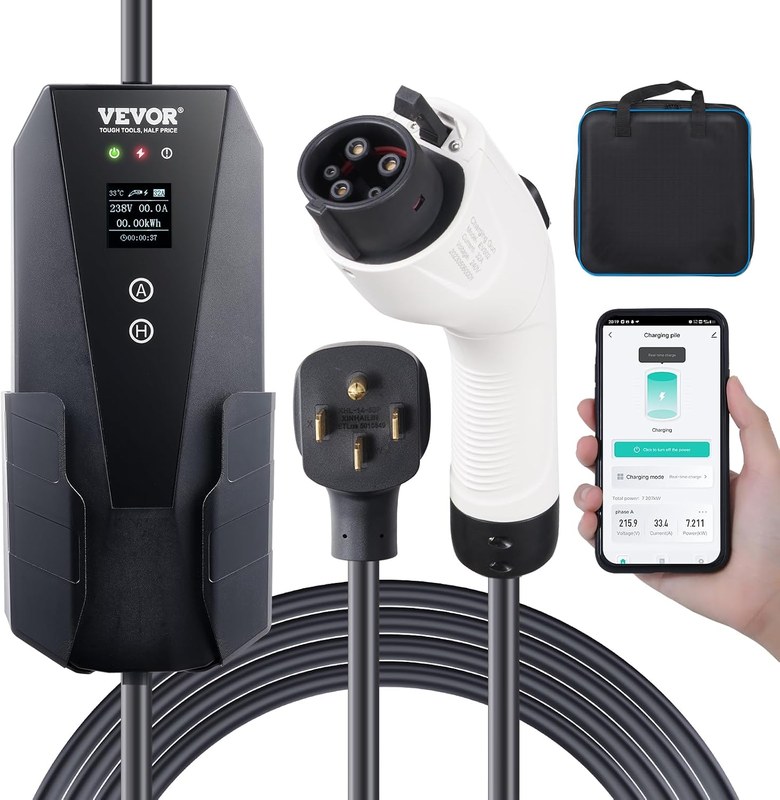
The box on the end of the cable is Electric Vehicle Supply Equipment (EVSE). It is closer to a smart, safety-rated power cord than to a battery charger. It performs three jobs: it provides a connector that mates with your car’s inlet, it signals how much current is available using the Control Pilot circuit defined by SAE J1772, and it contains ground-fault protection and relays that only close when conditions are safe.
The actual conversion from AC to DC happens inside the vehicle. That is why the “charger” label on the wall box is a convenience, not a technical description.
What “Portable” Really Means: Level 1 Travel Kits vs. Level 2 Plug-In Units
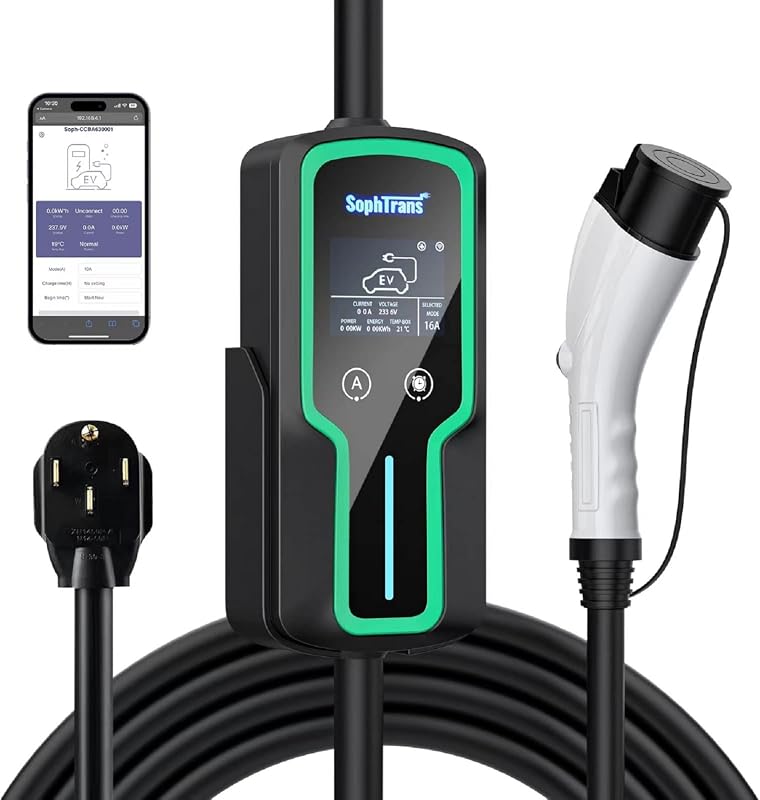
Portable EVSE generally falls into two groups. Level 1 units plug into a standard 120 V household outlet and typically draw 12 A, with some 16 A models intended for a 20 A circuit. Level 2 portable units plug into a 240 V receptacle such as NEMA 14-50, 6-50, or 14-30 and commonly offer selectable current between roughly 16 A and 40 A.
“Portable” describes the plug, not the weight. A 40 A unit with a long cable is transportable, not pocket-sized. For a closer look at that category, see our breakdown of a 40-amp Level 1 and Level 2 portable EV charger.
Why the Onboard Charger and Circuit Limit Your Speed—Not the Portable Unit Alone
Charging power is capped by the lowest rating in the chain. If a 48 A EVSE is plugged into a 40 A circuit, the circuit wins. If the same EVSE serves a car whose onboard charger accepts only 32 A, the vehicle wins. Voltage, breaker size, receptacle rating, cable, adapter, and battery state all participate.
This is why two drivers with identical portable units can see very different charge rates from the same outlet.
Portable EV Charger Anatomy: Connector, Cable, Amperage, kW, and Smart Features
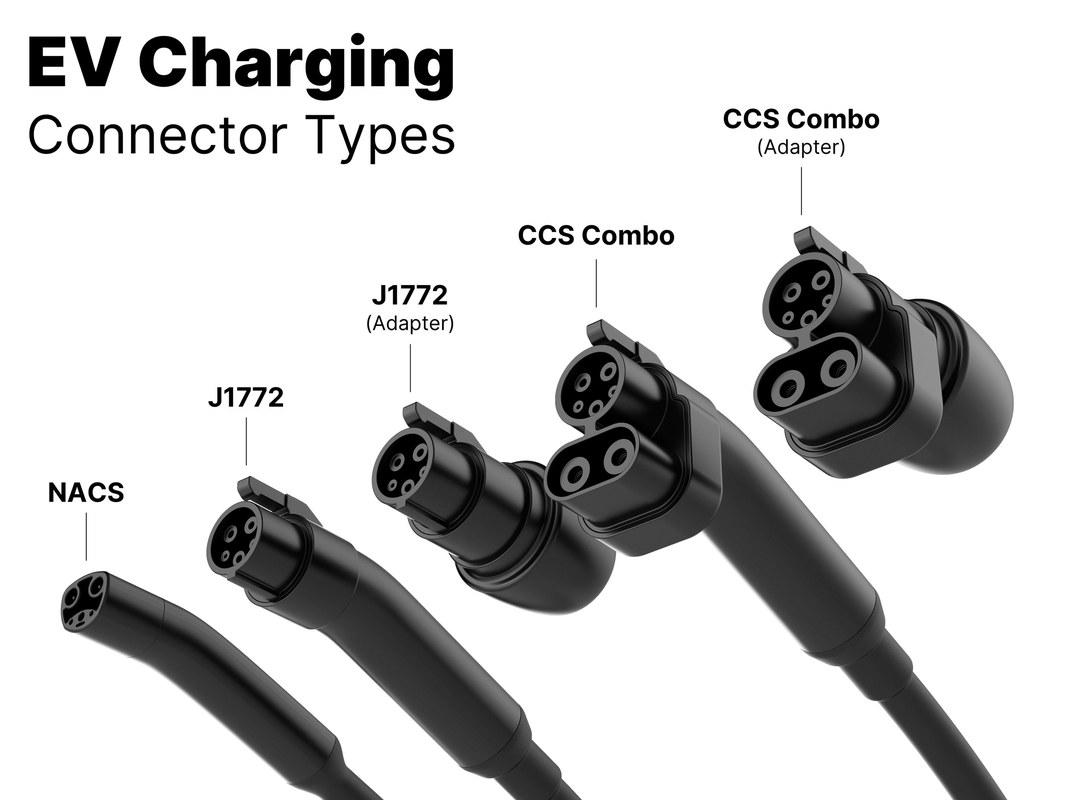
Connector Types in the U.S.: J1772, NACS/Tesla, and Vehicle Compatibility
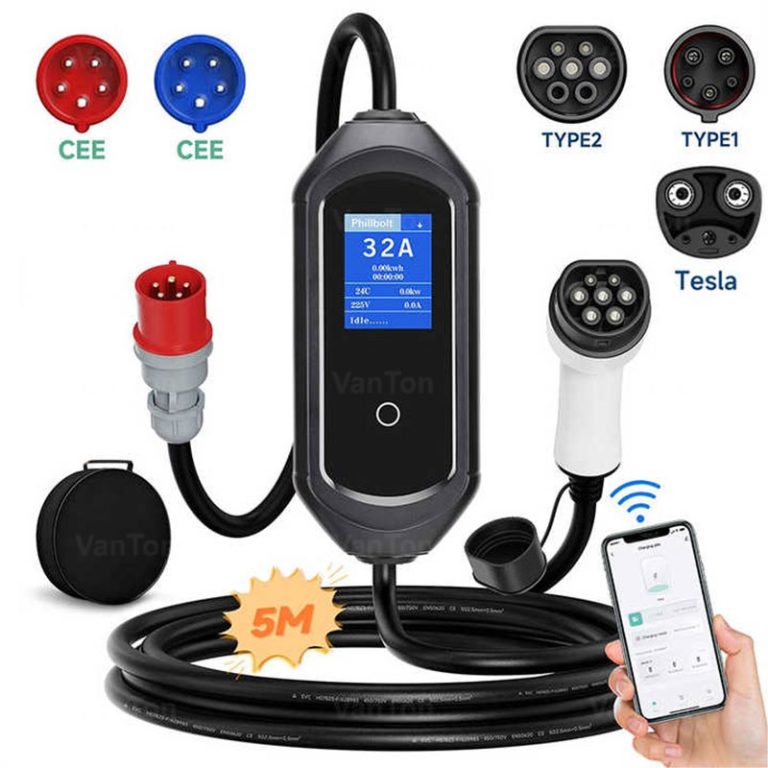
Most portable EVSE sold in the U.S. uses the J1772 connector, which fits the vast majority of non-Tesla EVs and plug-in hybrids. NACS, standardized as SAE J3400, is now appearing on new vehicles and on some portable units. Adapters exist in both directions, but direction matters: a J1772-to-NACS adapter for AC charging is a different part from a NACS-to-CCS1 DC adapter.
EVSE Amperage, Voltage, and kW: Reading the Spec Label Without Guesswork
Output in kilowatts is roughly voltage multiplied by current, divided by 1,000. A 240 V unit set to 32 A works out to about 7.7 kW; the same unit at 40 A is about 9.6 kW. EVSE is treated as a continuous load, which is why the National Electrical Code and most manufacturer instructions call for the charging current to stay at or below 80 percent of the branch-circuit rating.
If you want the arithmetic worked through, our explainer on how many kW a 48-amp Level 2 charger delivers walks through the math.
Cable Length, Weather Suitability, and Outdoor Use Caveats
Cable length affects real ownership more than it appears on a spec sheet, especially for renters and driveway parkers who cannot choose where the car sits. For outdoor use, verify the enclosure’s stated weather rating, the manufacturer’s operating-temperature range, and any guidance on storing the connector when not in use. Do not assume a unit is weather-sealed because it looks rugged.
Smart Features, Firmware Updates, and Warranty/Support Checks
Smart portable units add Wi-Fi or Bluetooth, scheduling, current adjustment, energy logging, and sometimes utility demand-response programs. Before buying, confirm what happens if the cloud service or app is unavailable — ideally the unit should still charge at a default or last-set rate. Also check the U.S. warranty term, whether firmware updates require an account, and how support handles a unit that fails mid-trip.
Plug-In vs. Hardwired Portable EVSE: Circuit, Panel, and Installation Implications
Common NEMA Outlets and Adapters: Source Connector, Destination Connector, and Direction
The plug on the wall side is a source connector; the J1772 or NACS handle is the destination connector. Common source plugs include NEMA 5-15 and 5-20 for Level 1, and 14-50, 6-50, and 14-30 for Level 2. Adapters that change the source plug must match the circuit’s voltage, amperage, and grounding arrangement — a 14-50 plug on a 14-30 circuit is not a safe substitution.
Panel Capacity, Load Calculations, and Local Code/Permit Rules
Adding a 240 V receptacle usually requires a load calculation to confirm the service panel can support it, a dedicated circuit, an appropriate breaker, and correct conductor sizing. Whether a permit, inspection, or utility notification is required depends on your jurisdiction and the specific equipment instructions.
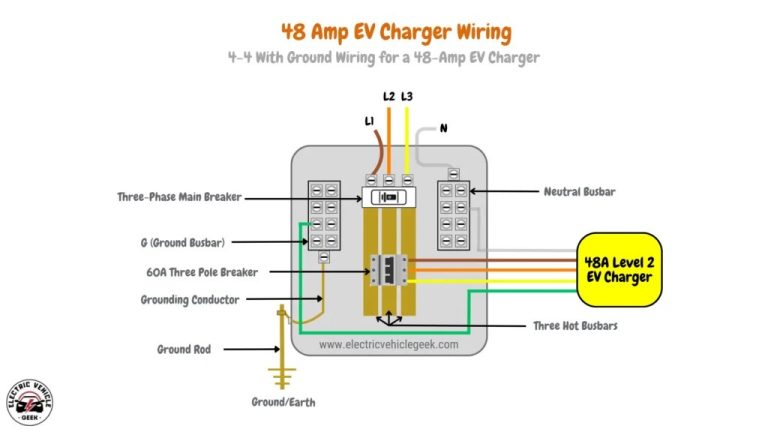
Breaker and conductor sizing trips people up often; our article on whether a 48-amp charger needs a 60-amp circuit explains the 80 percent continuous-load logic.
Hardwired vs. Plug-In: Same-Criteria Comparison and Who Each Option Fits
Portable and removable, typically installed on a dedicated 240 V receptacle. Fits renters, movers, and households that want to take the unit on trips. Requires a correctly rated receptacle and circuit.
Wired directly to the circuit, which can allow higher continuous current and a cleaner installation. Fits homeowners who want a permanent setup and are willing to involve a qualified electrician.
Thermal, GFCI, and Adapter Safety Limits: What the Manual and Code Require
Heat is the enemy of any charging connection. Loose blades in a worn receptacle, undersized conductors, or a partially seated adapter all raise resistance and temperature. EVSE includes ground-fault protection, but that does not replace a properly installed circuit, a sound receptacle, or correct breaker protection. If a plug or adapter feels hot to the touch during charging, stop and have the circuit inspected.
Adapters, AC/DC Modes, and Vehicle/Network Restrictions for Portable Charging
AC Level 1/2 vs. DC Fast Charging: Why Portable EVSE Is Almost Always AC
Portable EVSE supplies AC power and relies on the vehicle’s onboard charger. DC fast charging bypasses the onboard charger and feeds the pack directly, which requires substantially different hardware, cooling, and safety systems. A portable unit that plugs into a household or 240 V receptacle cannot perform DC fast charging, regardless of the connector on the end.
Power Limits From EVSE, Circuit, Adapter, and Vehicle: The Lowest Rating Wins
Think of it as a chain of ceilings: the branch circuit, the receptacle, the EVSE’s current setting, any adapter in the path, and the vehicle’s onboard charger. The lowest number governs the session. Adapters in particular can carry their own amperage limit, so check the adapter’s rating rather than assuming it matches the EVSE.
Vehicle, Network, and Firmware/Vendor Requirements to Verify Before You Plug In
Some vehicles require a specific sequence — plug in first, then authorize — while others start automatically. Network-connected public or workplace units may require an account, an RFID card, or an app session even when you bring your own cable. Vendor firmware can also change behavior after purchase, so it is worth reviewing release notes if a unit stops charging as expected.
What Portable EV Charging Costs: Formula, Assumptions, and U.S. Examples
Cost Formula: Electricity Rate × kWh Delivered ÷ Charging Efficiency
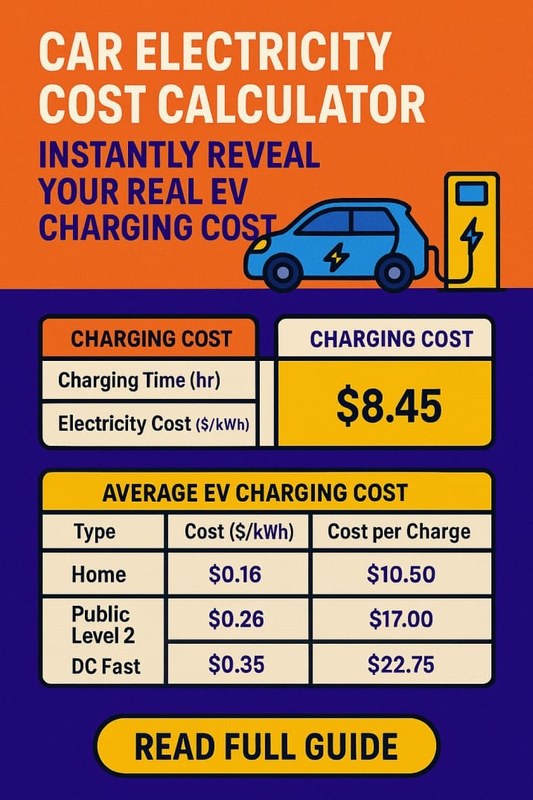
The core calculation is straightforward: energy added in kWh multiplied by your electricity rate, then adjusted upward for charging losses. If you add 30 kWh at an illustrative $0.15 per kWh and assume roughly 10 percent losses, the delivered energy is about 33 kWh and the cost lands near $5.00. Substitute your own rate and loss assumption.
Illustrative example only. Rates, taxes, fees, time-of-use pricing, demand charges, and losses vary by utility and vehicle.
Charging Losses, Time-of-Use Pricing, and Off-Peak Scheduling
Some energy is lost as heat in the onboard charger, the cable, and the battery itself, so the kWh billed by your utility is usually higher than the kWh stored in the pack. Time-of-use plans can shift the effective rate substantially between afternoon and overnight hours, which is where EVSE scheduling features earn their keep.
Equipment, Outlet, Permit, and Electrician Costs
Budget beyond the unit itself. A dedicated 240 V circuit may require an electrician, a breaker, conductors, a receptacle, and possibly a permit and inspection. If the panel needs an upgrade or a load-management device, that cost can exceed the EVSE. Get itemized quotes and confirm what the price includes.
Cost Comparison Criteria: Portable Level 1 vs. Portable Level 2 vs. Hardwired Level 2
Compare the same factors across options: installation cost, charging speed, portability, circuit requirements, weather suitability, and whether the vehicle can even use the extra current. A portable Level 1 unit is the cheapest to start with but slowest; a hardwired Level 2 unit costs more upfront but typically delivers the highest sustained rate your vehicle allows.
Battery Health and Charging Power: Manufacturer Guidance vs. General Patterns
Temperature, State of Charge, and Charging Power: What the BMS Controls
The battery management system decides how much current the pack will accept at any moment. Cold packs, very high states of charge, and elevated cell temperatures all reduce accepted power. This is normal behavior, not a fault in the portable unit.
DC Fast Charging Context, Battery Chemistry, and Thermal Management
Frequent DC fast charging is a different conversation from portable AC charging. Liquid-cooled packs generally tolerate it better than older air-cooled designs, and manufacturer guidance should take priority over forum folklore. Portable AC charging is comparatively gentle because the rate is low and the session is long.
Convenience Trade-Offs: Slower Portable Charging and Long-Term Battery Care
Slower charging is inconvenient, but it also means less heat and more time for the pack to balance. For many owners, overnight Level 1 or Level 2 charging covers daily driving entirely, making the speed penalty irrelevant in practice.
Portable EV Charger Range, Efficiency, and Real-World Speed Expectations
mi/kWh and Wh/mi: Converting Charging Energy Into Miles
Range added equals energy delivered multiplied by vehicle efficiency. A car that returns 3.5 mi/kWh will add roughly 3.5 miles for every kWh stored. Efficiency figures vary widely by model, season, and driving style, so treat any single number as an example, not a promise.
Speed, Weather, HVAC, Elevation, Payload, Tires, and Battery Temperature
Highway speed, cold weather, cabin heating, headwinds, elevation gain, roof racks, underinflated tires, and a cold battery can each cut real-world range meaningfully. Charging losses add another layer between what the meter delivers and what the wheels can use.
Estimating Overnight Range With Portable Level 1 and Level 2 EVSE
Multiply the charging power by the hours available, then apply efficiency. Ten hours on a 1.4 kW Level 1 setup is roughly 14 kWh before losses; ten hours on a 7.7 kW Level 2 setup is roughly 77 kWh. Convert those to miles using your own mi/kWh figure to see whether overnight charging covers your commute.
Buying, Installing, and Troubleshooting a Portable EV Charger in 2026
Buying Guide Criteria: Amperage, Connector, Cable, Weather, Smart Features, Warranty
Start with the vehicle: confirm the inlet type and the maximum AC charging rate it accepts. Then match the EVSE’s current setting to a circuit you can actually support, check cable length against your parking position, verify the weather rating if it will live outdoors, and confirm the safety listing, warranty term, and app requirements.
- Confirm vehicle inlet and AC/DC compatibility
- Check the vehicle’s maximum AC charging capability
- Verify EVSE amperage and electrical requirements
- Confirm cable length, mounting, and indoor/outdoor suitability
- Verify safety listing, warranty, app requirements, and support
- Include installation, adapter/accessory, and electricity costs
Installation Checklist: Manual First, Local Code, Permit, and Qualified Electrician
Read the manufacturer instructions before anything else — they define the required circuit, breaker, conductor, receptacle, and mounting method. Then confirm panel capacity, check local permit and inspection requirements, and use a qualified electrician for any new 240 V circuit or hardwired connection.
Troubleshooting: No Power, Fault Lights, GFCI Trips, Overheating, and App Errors
No power usually points to a tripped breaker, an unseated plug, or a vehicle charge timer. Repeated GFCI trips or fault lights after a reset can indicate moisture, a ground-fault condition, or a failing component — stop and get it checked. Overheating at the plug or adapter is a circuit problem, not a software problem. App errors often resolve with a firmware update or re-pairing, but confirm the unit still charges without connectivity.
Evidence Limits and Who Each Option Fits: Renters, Road Trippers, Homeowners
Portable EVSE is well suited to renters who cannot modify a property, road trippers who need a backup option at family homes and campgrounds, and homeowners who want flexibility before committing to a hardwired unit. It is less ideal for anyone needing the highest sustained charging rate, since hardwired installations typically support more current. Specs, listings, and compatibility should be verified against current manufacturer documentation before purchase, because these details change between model years.
- Best for: Renters, travelers, and drivers who need flexible AC charging from an existing outlet or receptacle.
- Think twice if: You need maximum charging speed or a permanent, weather-exposed installation with the highest current.
- Next step: Confirm your vehicle’s inlet type and onboard-charger limit, then verify the circuit, breaker, and receptacle your chosen unit requires.
Frequently Asked Questions
No. Portable EVSE supplies AC power and handles safety signaling, but the AC-to-DC conversion happens in your vehicle’s onboard charger. The EVSE is best understood as a smart, safety-rated power cord rather than a battery charger.
Yes, Level 1 portable EVSE is designed for standard 120 V household outlets and typically draws around 12 A, with some 16 A models intended for 20 A circuits. Charging is slow, but it often covers overnight commutes. Confirm the outlet is in good condition and on a circuit that can handle a continuous load.
Charging power is limited by the lowest rating in the chain: the branch circuit, the EVSE’s current setting, any adapter, and the vehicle’s onboard charger. Cold battery temperature and a high state of charge can also reduce accepted power. Check each link before assuming the unit is faulty.
Adapters exist for source plugs and for vehicle connectors, but direction and rating matter. A J1772-to-NACS AC adapter is not the same part as a DC fast-charging adapter, and an adapter’s amperage limit can be lower than the EVSE’s. Verify the adapter’s stated rating and intended use before plugging in.
Portable AC charging is generally a low-rate, low-heat process compared with DC fast charging, which most manufacturers consider the gentler option for daily use. Follow your vehicle manufacturer’s guidance on charge limits and habits rather than applying a universal percentage rule.
If a suitable 240 V receptacle already exists on a properly rated dedicated circuit, plugging in a portable unit is straightforward. Adding a new circuit, receptacle, or hardwired connection is safety-sensitive work that should be handled by a qualified electrician following manufacturer instructions and local code.

One Comment