NEMA 14-50 EV Charger Installation: Home EV Charging Guide
A NEMA 14-50 installation gives most US homes a flexible Level 2 setup, but the EVSE setting and your vehicle’s onboard charger usually cap the real charging speed, not the outlet. Before buying anything, confirm panel capacity, circuit requirements, and permit rules with a licensed electrician.
NEMA 14-50 EV charger installation is the most common way US homeowners add Level 2 charging, because the 14-50 receptacle is a familiar 240-volt outlet that most plug-in EVSEs are designed to use. The catch is that the outlet, the breaker, the EVSE’s amperage setting, and your vehicle’s onboard charger all have to agree — and the electrical work has to match your panel, your local code, and the equipment instructions.
- Compatibility: The 14-50 is the wall-side connection; your vehicle’s J1772 or NACS inlet is separate.
- Performance: EVSE amperage, circuit capacity, and the onboard charger all limit speed — the lowest.
- Safety: EV charging is a continuous load; panel load calculations, GFCI rules, and permits vary.
- Cost: Equipment and labor vary widely, while electricity rate, time-of-use pricing, and charging losses drive.
What NEMA 14-50 EV Charger Installation Means for Your Home in 2026
A NEMA 14-50 installation means running a dedicated 240-volt branch circuit to a four-pole receptacle — two hot conductors, one neutral, one ground — and plugging a Level 2 EVSE into it. The EVSE then delivers AC power to the vehicle, where the onboard charger converts it to DC for the battery.
NEMA 14-50 Outlet vs. Hardwired EVSE: Key Differences
A 14-50 outlet gives you a plug-and-play connection you can unplug and take with you. A hardwired EVSE is permanently wired, which removes the receptacle and plug from the circuit and is often used for higher-amperage units.
The trade-off is flexibility versus simplicity: plug-in units are portable but add a receptacle and plug connection point, while hardwired units generally need an electrician for removal or replacement.
Why the 14-50 Receptacle Is the Default Plug-In EV Charging Standard
The 14-50 pattern was already common in US homes for electric ranges and RV hookups, so it became the natural plug standard for portable and plug-in Level 2 EVSEs. Most plug-in EVSEs ship with a 14-50 plug or offer a 14-50 wall-plug option.
That familiarity does not make it universal. Some EVSEs use a 6-50 plug, some are hardwired only, and some vehicles ship with a mobile connector that uses interchangeable wall plugs.
NEMA 14-50 Connector, EVSE Amperage, and Your Vehicle’s Onboard Charger Limit
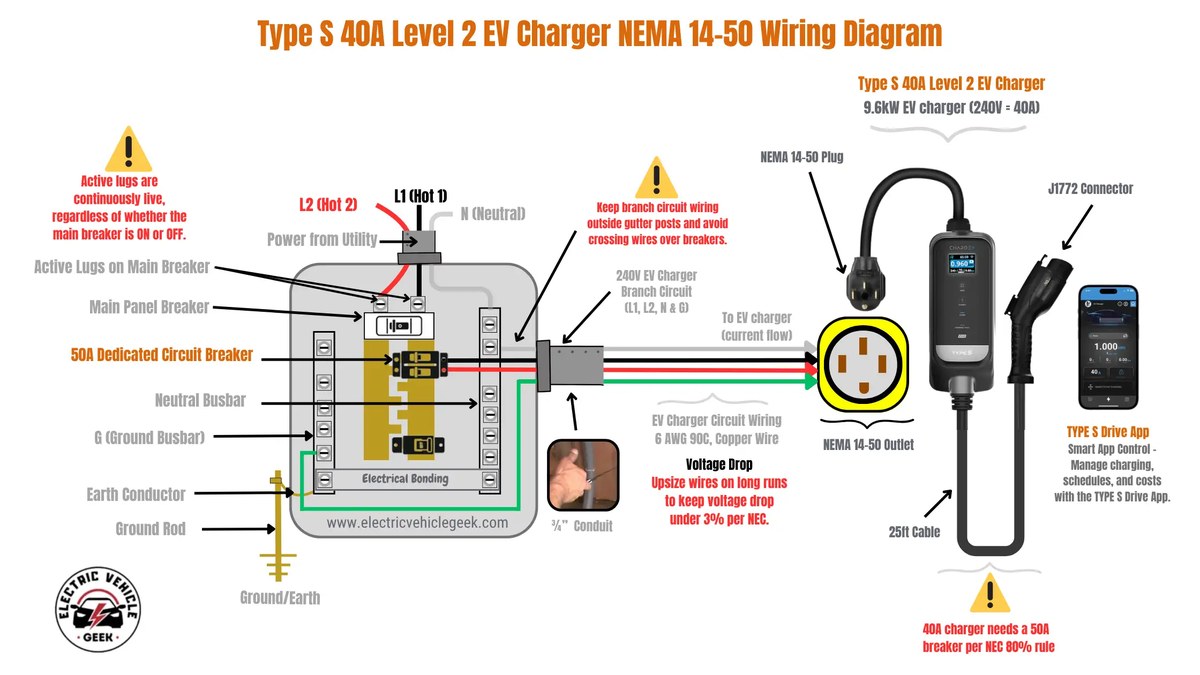
Three separate limits decide how fast you actually charge: the circuit’s continuous capacity, the EVSE’s output setting, and the vehicle’s onboard AC charger rating. The slowest of the three wins.
How EVSE Amperage and kW Translate to Real Charging Speed
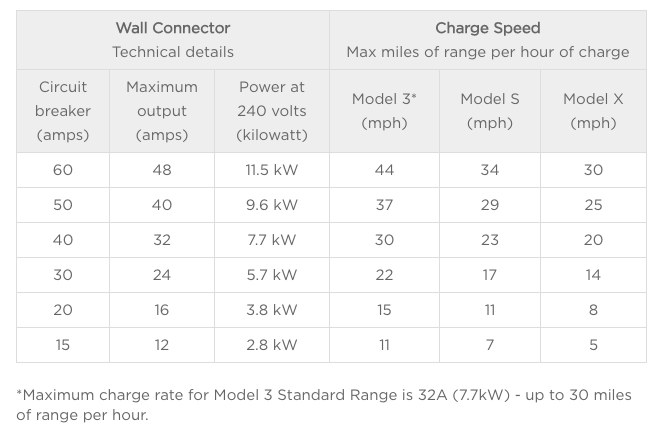
Charging power in kilowatts is roughly voltage multiplied by amperage, divided by 1,000. At a nominal 240 V, a 32 A EVSE setting works out to about 7.7 kW, and a 40 A setting to about 9.6 kW.
Those are approximate figures. Actual voltage at the outlet varies by service and load, and the vehicle may not draw the full EVSE rating at every state of charge. For a closer look at where 40 A sits in the real world, see is 40 amps enough for a Level 2 EV charger.
Matching the Charger to Your EV’s Onboard Charger: What Happens If You Go Bigger
If your vehicle’s onboard charger tops out at 7.2 kW or 11 kW, a 40 A EVSE will not push more power than that ceiling allows. The extra capacity simply goes unused.
Going bigger is not harmful in itself, but it costs more in equipment and wiring for a benefit your car may never use. Check the vehicle’s onboard charger rating before paying for a higher-amperage circuit.
Values are illustrative. Confirm the EVSE setting, circuit capacity, and vehicle onboard-charger limit separately.
Electrical Requirements for NEMA 14-50 EV Charger Installation: Circuit, Breaker, Panel, and Code
EV charging is a continuous load, which is why the numbers on the EVSE and the numbers on the breaker are not the same. The equipment instructions and your local electrical authority govern the final design.
What the Product Manual Says vs. What Your Electrician Must Verify
The manual states the EVSE’s required circuit and the amperage setting it supports. Your electrician must verify conductor size, breaker rating, receptacle type, grounding, GFCI requirements, torque values, and the wiring method actually used in your home.
Those two things are not interchangeable. A manual requirement describes the product; the electrician’s verification describes your specific installation.
Panel Capacity, Load Calculations, and When a Service Upgrade Is Needed
A load calculation compares your existing household demand against the new continuous EV load. If the panel or service cannot support it, options include an electrical service upgrade, a lower EVSE setting, or an energy-management device that limits charging when household demand is high.
Panel capacity is often the deciding factor in older homes, and it is the main reason two neighbors can get very different quotes for what sounds like the same job.
Permits, Inspections, and NEC 2026 Context for EV Charging
The National Electrical Code is a model code; states and local jurisdictions adopt specific editions, sometimes years apart. Article 625 covers EV charging equipment, and requirements for GFCI protection on certain receptacles have changed across recent editions.
Because adoption timing and local amendments vary, treat the NEC as a starting point rather than a universal answer. Your local permitting office and licensed electrician determine what actually applies.
Conductor sizing is one of the most commonly misunderstood parts of the job. For a closer look at how amperage maps to copper, see 48 amp EV charger wire size.
Plug-In vs. Hardwired NEMA 14-50 EV Charger Installation: Which Fits Your Home?

Both approaches deliver Level 2 AC charging. The right choice depends on how much flexibility you want, how exposed the location is, and whether you plan to stay in the home.
Uses a 14-50 receptacle and plug. Easier to swap or take with you when you move. Adds a receptacle and plug as connection points and may be subject to stricter GFCI and receptacle rules.
Permanently connected, no receptacle or plug. Often used for higher-amperage units and outdoor installs. Less portable and typically requires an electrician to change.
Cost, Flexibility, and Weather Exposure Trade-Offs
Plug-in installations can be simpler and sometimes cheaper because the receptacle is a standard part. Hardwired installations can reduce connection points but usually involve more labor.
Outdoors, weather exposure matters more than the plug style. Verify the EVSE’s enclosure rating, operating-temperature limits, and connector storage guidance from the manufacturer before mounting anything outside.
Cable Length, Mounting, and Everyday Convenience
Cable length decides whether you can reach the charge port with the car parked nose-in or backed in. Measure the real distance from your mounting location to the charge port, then add slack.
Mounting height, cable management, and whether the connector holster faces the driveway all affect daily use more than most buyers expect.
- Owners who want a portable EVSE or plan to move
- Homes where a standard 14-50 receptacle is already present
- Installations needing higher amperage than a 14-50 circuit supports
- Situations where the panel cannot support an added continuous load
NEMA 14-50 Adapters and Compatibility: What You Can and Cannot Do
Adapters are where a lot of unsafe assumptions happen. The 14-50 describes the wall-side connection, not the vehicle-side connector, and physical fit never proves that a charging mode is supported.
Adapter Direction, Source and Destination Connectors, and AC vs. DC Mode
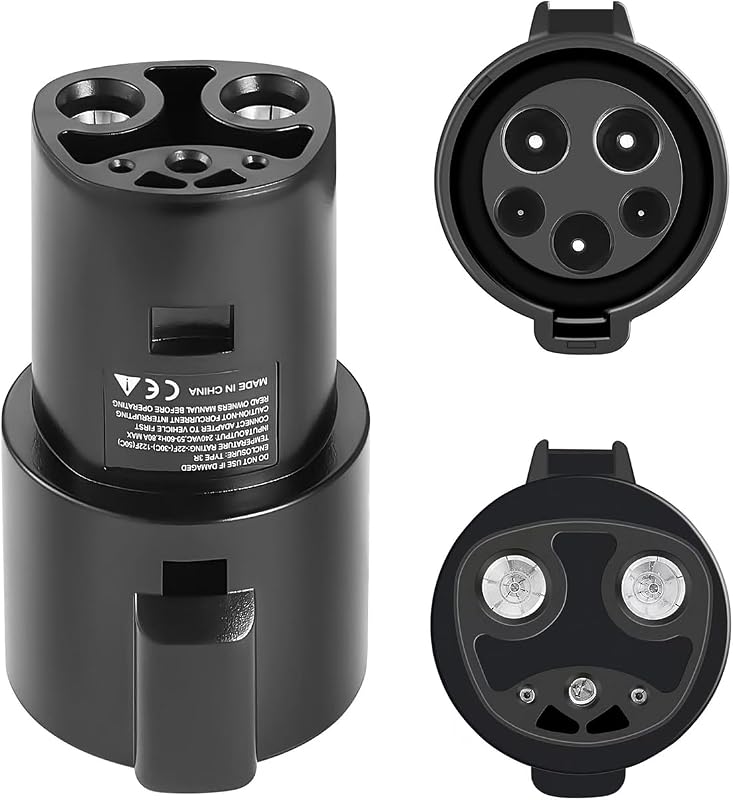
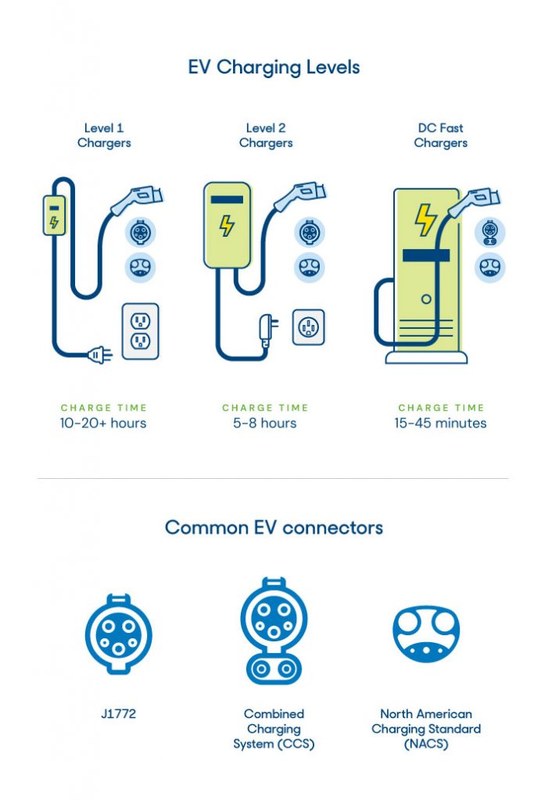
A 14-50 plug on an EVSE connects to a 14-50 receptacle on the wall. The vehicle side is a separate connector — commonly J1772 or NACS / SAE J3400 on newer vehicles. Adapters that change the wall-side plug type are a different category from adapters that change the vehicle-side connector.
Adapters do not convert AC to DC. A NEMA 14-50 circuit supplies AC only, and no adapter turns it into DC fast charging.
Power Limits, Thermal Safety, and Firmware/Vendor Requirements
Adapters have their own amperage and temperature ratings. A mismatch between the adapter rating and the EVSE’s output can create heat at the connection point.
Some EVSE and vehicle makers restrict or void support for third-party adapters, and some require specific firmware or app settings. Check the manufacturer’s documentation before assuming an adapter is approved.
Vehicle and Charging Network Restrictions for Adapter Use
Vehicle manufacturers and charging networks set their own compatibility rules, and those rules change. A connector that physically fits may still be unsupported by the vehicle or the network.
Verify current compatibility from the vehicle manufacturer and the network operator rather than relying on forum reports or product photos.
NEMA 14-50 EV Charger Installation Cost: Equipment, Labor, and Electricity
Cost splits into three buckets: the EVSE, the electrical work, and the electricity you buy over time. Only the third one keeps costing money after installation.
Installation and Equipment Cost Assumptions for 2026
Equipment prices vary widely by amperage, cable length, smart features, and safety listing. Installation cost depends on run length, panel capacity, whether a service upgrade is needed, and local labor rates.
Because these figures change and vary by region, get itemized quotes from licensed electricians in your area rather than relying on national averages.
Electricity Rate, kWh Delivered, Charging Losses, and Time-of-Use Pricing
Your utility rate is the biggest long-term variable. Time-of-use plans can make overnight charging much cheaper than daytime charging, but they can also raise peak-hour rates.
Charging losses mean the wall delivers more energy than the battery stores. Level 2 AC charging losses are commonly cited in the range of roughly 10 percent, though the actual figure depends on the vehicle, the EVSE, and conditions.
Illustrative example only. Your rate, taxes, fees, time-of-use windows, and actual losses will differ. Verify current rates with your utility.
Formula: Cost per Mile and Monthly Charging Cost
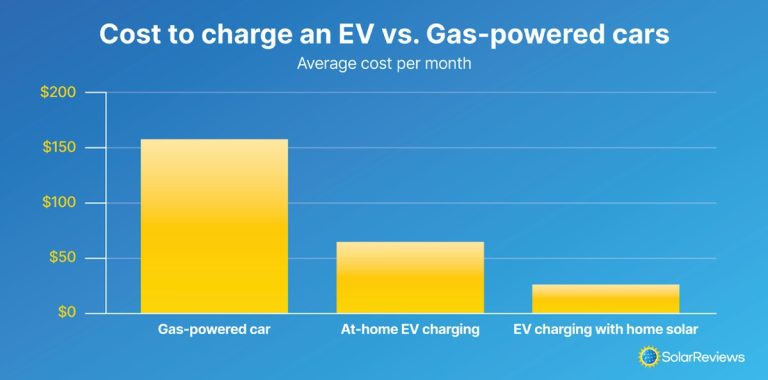
Cost per mile equals your effective electricity rate divided by vehicle efficiency in miles per kWh, adjusted for charging losses. At $0.16 per kWh and roughly 3.5 mi/kWh, the result is about 5 cents per mile before losses.
For a monthly estimate, multiply miles driven by cost per mile. A 1,000-mile month at that rate lands near $50 before taxes, fees, and any demand charges.
Battery Health and Charging Behavior with a NEMA 14-50 Setup
Level 2 home charging is generally considered the gentlest routine charging method because it is slow relative to DC fast charging and usually happens at home overnight. That does not make it a universal prescription.
Manufacturer Guidance vs. General Patterns for Daily Charging
Every automaker publishes its own charging recommendations, and they differ by model and battery system. Follow the owner’s manual for your specific vehicle rather than a general rule from the internet.
Some manufacturers suggest daily charge limits, some suggest charging to full regularly, and some give different guidance for different battery chemistries. There is no single correct percentage for every EV.
Temperature, State of Charge, Charging Power, and DC Fast Charging Context
Battery temperature affects both charging speed and long-term behavior. Very cold or very hot packs may accept less power or require preconditioning.
DC fast charging is a separate use case with its own considerations. Frequent DC fast charging is not the same as routine Level 2 charging, and manufacturer guidance often treats them differently.
Chemistry, Thermal Management, and Convenience Trade-Offs
Lithium iron phosphate and nickel-based chemistries behave differently, and vehicles with active thermal management can handle different usage patterns than those without.
In practice, most owners optimize for convenience: plug in when parked, use scheduled charging for lower rates, and adjust habits only if the manufacturer recommends it.
Range, Efficiency, and Charging Losses: What a NEMA 14-50 Installation Delivers
A 14-50 installation delivers AC power at a steady rate. How far that goes depends far more on the vehicle and conditions than on the outlet.
mi/kWh, Wh/mi, Speed, Weather, HVAC, Elevation, Payload, Tires, and Battery Temperature
Efficiency is usually expressed as miles per kWh or watt-hours per mile. Highway speed, cold weather, cabin heating and cooling, elevation change, cargo weight, tire pressure and tread, and battery temperature all move that number.
A car rated near 3.5 mi/kWh in mild conditions may see noticeably lower efficiency in winter or at sustained high speeds. These are estimates, not guarantees.
Accounting for Charging Losses in Your Real-World Range
Energy drawn from the wall is not the same as energy stored in the battery. If you are calculating cost or comparing against gasoline, use wall energy, not battery energy.
For range planning, use battery energy. For cost planning, use wall energy. Mixing the two is one of the most common mistakes in home charging math.
Smart Features, Warranty, and Support for NEMA 14-50 EV Chargers
Smart features are useful, but they add dependencies. A charger that needs a cloud account to schedule charging behaves differently when that service is unavailable.
Wi-Fi, Scheduling, Load Management, and Energy Monitoring
Wi-Fi connectivity enables scheduling, remote status, and sometimes utility demand-response programs. Load management can let a charger share capacity with the rest of the house instead of requiring a service upgrade.
Energy monitoring shows how much electricity the EVSE delivered, which is useful for cost tracking. Check whether these features work locally or require an account and internet connection.
Warranty Length, Customer Support, and What to Check Before Buying
Warranty terms vary by manufacturer and are often shorter than owners expect. Confirm the US warranty length, what it covers, and whether professional installation is required to keep it valid.
Also verify the safety listing from the manufacturer or a certification record, confirm the cable length and indoor/outdoor suitability, and check whether the app is required for basic operation. If you are comparing hardwired options, hardwired 48-amp EV chargers sit in a different category from plug-in 14-50 units.
- Confirm your vehicle’s inlet type and maximum onboard AC charging rate
- Verify the EVSE amperage setting and its required circuit
- Check panel capacity with a licensed electrician before ordering
- Confirm cable length, mounting location, and indoor/outdoor suitability
- Verify the safety listing, US warranty, and app requirements
- Budget for installation, permits, and your electricity rate
- Best for: Homeowners who want a flexible, widely supported Level 2 setup that most plug-in EVSEs are built around.
- Think twice if: Your panel cannot support the added continuous load, or your vehicle’s onboard charger is already the limiting factor.
- Next step: Have a licensed electrician confirm panel capacity, circuit requirements, and permit needs before you buy equipment.
Frequently Asked Questions
It is a dedicated 240-volt branch circuit ending in a NEMA 14-50 receptacle, into which a Level 2 EVSE with a 14-50 plug is connected. The receptacle has two hot conductors, a neutral, and a ground, and it is the most common wall-side plug standard for plug-in Level 2 chargers in the US.
The outlet type alone does not set the charging current. Because EV charging is treated as a continuous load, the EVSE’s amperage setting is typically lower than the circuit’s rating, and the vehicle’s onboard charger may limit it further. Confirm the exact requirement in the EVSE instructions and with your electrician.
Permit requirements vary by state, county, and city, and many jurisdictions require an electrical permit and inspection for a new 240-volt circuit. Check with your local building or permitting office before work begins, since rules and code editions differ by location.
Adapters exist for both the wall side and the vehicle side, but direction, amperage rating, and vendor approval matter. Adapters do not change AC into DC, and some vehicle manufacturers and charging networks restrict adapter use. Verify compatibility with the vehicle and equipment manufacturers first.
Neither is universally better. A 14-50 outlet is more portable and easier to swap, while a hardwired connection removes the receptacle and plug and is often used for higher-amperage units. The right choice depends on your panel, your target amperage, the mounting location, and whether you plan to move.
Monthly cost depends on your electricity rate, how many miles you drive, your vehicle’s efficiency, and charging losses. Multiply miles driven by cost per mile, where cost per mile equals your effective rate per kWh divided by miles per kWh, adjusted for losses. Rates, taxes, fees, and time-of-use windows vary by utility.