How Are Portable EV Chargers Defined in NEC Article 625?
Under NEC Article 625, a portable EV charger is defined as electric vehicle supply equipment (EVSE) that is designed to be moved and is not permanently installed, so the primary owner decision is whether to use it as a travel/backup charger or invest in a permanently installed home unit. The key limitation is that its installation, safety, and charging speed depend on the compatible, properly grounded receptacle and branch circuit it plugs into, and it will typically deliver less power than a hardwired Level 2 charger.
How are portable EV chargers defined in article 625? In the National Electrical Code (NEC), the answer has almost nothing to do with wattage and almost everything to do with two physical facts: whether the equipment is fastened in place, and how it connects to the building’s wiring. Article 625 — titled “Electric Vehicle Charging System” in the 2020 NEC and retitled “Electric Vehicle Power Transfer System” in the 2023 NEC — places cord-and-plug equipment that is not fastened in place in the portable category, and treats wall- or pedestal-mounted equipment as fixed.
For a US EV owner, that distinction is not academic. It decides which connection rules apply, whether a dedicated branch circuit is required, what kind of receptacle can be used, how cable length is limited, and how your local inspector will look at the installation.
- Definition: NEC Article 625 treats portable EVSE as equipment designed to be carried by one.
- Compatibility: A portable unit must match the EV connector and the premises receptacle/circuit; Article 625.
- Installation/Electrical Safety: Portable EVSE connects by cord-and-plug and must follow Article 625 plus applicable NEC rules.
- Charging Performance/Battery/Range: NEC does not set charging speed or range; real-world performance depends on the EVSE.
- Cost/Ownership Limits: Portable use can avoid hardwiring, but a dedicated circuit/outlet or electrical upgrade may still.
The Short Answer in Plain English
Strip away the code language and Article 625’s portable category comes down to three ideas:
- Not fastened in place. The equipment is not secured to a wall, post, floor, or other structural element in a way that requires tools to remove.
- Cord-and-plug connection. It plugs into a receptacle rather than being permanently wired to the premises wiring.
- Intended to be moved. The design and connection method let the owner relocate the unit — from a garage to a relative’s driveway, a rental property, or a campground pedestal.
A Level 2 wall unit that is screwed to studs and plugged into a NEMA 14-50 receptacle fails the first test. It is fixed EVSE, even though it has a plug on the end of its supply cord.
Why the Definition Matters More Than the Label
Manufacturers use “portable” as a marketing word. The NEC uses it as a technical category that determines which requirements in Article 625 apply. In practical terms, the classification can affect:
- Which connection method Article 625 permits for the equipment.
- Whether the outlet must be supplied by an individual branch circuit.
- Whether ground-fault circuit-interrupter protection is required at the receptacle.
- How supply cable length is limited.
- How the load is counted in a panel or service calculation.
- Whether your local authority having jurisdiction (AHJ) expects a permit and inspection.
None of those are things to guess at. They are also the reason a “portable” badge on a product page should never be treated as a code determination.
What Article 625 Actually Regulates
EVSE Is Not the Charger
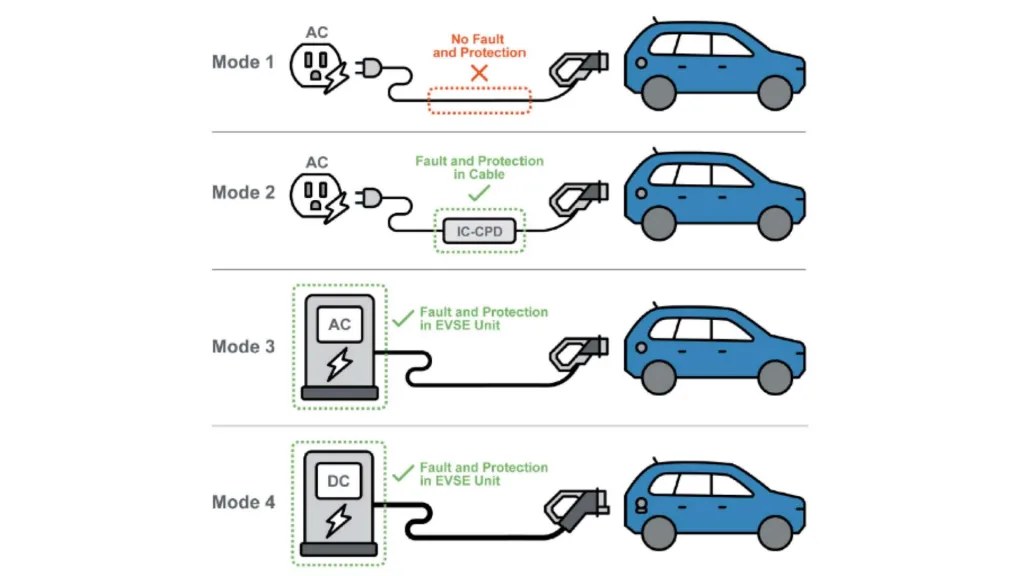
This is the single most useful distinction for an EV owner. The box on your wall — or the cable bag in your trunk — is electric vehicle supply equipment. It delivers AC power, communicates with the vehicle, and provides safety functions such as ground-fault protection and pilot signaling. The actual conversion from AC to DC happens in the vehicle’s onboard charger.
That matters because the EVSE does not set your charging speed on its own. A portable EVSE rated for 40 A will not charge faster than the vehicle’s onboard charger allows. A 32 A portable unit and a 48 A wall unit can deliver identical results on a car with a 32 A onboard charger. Article 625 governs the supply side of that equation; the vehicle governs the other side.
Branch Circuits and Receptacles
Article 625 works alongside the general wiring rules in Chapters 1 through 4 of the NEC. Among the provisions EV owners run into most often:
- An individual branch circuit for each outlet installed for the purpose of charging electric vehicles.
- Equipment ratings sufficient for the load served, with energy management provisions appearing in newer editions.
- Ground-fault circuit-interrupter protection for receptacles installed for EVSE connection, in the editions that include that requirement.
- Receptacle type and rating requirements for EVSE connections.
Exact section numbers, thresholds, and wording differ between editions. That is why the safe habit is to read the requirement in the code your jurisdiction has adopted, and to confirm it with the AHJ before work begins.
Connection Rules: Cord-and-Plug vs. Permanent Wiring
Article 625 addresses how EVSE connects to the premises wiring, and those rules vary depending on whether the equipment is fixed or portable and on the voltage and current involved. That is the practical heart of the portable definition: the connection method is part of what makes the equipment portable in the first place.
Portable vs. Fixed — Where the Line Falls
| Factor | Portable EVSE | Fixed EVSE |
|---|---|---|
| Mounting | Not fastened in place; designed to move | Fastened to a wall, pedestal, or structure |
| Connection to premises wiring | Cord-and-plug | Hardwired, or cord-and-plug in some installations |
| Typical example | Level 1 cable that shipped with the vehicle; dual-voltage travel unit | Wall-mounted Level 2 unit, hardwired or plugged into a 14-50 |
| Portable in the code sense | Yes | No |
| Who typically handles installation | Owner plugs it in; an electrician verifies the circuit | Qualified electrician for new circuits and hardwiring |
| Key limitation | Cannot exceed the safe capacity of the receptacle circuit | Not designed to move between locations |
Treat this as a general comparison, not a substitute for the adopted code text or the equipment instructions.
The Portable EVSE Types US Drivers Actually Own
Level 1 EVSE That Came With the Car
The cable that ships with most new EVs is the textbook portable EVSE. It is not fastened in place, it plugs into a standard 120 V household receptacle, and it is designed to travel in the trunk. Typical current draw is 12 A on a 15 A circuit, which is why Level 1 charging adds range slowly — often only a few miles per hour, depending on the vehicle, temperature, and whether the pack is being warmed or cooled.
Two cautions apply. First, the receptacle matters: an old, worn, or ungrounded outlet is a genuine hazard under continuous EV load. Second, the individual-branch-circuit requirement means a shared garage circuit feeding a freezer, a shop light, and your car is not an appropriate host for regular charging.
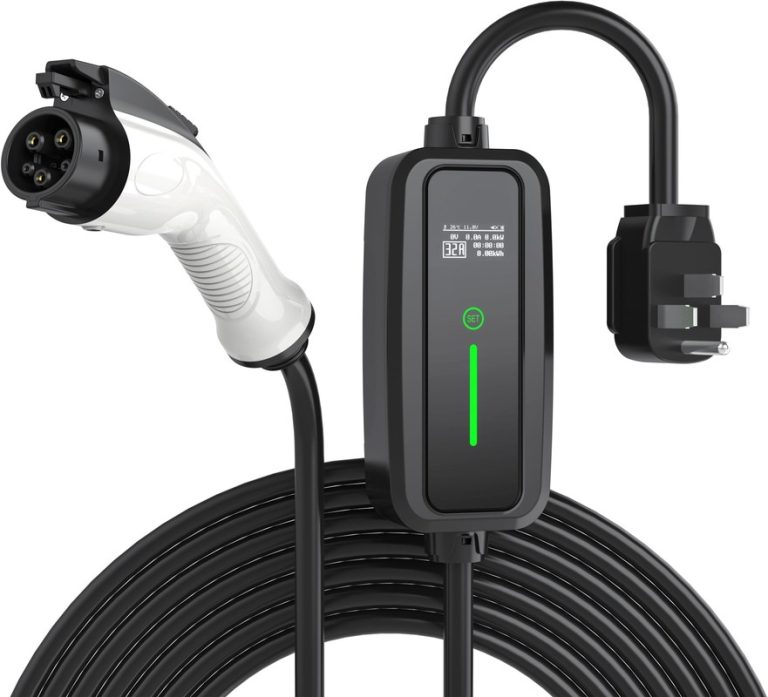
Dual-Voltage Portable EVSE
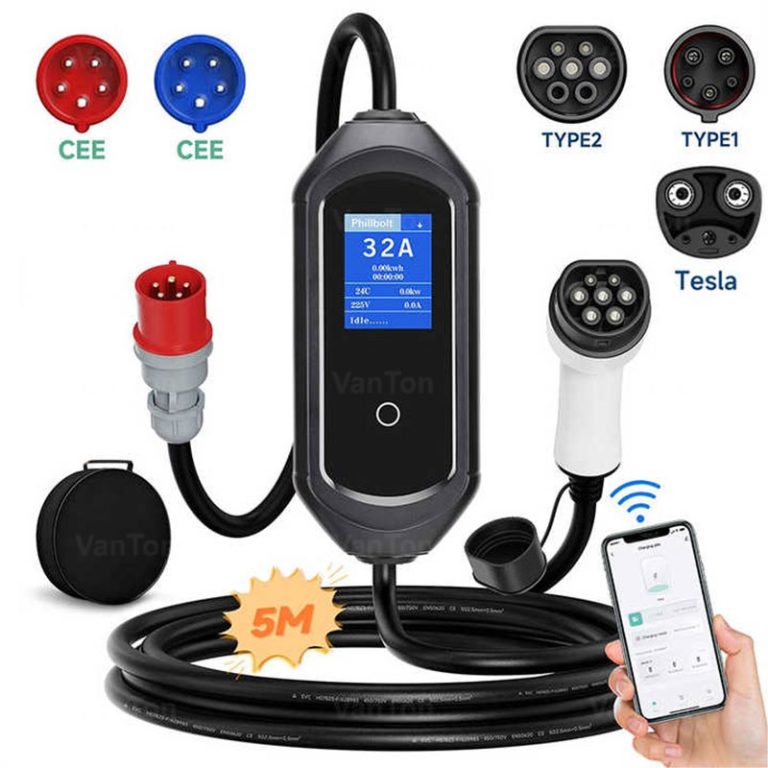
A growing category of portable EVSE works on both 120 V and 240 V by swapping adapter plugs — typically a NEMA 5-15 for Level 1 and a NEMA 14-50, 6-50, or 6-20 for Level 2. These units are genuinely portable in the code sense: cord-and-plug, not fastened in place, and movable. If you are weighing that format, our look at dual-voltage 40-amp Level 1 and Level 2 portable EV chargers covers how amperage settings and adapter plugs change the outcome.
The catch is that a portable EVSE cannot create circuit capacity. Plugging a 40 A-capable unit into a 30 A dryer outlet with an adapter does not give you 40 A of safe charging — it gives you an overloaded circuit unless the EVSE is deliberately set to a lower current and the circuit is otherwise suitable.
Plug-In Wall Units That Are Not Portable Under the Code
Many popular Level 2 units can be either hardwired or plugged into a NEMA 14-50 receptacle. If you mount one on the wall, it is fixed EVSE. The plug does not make it portable, and treating it as portable can lead to incorrect assumptions about circuit requirements, load calculations, and permitting. If you are shopping in that category rather than for a travel unit, our Level 2 home chargers coverage is the better starting point.
Edition Changes You Should Know About
Article 625 is not static. The 2017, 2020, and 2023 editions each changed how the article is organized and worded. The 2023 edition retitled it to “Electric Vehicle Power Transfer System” and added provisions for equipment that can export power from the vehicle — often described as bidirectional charging. Definition wording has been revised along the way as well.
For a homeowner, the practical takeaway is simple: never assume that a definition you read online matches the code your city or county enforces. Adoption lags publication, sometimes by years, and some jurisdictions amend what they adopt.
What the Definition Means for Your Garage or Driveway
If you are plugging a portable EVSE into an existing receptacle, the checklist is short but strict:
If you are installing a new circuit — whether for a portable unit or a fixed one — the sizing question comes up fast. Our explainer on whether a 48-amp EV charger needs a 60-amp circuit walks through how the continuous-load rule drives breaker and conductor sizing, and the companion piece on wire size for a 48-amp EV charger covers the conductor side of the same decision.
Portable EVSE Outdoors
Portable does not mean weatherproof. Manufacturers publish an enclosure rating and an operating temperature range for each unit, and some explicitly restrict outdoor use or specify how the connector should be stored when it is not in use. Verify those details in the product documentation rather than assuming a portable unit is fine in rain, snow, or an unheated garage.
Outdoor receptacles bring their own requirements, including GFCI protection in most modern editions and a weather-resistant cover. If the receptacle is old, corroded, or not GFCI-protected, that is a job for a qualified electrician — not a hardware-store workaround.
Common Misconceptions About Portable EV Chargers and Article 625
- “Portable means low power.” Portability is a mounting-and-connection category, not a power class. Portable units exist across a wide range of current ratings.
- “If it has a plug, it’s portable.” A fastened plug-in wall unit is fixed EVSE under the code’s logic.
- “Any 240 V receptacle will work.” Receptacle type, circuit rating, breaker size, conductor size, and the EVSE’s current setting all have to line up.
- “I can use an extension cord.” An extension cord is not part of a listed EVSE assembly and is a common cause of overheating at the plug.
- “The EVSE sets the charging speed.” On AC charging, the vehicle’s onboard charger is usually the limiting factor.
- “A portable unit doesn’t need a permit.” Local requirements vary, and a new 240 V circuit generally does require one.
How to Check Your Setup Before You Plug In
- Confirm the vehicle inlet type and whether the EVSE is AC only
- Check the vehicle’s maximum AC charging capability, not just the EVSE rating
- Verify the EVSE’s adjustable current settings and its maximum output
- Confirm the receptacle type, circuit rating, and breaker size match the equipment instructions
- Verify the safety listing, warranty terms, and US support from the manufacturer
- Confirm cable length, connector storage guidance, and indoor/outdoor suitability
- Check whether your AHJ requires a permit or inspection for the circuit
- Include electricity cost, adapter cost, and any electrician labor in the total
Final Verdict
- Best for: Drivers who need a cord-and-plug EVSE they can move between locations — a Level 1 cable that came with the car, or a dual-voltage travel unit.
- Think twice if: You plan to mount the unit on a wall. Once it is fastened in place, it is fixed EVSE, and the circuit, permitting, and load-calculation conversation changes.
- Next step: Read the definition in the NEC edition your jurisdiction has adopted, then verify your receptacle, breaker, and conductor against the equipment instructions before the first charge — and bring in a qualified electrician if any part of that check is uncertain.
Frequently Asked Questions
Article 625.2 defines portable EVSE as electric vehicle supply equipment that is not fastened in place and is intended to be carried by the user. The key test is whether the unit is mounted or secured to a wall, floor, or other structure. If it is fastened in place, Article 625 treats it as fixed EVSE, not portable EVSE.
No. NEC Article 625 looks at how the equipment is installed and used, not just whether it has a plug. A plug-in unit that is mounted or secured in place can be fixed EVSE. A unit that is not fastened in place and is intended to be carried by the user fits the portable EVSE definition.
No. The EVSE, its attachment plug, the receptacle, the branch circuit, and the vehicle must all be compatible and properly rated. Article 625 covers EVSE installation and connection requirements, but the exact rules depend on the circuit and location. Do not use household adapters or extension cords unless the EVSE manufacturer and local code allow it.
The Article 625 definition of portable EVSE is about whether the equipment is not fastened in place and is intended to be carried by the user; it does not itself set a single current or voltage rating for all portable EVSE. Practical limits come from the EVSE manufacturer’s instructions and ratings, the circuit and receptacle rating, and the vehicle’s onboard charger. You should never exceed any of those limits.
Article 625 addresses installation locations and equipment suitability, but it does not make a portable EVSE weatherproof. You must use EVSE, cords, connectors, and receptacles rated for the environment and follow the manufacturer’s instructions. Avoid using damaged equipment or making connections in wet conditions.
Article 625 is an electrical installation and safety code; it does not set prices, incentives, or a maintenance schedule. It can affect installed cost indirectly because a proper circuit, receptacle, and any required protection must be provided. For maintenance, inspect cords, plugs, connectors, and receptacles for damage, heat, or moisture, and follow the manufacturer’s care instructions.