How Charging Habits Affect EV Battery Lifespan
Charging habits affect EV battery lifespan mainly through state of charge, heat, and how often the pack is fast charged — not through the brand of wall unit you buy. The catch is that the right charge limit and fast-charging guidance differ by chemistry and model, so your owner’s manual overrides any generic rule.
EV battery lifespan charging habits are one of the few things an owner can actually control, and the effect is gradual rather than dramatic. The habits that matter most are how high and how low you let state of charge swing, how much heat the pack absorbs, and whether you follow your own manufacturer’s guidance instead of a generic rule copied from a forum.
This guide separates what manufacturers document, what research and owner data suggest, and what is simply reasonable practice — so you can build a routine that protects the pack without making ownership annoying.
- Compatibility: Physical connector fit does not prove an AC or DC charging mode is supported.
- Performance: The vehicle’s onboard charger limit, not the EVSE rating, caps AC charging speed.
- Safety: Circuit, breaker, panel, permit, and inspection requirements vary by jurisdiction — confirm with your.
- Cost: Charging losses mean you pay for slightly more kWh than the pack stores, and.
The Short Answer: Which Charging Habits Actually Affect EV Battery Lifespan in 2026?
Three habits do most of the work: avoiding prolonged time at very high or very low state of charge, limiting how often the pack gets hot from repeated DC fast charging, and charging in a temperature range the pack tolerates. Everything else — cable length, app features, connector type — matters mainly because it changes how consistently you can do those three things.
What EV Battery Lifespan Means: Capacity Loss, Range Loss, and Failure
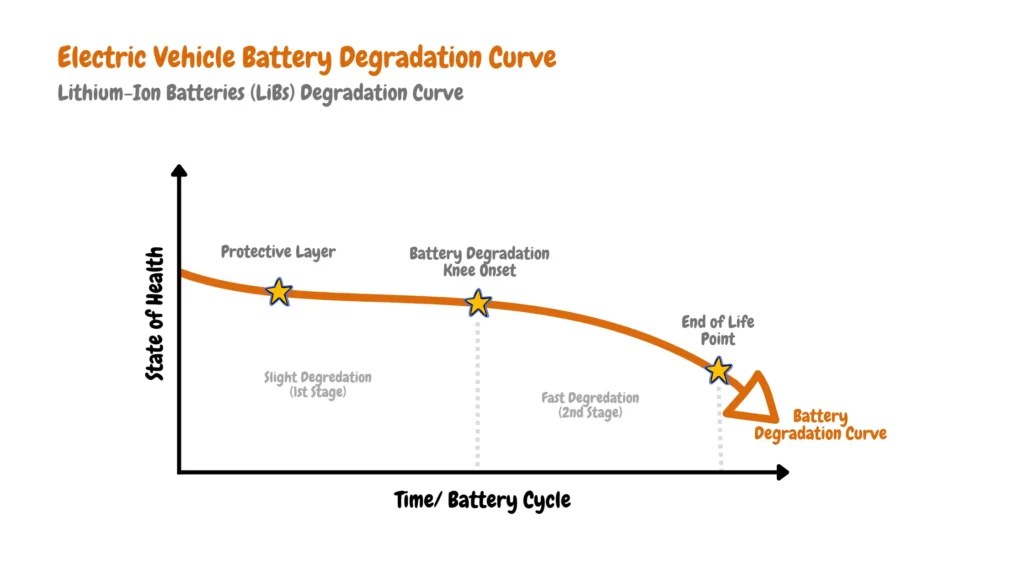
Battery lifespan is usually discussed as capacity fade, not sudden death. A pack that started at 100% usable capacity may hold 90% after several years, which shows up as slightly less range and slightly slower charging at the top of the curve.
Two mechanisms drive most of it. Calendar aging happens while the car sits, and it accelerates at high state of charge and high temperature. Cycle aging happens with each charge and discharge, and it accelerates with deep swings, high current, and heat. A battery that “fails” outright is a different event — usually a cell defect, a manufacturing issue, or damage — and it is far less common than gradual fade.
Manufacturer Guidance vs. General Patterns: Why Your Owner’s Manual Wins
General patterns are useful context, but they are not instructions. A nickel-manganese-cobalt pack with liquid cooling, a lithium iron phosphate (LFP) pack, and an older air-cooled pack have different tolerances for high state of charge and fast charging.
Your owner’s manual and the vehicle’s charging screen reflect the chemistry, thermal system, and buffer your car actually has. When a website and your manual disagree, the manual wins.
State of Charge: The Daily Habit That Shapes Battery Degradation
State of charge (SOC) is the single most controllable variable. Sitting at a moderate level is easier on most packs than sitting full or nearly empty, because high SOC raises cell voltage and low SOC leaves less margin if the car sits unused in the cold.
Why 20–80% Is a Common Recommendation—and When It Does Not Apply
The 20–80% band is a widely repeated default, not a universal rule. It reflects the fact that the extremes are the stressful part for many lithium-ion chemistries, and that most daily driving fits comfortably inside that window.
It does not apply cleanly in every case. Some manufacturers explicitly tell owners to charge to 100% regularly on certain LFP-equipped vehicles so the battery management system can calibrate. Others set a lower daily limit in the vehicle software and expect you to use it. Follow the label on your own car.
Charging to 100%: Road Trips, LFP Packs, and Calendar Aging
Charging to 100% before a trip is normal and expected. The concern is not the charge itself but the time spent sitting there — especially in heat. If you charge to full, plan to leave soon after rather than letting the car sit at 100% for days.
On LFP vehicles, the manufacturer may instruct periodic full charges for calibration. That is a manufacturer instruction, not a loophole that makes full charging free of trade-offs for every chemistry.
Storage, Vampire Drain, and Leaving the EV Plugged In
For long parking periods, most manufacturers recommend a mid-range SOC rather than full or empty, and many suggest leaving the car plugged in so the thermal system and low-voltage battery can be maintained. Vampire drain — the small standby consumption while parked — can pull SOC down over weeks, so a plugged-in car with a charge limit set is usually better than an unplugged one drifting toward empty.
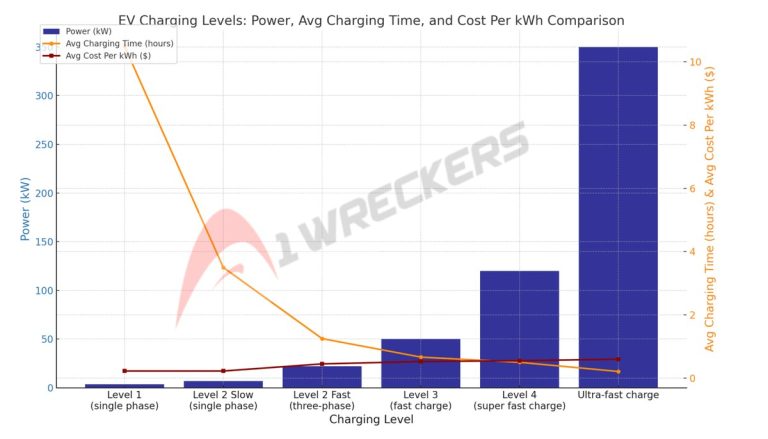
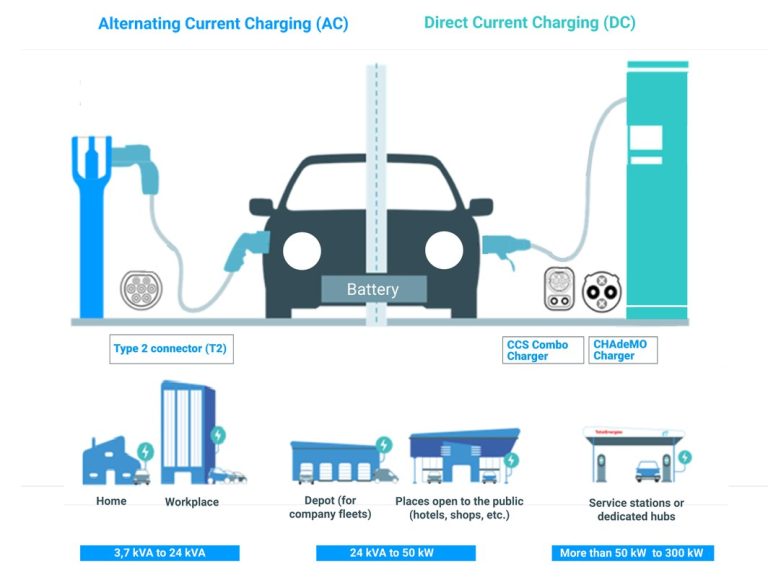
Charging Power and Speed: AC Level 1, Level 2, and DC Fast Charging
Charging speed affects the pack mostly through heat and current, not through the connector shape. Level 1 and Level 2 are AC charging handled by the vehicle’s onboard charger. DC fast charging bypasses that onboard charger and feeds the pack more directly, which is why it stresses the battery differently.
Onboard Charger Limits and EVSE Amperage: What the Battery Actually Sees
The EVSE — the wall unit people call “the charger” — advertises power to the car. The car’s onboard charger decides how much it actually accepts. If the vehicle is limited to a lower AC rate, a higher-output EVSE will not push more into the pack. Circuit capacity, EVSE setting, voltage, amperage, and the onboard charger limit are separate numbers, and the lowest one wins.
Example arithmetic only: 240 V × 32 A ≈ 7.7 kW. The vehicle’s onboard charger limit and battery state can reduce what the pack actually receives. For a closer look at output math, see how many kW a 48-amp Level 2 charger delivers.
DC Fast Charging Frequency: Separating Heat Stress from Convenience
DC fast charging is not inherently damaging, and many manufacturers build thermal management specifically to handle it. The pattern that tends to matter is frequent fast charging combined with heat, high SOC sessions, or a pack that is already hot from driving.
For most owners, occasional road-trip fast charging is a normal part of ownership. If fast charging is your only charging method, that is a different usage profile, and it is worth reading what your manufacturer says about it rather than assuming either extreme.
Battery Chemistry and Thermal Management: Why Two EVs Age Differently
Two cars charged identically can age differently. Liquid-cooled packs shed heat more effectively than passively cooled ones, LFP and nickel-based chemistries respond differently to high SOC, and some manufacturers reserve a larger top and bottom buffer that hides capacity loss from the driver. Age, climate, and mileage add more variance.
Temperature and Weather: Charging Habits That Protect or Stress the Pack
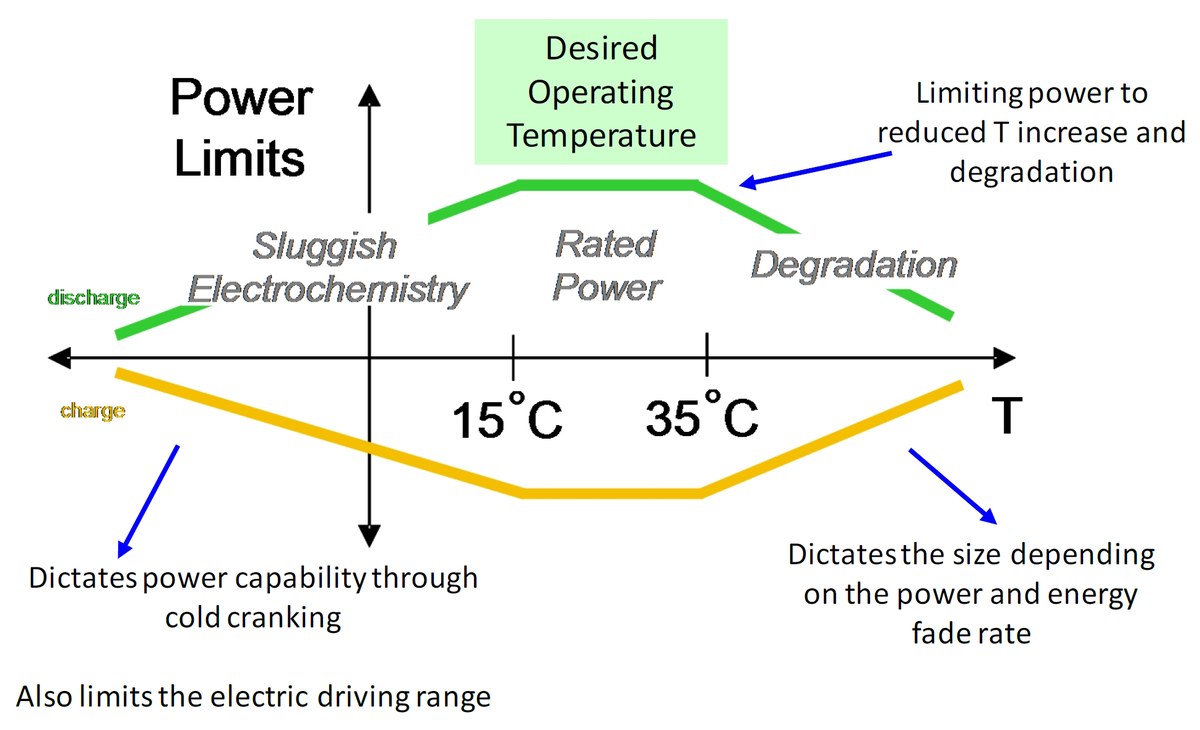
Temperature is the variable owners underestimate most. Both calendar aging and cycle aging accelerate in heat, and cold makes charging slower and less efficient even when it is not damaging.
Hot Climates, Cold Climates, and Preconditioning Before DC Fast Charging
In hot climates, parking in shade, charging overnight when ambient temperatures drop, and avoiding long sits at high SOC all reduce stress. In cold climates, the pack may need to warm before it accepts a high charge rate, which is why many vehicles precondition the battery when a fast charger is set as a navigation destination.
Preconditioning is a manufacturer-designed feature, not a workaround. Using it as intended usually produces a faster, gentler session than arriving cold and demanding maximum power.
Level 1 in Freezing Weather, Shade, Garages, and Parking Habits
Level 1 charging in freezing weather can be slow enough that some of the energy goes to keeping the pack warm rather than adding range. That is normal behavior, not a fault. A garage, a shaded spot, or a covered carport moderates both summer heat and winter cold, and those parking choices often do more for the pack than any app setting.
Charging Equipment Habits That Indirectly Affect Battery Health
Equipment does not usually damage a pack directly. It affects battery health by determining whether you can reliably charge at moderate power, on a schedule, in the temperature range you want. Portable options matter here too — see how portable EV chargers differ from permanently mounted units.
Plug-In vs. Hardwired EVSE: Circuit, Panel, and Local Code Considerations
Plug-in units are portable and easier to relocate; hardwired units are permanently connected and typically support higher continuous current. Either way, the circuit, breaker, and panel capacity must match the equipment instructions and applicable local electrical requirements. For a common question on this, see whether a 48-amp charger needs a 60-amp circuit.
Smart Features, Scheduled Charging, and Time-of-Use Rate Management
Scheduled charging lets you charge overnight when the grid and the ambient temperature are both cooler, and it aligns with time-of-use rates. That is a genuine battery-health benefit in hot climates, not just a cost trick.
Check what happens if the app or cloud service is unavailable. A schedule stored in the vehicle is more resilient than one that depends entirely on a connected charger.
Connectors and Adapters: Direction, AC/DC Mode, Network Restrictions, Thermal Safety, and Firmware
Physical fit does not prove that a charging mode is supported. NACS/SAE J3400, J1772, and CCS1 differ in what they carry, and adapter direction matters — an AC adapter and a DC adapter are not interchangeable. Vehicle-side support, charger-side support, network authorization, and firmware version all have to line up.
Cable Length, Weather Suitability, Warranty, Support, and Installation
Cable length affects where you can park, not battery chemistry. It matters because a cable that reaches comfortably lets you charge at home consistently instead of relying on fast charging out of necessity. Confirm the safety listing, warranty terms, and support channels from the manufacturer or certification record rather than from a product photo.
Charging Losses, Cost, and Efficiency: The Math Behind Battery-Friendly Habits
Charging losses are the gap between energy billed at the meter and energy stored in the pack. They rise in cold weather, at high charge rates, and when the pack must be thermally managed. That gap is a cost issue more than a battery-health issue, but it explains why “free” charging is rarely free.
Electricity Rate, kWh Delivered, and Charging Losses: A Simple Formula
The basic formula is cost = energy added (kWh) × rate ($/kWh) ÷ charging efficiency. If you add 40 kWh at $0.17/kWh with roughly 90% efficiency, you pay for about 44.4 kWh at the meter.
Assumptions are illustrative only. Actual rates, taxes, fees, time-of-use periods, demand charges, and losses vary by utility and by conditions. Verify current rates with your utility.
US Time-of-Use Pricing and Off-Peak Charging Habits
Many US utilities offer time-of-use plans with cheaper overnight windows. Off-peak charging is usually also cooler, which is a small bonus for the pack in summer. Check whether your plan includes demand charges or separate delivery and supply rates before comparing plans.
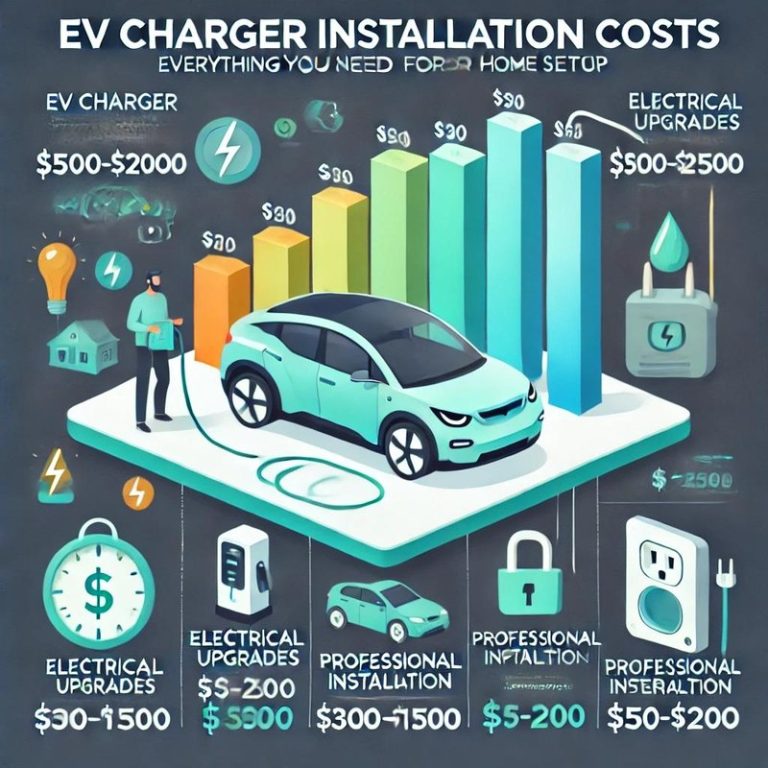
Installation and Equipment Costs vs. Battery Replacement Risk
Home charging equipment and installation are one-time costs that make moderate-power daily charging easy. That convenience is the real battery benefit: a car that charges gently at home every night is less likely to depend on fast charging. Weigh that against your actual driving pattern rather than against a hypothetical replacement pack.
Range and Efficiency Habits That Reveal Battery Stress
Efficiency numbers are a diagnostic, not just a bragging right. A sudden, sustained drop in mi/kWh that is not explained by weather or driving style is worth investigating.
mi/kWh and Wh/mi: Speed, Weather, HVAC, Elevation, Payload, Tires, and Battery Temperature
Efficiency varies with speed, ambient temperature, cabin heating or cooling, elevation change, payload, tire pressure and tread, and battery temperature. Winter efficiency drops are expected, not evidence of degradation.
When Range Loss Is Normal and When to Check the Battery
Some capacity loss over years and miles is normal. What deserves a service visit is a sharp drop over a short period, an unexplained state-of-charge swing, a charging rate that no longer matches conditions, or a warning message. Use the vehicle’s own state-of-health readout where available, and compare like-for-like conditions before concluding anything.
A Practical 2026 Charging Routine for Long EV Battery Life
A workable routine is one you will actually follow. Below is a structure, not a prescription — adjust it to your manual and your climate.
Daily, Weekly, and Road-Trip Habits by Use Case
Daily commuters: set the charge limit to whatever your manufacturer recommends for daily use, plug in overnight, and let scheduled charging handle the timing. Weekly low-mileage drivers: a mid-range limit and a plugged-in car is usually enough; avoid leaving it at 100% or near empty for long stretches.
Road-trippers: charge to full before departure, precondition before fast charging when the vehicle supports it, and avoid back-to-back high-power sessions on a hot pack when a slower stop would do. Renters and apartment dwellers without home charging: prioritize charging when the pack is not heat-soaked, and treat fast charging as your normal rather than as an occasional exception — then check your manual for any guidance specific to that pattern.
Convenience Trade-Offs: When Battery-Friendly Habits Are Not Worth the Hassle
Some habits cost more effort than they return. Driving to a distant charger to avoid a convenient one, or refusing to charge to 100% before a long trip, does not meaningfully protect a pack. If a habit makes ownership worse without changing temperature, state of charge, or current in any real way, it is probably not worth keeping.
What to Document and When to Revisit Manufacturer Guidance
Keep a simple record: your typical charge limit, how often you fast charge, and any state-of-health reading the car provides. Revisit your settings when you move to a different climate, change your commute, buy a different vehicle, or receive a manufacturer software update that alters charging behavior. Guidance can change with the car, and it is worth re-reading.
- Best for: Owners who want a simple routine — moderate daily charge limit, overnight charging, and occasional fast charging as needed.
- Think twice if: You are applying a generic 20–80% rule to a vehicle whose manufacturer says otherwise.
- Next step: Open your owner’s manual, find the recommended daily charge limit and fast-charging guidance, and set the car to match.
Frequently Asked Questions
Not automatically. Many manufacturers design thermal management to handle regular fast charging. The pattern that tends to matter is repeated high-power sessions on a hot pack or at high state of charge. Check your owner’s manual for guidance specific to your model and chemistry.
That band is a common general recommendation, not a universal rule. Some manufacturers set a different daily limit in the vehicle software, and some LFP-equipped vehicles are designed for periodic full charges for calibration. Follow the guidance for your specific car.
For most vehicles, leaving the car plugged in with a charge limit set is normal and often recommended, because it lets the vehicle manage the pack and the low-voltage battery. What you want to avoid is sitting at 100% for extended periods, particularly in heat.
Level 1 is lower current and generally gentler on the pack, but it is slow and less efficient in cold weather, and some energy may go to keeping the battery warm. Level 2 is usually the practical middle ground for daily charging.
Some capacity loss over years and miles is expected. A gradual decline is different from a sharp drop over a short period, unexplained state-of-charge swings, or charging behavior that no longer matches conditions. The latter are worth a service visit.
They help indirectly by making consistent overnight charging easier and by shifting charging to cooler, off-peak hours. Check what happens if the app or cloud service is unavailable — a schedule stored in the vehicle is more resilient than one that depends entirely on connectivity.